The post Bitcoin Volatility Surges with $575M Liquidations Amid BoJ Rate Hike Pressure appeared on BitcoinEthereumNews.com. Crypto liquidations surged to $575 millionThe post Bitcoin Volatility Surges with $575M Liquidations Amid BoJ Rate Hike Pressure appeared on BitcoinEthereumNews.com. Crypto liquidations surged to $575 million

Bitcoin Volatility Surges with $575M Liquidations Amid BoJ Rate Hike Pressure

  • Bitcoin experienced sharp whipsaws after inflation data came in below expectations at 2.7% headline and 2.6% core, sparking initial rallies toward $90,000 before reversals.

  • Derivatives traders engaged in profit-taking, contributing to the liquidation cascade unlike prior spot-driven declines.

  • The Bank of Japan’s quarter-point rate increase ended a decades-long low-rate era, pressuring the yen carry trade and reducing liquidity for risk assets like cryptocurrencies, with four days in December exceeding $500 million in total liquidations per Coinalyze data.

Crypto liquidations hit $575M amid Bitcoin volatility from U.S. inflation surprises and Bank of Japan rate hikes. Discover how macroeconomic shifts impact crypto markets and what traders should watch next—stay informed on the latest trends.

What Caused the Recent Surge in Crypto Liquidations?

Crypto liquidations spiked dramatically to $575 million over the past 24 hours, primarily triggered by heightened volatility in Bitcoin following a softer-than-expected U.S. inflation report and the Bank of Japan’s unexpected interest rate adjustment. According to data from CoinGlass, long positions bore the brunt of the losses, totaling $368 million, with Bitcoin alone seeing $202 million in liquidations, including $119 million from bullish bets. This event underscores the fragility of leveraged positions in a market sensitive to macroeconomic cues, as profit-taking by derivatives investors amplified the downturn after initial gains pushed Bitcoin near $90,000.

How Did the U.S. Inflation Report Influence Bitcoin’s Price Movement?

The U.S. inflation figures released on Thursday revealed headline inflation at 2.7% and core inflation at 2.6%, both undershooting economist forecasts of around 3%. This positive surprise initially fueled optimism in risk assets, propelling Bitcoin toward $90,000 as investors anticipated a more accommodative Federal Reserve policy. However, the rally quickly reversed within hours due to aggressive selling, leading to over $500 million in crypto liquidations across the board.

Experts note that while the data suggested a cooling inflationary environment, the market’s reaction highlighted ongoing uncertainties. As reported by financial analysts at Velo, this particular whipsaw differed from midweek movements, which were more attributable to spot market dynamics; here, derivatives traders’ profit-taking played a pivotal role in the cascade. Bitcoin’s resilience was evident as it stabilized between $85,000 and $81,000, a range that has consistently attracted buyers, resulting in a net 1% gain over the 24-hour period. Current trading levels hover around $88,100, per CoinGecko metrics, reflecting steady demand despite the turbulence.

This episode aligns with broader patterns in the crypto ecosystem, where leverage amplifies both upsides and downsides. Traders monitoring prediction markets, such as Myriad, show continued bullish sentiment, with a 61% probability assigned to Bitcoin reaching $100,000 before dropping to $69,000. Such indicators provide a glimpse into market psychology, even as external factors introduce unpredictability.

Frequently Asked Questions

What Factors Contributed to the $575 Million in Crypto Liquidations?

The surge in crypto liquidations was fueled by Bitcoin’s volatile price action after the U.S. inflation report, combined with profit-taking in derivatives markets and the Bank of Japan’s rate hike disrupting the yen carry trade. Long positions, especially in Bitcoin, accounted for the majority of losses, totaling $368 million as per CoinGlass data, highlighting the risks of high leverage in uncertain conditions.

How Might the Bank of Japan’s Rate Hike Affect Crypto Markets?

The Bank of Japan’s decision to raise its key interest rate by a quarter point marks the end of a 30-year era of ultra-low rates, putting significant pressure on the yen carry trade that has long supported liquidity in global risk assets including cryptocurrencies. As the trade unwinds, reduced capital flows could heighten volatility in crypto markets, particularly as holiday-season thinning of liquidity exacerbates price swings and increases liquidation risks for leveraged traders.

Key Takeaways

  • Volatility from Macro Data: Softer U.S. inflation readings initially boosted Bitcoin toward $90,000 but triggered $575 million in liquidations through rapid reversals and profit-taking.
  • Leverage Risks Highlighted: Long positions dominated losses at $368 million, with Bitcoin comprising over a third, per CoinGlass, emphasizing the dangers of elevated leverage in crypto derivatives.
  • Global Policy Impacts: The Bank of Japan’s rate hike pressures the yen carry trade, potentially curtailing liquidity for risk assets—traders should monitor portfolio rebalancing ahead of holidays for amplified swings.

Conclusion

In summary, the recent crypto liquidations exceeding $575 million reflect a confluence of factors, including Bitcoin’s whipsaw movements post-U.S. inflation data and the macroeconomic ripple effects from the Bank of Japan’s rate hike on the yen carry trade. With leverage remaining high in the ecosystem—evidenced by multiple $500 million-plus liquidation days in December, according to Coinalyze—the market’s sensitivity to global policy shifts is clear. As the year progresses into 2025, investors are advised to prioritize risk management strategies, such as reducing exposure to over-leveraged positions, to navigate upcoming volatility. Staying attuned to these developments will be essential for informed decision-making in the evolving crypto landscape.

Source: https://en.coinotag.com/bitcoin-volatility-surges-with-575m-liquidations-amid-boj-rate-hike-pressure
Piyasa Fırsatı
Union Logosu
Union Fiyatı(U)
$0.003197
$0.003197$0.003197
+0.59%
USD
Union (U) Canlı Fiyat Grafiği
Sorumluluk Reddi: Bu sitede yeniden yayınlanan makaleler, halka açık platformlardan alınmıştır ve yalnızca bilgilendirme amaçlıdır. MEXC'nin görüşlerini yansıtmayabilir. Tüm hakları telif sahiplerine aittir. Herhangi bir içeriğin üçüncü taraf haklarını ihlal ettiğini düşünüyorsanız, kaldırılması için lütfen service@support.mexc.com ile iletişime geçin. MEXC, içeriğin doğruluğu, eksiksizliği veya güncelliği konusunda hiçbir garanti vermez ve sağlanan bilgilere dayalı olarak alınan herhangi bir eylemden sorumlu değildir. İçerik, finansal, yasal veya diğer profesyonel tavsiye niteliğinde değildir ve MEXC tarafından bir tavsiye veya onay olarak değerlendirilmemelidir.

Ayrıca Şunları da Beğenebilirsiniz

Building a DEXScreener Clone: A Step-by-Step Guide

Building a DEXScreener Clone: A Step-by-Step Guide

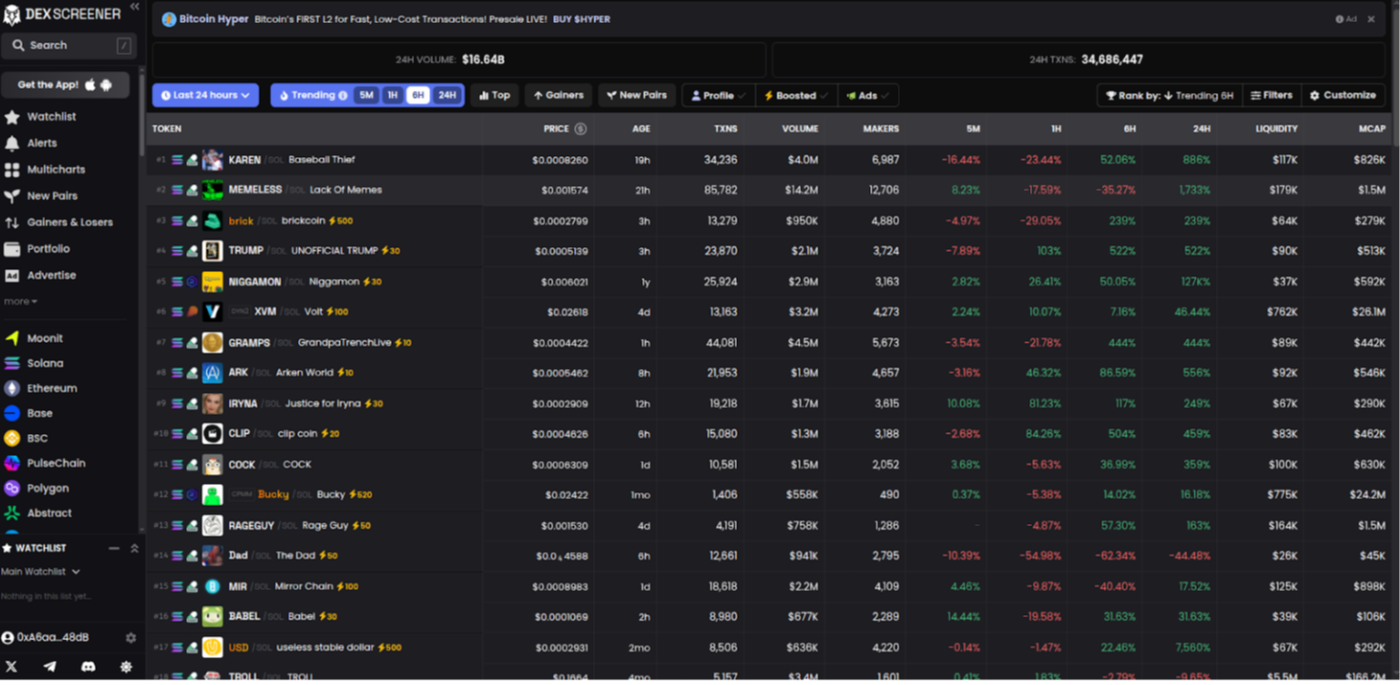
DEX Screener is used by crypto traders who need access to on-chain data like trading volumes, liquidity, and token prices. This information allows them to analyze trends, monitor new listings, and make informed investment decisions. In this tutorial, I will build a DEXScreener clone from scratch, covering everything from the initial design to a functional app. We will use Streamlit, a Python framework for building full-stack apps.
Paylaş
Hackernoon2025/09/18 15:05
Which DOGE? Musk's Cryptic Post Explodes Confusion

Which DOGE? Musk's Cryptic Post Explodes Confusion

A viral chart documenting a sharp decline in U.S. federal employment during President Trump's second term has sparked unexpected confusion in cryptocurrency markets
Paylaş
Coinstats2025/12/20 01:13
Google's AP2 protocol has been released. Does encrypted AI still have a chance?

Google's AP2 protocol has been released. Does encrypted AI still have a chance?

Following the MCP and A2A protocols, the AI Agent market has seen another blockbuster arrival: the Agent Payments Protocol (AP2), developed by Google. This will clearly further enhance AI Agents' autonomous multi-tasking capabilities, but the unfortunate reality is that it has little to do with web3AI. Let's take a closer look: What problem does AP2 solve? Simply put, the MCP protocol is like a universal hook, enabling AI agents to connect to various external tools and data sources; A2A is a team collaboration communication protocol that allows multiple AI agents to cooperate with each other to complete complex tasks; AP2 completes the last piece of the puzzle - payment capability. In other words, MCP opens up connectivity, A2A promotes collaboration efficiency, and AP2 achieves value exchange. The arrival of AP2 truly injects "soul" into the autonomous collaboration and task execution of Multi-Agents. Imagine AI Agents connecting Qunar, Meituan, and Didi to complete the booking of flights, hotels, and car rentals, but then getting stuck at the point of "self-payment." What's the point of all that multitasking? So, remember this: AP2 is an extension of MCP+A2A, solving the last mile problem of AI Agent automated execution. What are the technical highlights of AP2? The core innovation of AP2 is the Mandates mechanism, which is divided into real-time authorization mode and delegated authorization mode. Real-time authorization is easy to understand. The AI Agent finds the product and shows it to you. The operation can only be performed after the user signs. Delegated authorization requires the user to set rules in advance, such as only buying the iPhone 17 when the price drops to 5,000. The AI Agent monitors the trigger conditions and executes automatically. The implementation logic is cryptographically signed using Verifiable Credentials (VCs). Users can set complex commission conditions, including price ranges, time limits, and payment method priorities, forming a tamper-proof digital contract. Once signed, the AI Agent executes according to the conditions, with VCs ensuring auditability and security at every step. Of particular note is the "A2A x402" extension, a technical component developed by Google specifically for crypto payments, developed in collaboration with Coinbase and the Ethereum Foundation. This extension enables AI Agents to seamlessly process stablecoins, ETH, and other blockchain assets, supporting native payment scenarios within the Web3 ecosystem. What kind of imagination space can AP2 bring? After analyzing the technical principles, do you think that's it? Yes, in fact, the AP2 is boring when it is disassembled alone. Its real charm lies in connecting and opening up the "MCP+A2A+AP2" technology stack, completely opening up the complete link of AI Agent's autonomous analysis+execution+payment. From now on, AI Agents can open up many application scenarios. For example, AI Agents for stock investment and financial management can help us monitor the market 24/7 and conduct independent transactions. Enterprise procurement AI Agents can automatically replenish and renew without human intervention. AP2's complementary payment capabilities will further expand the penetration of the Agent-to-Agent economy into more scenarios. Google obviously understands that after the technical framework is established, the ecological implementation must be relied upon, so it has brought in more than 60 partners to develop it, almost covering the entire payment and business ecosystem. Interestingly, it also involves major Crypto players such as Ethereum, Coinbase, MetaMask, and Sui. Combined with the current trend of currency and stock integration, the imagination space has been doubled. Is web3 AI really dead? Not entirely. Google's AP2 looks complete, but it only achieves technical compatibility with Crypto payments. It can only be regarded as an extension of the traditional authorization framework and belongs to the category of automated execution. There is a "paradigm" difference between it and the autonomous asset management pursued by pure Crypto native solutions. The Crypto-native solutions under exploration are taking the "decentralized custody + on-chain verification" route, including AI Agent autonomous asset management, AI Agent autonomous transactions (DeFAI), AI Agent digital identity and on-chain reputation system (ERC-8004...), AI Agent on-chain governance DAO framework, AI Agent NPC and digital avatars, and many other interesting and fun directions. Ultimately, once users get used to AI Agent payments in traditional fields, their acceptance of AI Agents autonomously owning digital assets will also increase. And for those scenarios that AP2 cannot reach, such as anonymous transactions, censorship-resistant payments, and decentralized asset management, there will always be a time for crypto-native solutions to show their strength? The two are more likely to be complementary rather than competitive, but to be honest, the key technological advancements behind AI Agents currently all come from web2AI, and web3AI still needs to keep up the good work!
Paylaş
PANews2025/09/18 07:00