The post Markup For The Clarity Act is Coming In January: David Sacks appeared on BitcoinEthereumNews.com. Key Highlights David Sacks has confirmed that markup The post Markup For The Clarity Act is Coming In January: David Sacks appeared on BitcoinEthereumNews.com. Key Highlights David Sacks has confirmed that markup

Markup For The Clarity Act is Coming In January: David Sacks

Key Highlights

  • David Sacks has confirmed that markup for the CLARITY Act will come in January
  • He confirmed the news with Senator Tim Scott and Senator John Boozman that after the latest report on the CLARITY Act delay
  • Ahead of the decision, many institutional investors have started making moves by considering its impact on the cryptocurrency market

White House AI and crypto czar David Sacks, David Sacks shared a post on X  (formerly Twitter), where he confirmed the much-awaited timeline for the Digital Asset Market Clarity Act (CLARITY Act). 

In his Tweet, David Sacks revealed that he got confirmation from Senator Tim Scott and Senator John Boozman that a markup for Clarity is coming in January. 

“Thanks to their leadership, as well as @RepFrenchHill and @CongressmanGT in the House, we are closer than ever to passing the landmark crypto market structure legislation that President Trump has called for. We look forward to finishing the job in January,” stated in the post on X. 

This statement comes after outrage in the cryptocurrency community over delays in late 2025. The House of Representatives had already passed its version of the bill with strong bipartisan support back in July. However, Senate progress slowed down, which now shifted its final node into the new year. 

What is the CLARITY Act and Market Structure Legislation?

The CLARITY Act is expected to end the year of ambiguity by creating a clear legal line between the U.S.’s two major financial regulators. Its main purpose is to clarify whether a digital asset is a security, regulated by the Securities and Exchange Commission (SEC), or a Commodity, which will be regulated by the Commodity Futures Trading Commission (CFTC).

The bill will also make it mandatory for digital commodity exchanges, brokers, and dealers to register with the CFTC and follow the strict rules to protect customers and monitor trading. It provides a clear road for companies to operate provisionally while new rules are written and includes some exemptions for decentralized finance projects. 

Institutional Investors Are Already Making Moves 

While lawmakers are still discussing this bill, many investors are already preparing for the law’s impact on the cryptocurrency market. Prominent television personality and investor Kevin O’ Leary revealed that he has sold nearly all of his cryptocurrency holdings except for Bitcoin (BTC) and Ethereum (ETH), which captures over 97% of the crypto market’s historical gains. 

O’Leary believes that the CLARITY Act will be a major turning point for the cryptocurrency industry that brings “meaningful capital” from large institutions like pension funds into the market. He affirmed that these conservative investors will only be interested in the most liquid and compliant assets, which he sees as Bitcoin and Ethereum. 

“When large institutions run the data, they’re going to arrive at the same conclusion we did, you capture the overwhelming majority of crypto’s long-term returns with Bitcoin and Ethereum. There’s no incentive for them to hold anything else,” He said.

The January markup is a major regulatory procedure for the cryptocurrency sector. During the session, senators from the Banking and Agriculture committees will review, amend, and vote on the final draft of the bill. It will require a full vote in the Senate, where it would need 60 votes to pass before returning to the House for final approval. 

Also Read: NYSE Owner Might Invest in Crypto Payments Firm ‘MoonPay’

Source: https://www.cryptonewsz.com/markup-clarity-act-coming-january-david-sacks/
Piyasa Fırsatı
The AI Prophecy Logosu
The AI Prophecy Fiyatı(ACT)
$0.03028
$0.03028$0.03028
+1.13%
USD
The AI Prophecy (ACT) Canlı Fiyat Grafiği
Sorumluluk Reddi: Bu sitede yeniden yayınlanan makaleler, halka açık platformlardan alınmıştır ve yalnızca bilgilendirme amaçlıdır. MEXC'nin görüşlerini yansıtmayabilir. Tüm hakları telif sahiplerine aittir. Herhangi bir içeriğin üçüncü taraf haklarını ihlal ettiğini düşünüyorsanız, kaldırılması için lütfen service@support.mexc.com ile iletişime geçin. MEXC, içeriğin doğruluğu, eksiksizliği veya güncelliği konusunda hiçbir garanti vermez ve sağlanan bilgilere dayalı olarak alınan herhangi bir eylemden sorumlu değildir. İçerik, finansal, yasal veya diğer profesyonel tavsiye niteliğinde değildir ve MEXC tarafından bir tavsiye veya onay olarak değerlendirilmemelidir.

Ayrıca Şunları da Beğenebilirsiniz

Building a DEXScreener Clone: A Step-by-Step Guide

Building a DEXScreener Clone: A Step-by-Step Guide

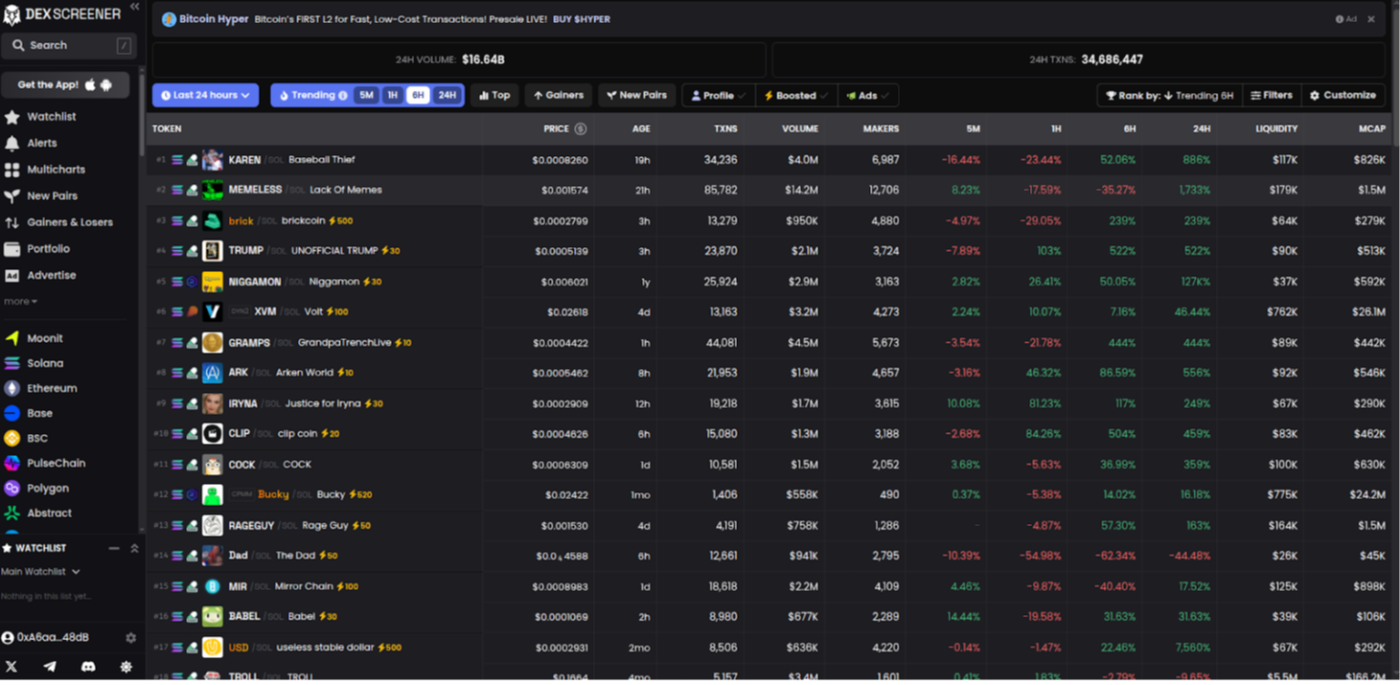
DEX Screener is used by crypto traders who need access to on-chain data like trading volumes, liquidity, and token prices. This information allows them to analyze trends, monitor new listings, and make informed investment decisions. In this tutorial, I will build a DEXScreener clone from scratch, covering everything from the initial design to a functional app. We will use Streamlit, a Python framework for building full-stack apps.
Paylaş
Hackernoon2025/09/18 15:05
Which DOGE? Musk's Cryptic Post Explodes Confusion

Which DOGE? Musk's Cryptic Post Explodes Confusion

A viral chart documenting a sharp decline in U.S. federal employment during President Trump's second term has sparked unexpected confusion in cryptocurrency markets
Paylaş
Coinstats2025/12/20 01:13
Google's AP2 protocol has been released. Does encrypted AI still have a chance?

Google's AP2 protocol has been released. Does encrypted AI still have a chance?

Following the MCP and A2A protocols, the AI Agent market has seen another blockbuster arrival: the Agent Payments Protocol (AP2), developed by Google. This will clearly further enhance AI Agents' autonomous multi-tasking capabilities, but the unfortunate reality is that it has little to do with web3AI. Let's take a closer look: What problem does AP2 solve? Simply put, the MCP protocol is like a universal hook, enabling AI agents to connect to various external tools and data sources; A2A is a team collaboration communication protocol that allows multiple AI agents to cooperate with each other to complete complex tasks; AP2 completes the last piece of the puzzle - payment capability. In other words, MCP opens up connectivity, A2A promotes collaboration efficiency, and AP2 achieves value exchange. The arrival of AP2 truly injects "soul" into the autonomous collaboration and task execution of Multi-Agents. Imagine AI Agents connecting Qunar, Meituan, and Didi to complete the booking of flights, hotels, and car rentals, but then getting stuck at the point of "self-payment." What's the point of all that multitasking? So, remember this: AP2 is an extension of MCP+A2A, solving the last mile problem of AI Agent automated execution. What are the technical highlights of AP2? The core innovation of AP2 is the Mandates mechanism, which is divided into real-time authorization mode and delegated authorization mode. Real-time authorization is easy to understand. The AI Agent finds the product and shows it to you. The operation can only be performed after the user signs. Delegated authorization requires the user to set rules in advance, such as only buying the iPhone 17 when the price drops to 5,000. The AI Agent monitors the trigger conditions and executes automatically. The implementation logic is cryptographically signed using Verifiable Credentials (VCs). Users can set complex commission conditions, including price ranges, time limits, and payment method priorities, forming a tamper-proof digital contract. Once signed, the AI Agent executes according to the conditions, with VCs ensuring auditability and security at every step. Of particular note is the "A2A x402" extension, a technical component developed by Google specifically for crypto payments, developed in collaboration with Coinbase and the Ethereum Foundation. This extension enables AI Agents to seamlessly process stablecoins, ETH, and other blockchain assets, supporting native payment scenarios within the Web3 ecosystem. What kind of imagination space can AP2 bring? After analyzing the technical principles, do you think that's it? Yes, in fact, the AP2 is boring when it is disassembled alone. Its real charm lies in connecting and opening up the "MCP+A2A+AP2" technology stack, completely opening up the complete link of AI Agent's autonomous analysis+execution+payment. From now on, AI Agents can open up many application scenarios. For example, AI Agents for stock investment and financial management can help us monitor the market 24/7 and conduct independent transactions. Enterprise procurement AI Agents can automatically replenish and renew without human intervention. AP2's complementary payment capabilities will further expand the penetration of the Agent-to-Agent economy into more scenarios. Google obviously understands that after the technical framework is established, the ecological implementation must be relied upon, so it has brought in more than 60 partners to develop it, almost covering the entire payment and business ecosystem. Interestingly, it also involves major Crypto players such as Ethereum, Coinbase, MetaMask, and Sui. Combined with the current trend of currency and stock integration, the imagination space has been doubled. Is web3 AI really dead? Not entirely. Google's AP2 looks complete, but it only achieves technical compatibility with Crypto payments. It can only be regarded as an extension of the traditional authorization framework and belongs to the category of automated execution. There is a "paradigm" difference between it and the autonomous asset management pursued by pure Crypto native solutions. The Crypto-native solutions under exploration are taking the "decentralized custody + on-chain verification" route, including AI Agent autonomous asset management, AI Agent autonomous transactions (DeFAI), AI Agent digital identity and on-chain reputation system (ERC-8004...), AI Agent on-chain governance DAO framework, AI Agent NPC and digital avatars, and many other interesting and fun directions. Ultimately, once users get used to AI Agent payments in traditional fields, their acceptance of AI Agents autonomously owning digital assets will also increase. And for those scenarios that AP2 cannot reach, such as anonymous transactions, censorship-resistant payments, and decentralized asset management, there will always be a time for crypto-native solutions to show their strength? The two are more likely to be complementary rather than competitive, but to be honest, the key technological advancements behind AI Agents currently all come from web2AI, and web3AI still needs to keep up the good work!
Paylaş
PANews2025/09/18 07:00