The post WeFi Named “Most Innovative Web3 Project” appeared on BitcoinEthereumNews.com. Today, WeFi is recognized by The Cryptonomist as “Most Innovative Web3 ProjectThe post WeFi Named “Most Innovative Web3 Project” appeared on BitcoinEthereumNews.com. Today, WeFi is recognized by The Cryptonomist as “Most Innovative Web3 Project

WeFi Named “Most Innovative Web3 Project”

Today, WeFi is recognized by The Cryptonomist as “Most Innovative Web3 Project” at their inaugural Cryptonomist Awards. It’s a move that reflects changing perceptions of blockchain and crypto, offering compelling evidence that finance remains a space that’s ripe for disruption.

As more consumers embrace online payment processors and cryptocurrencies, they’re beginning to see traditional banking for what it is: infrastructure built for a pre-digital age, creaking under the weight of modern expectations. Despite this growing awareness, persistent misconceptions around cryptocurrencies and DeFi have slowed public adoption beyond what many anticipated.

Today’s award reflects changing perceptions of blockchain and crypto — offering compelling evidence that finance remains a space ripe for disruption.

Many consumers still feel the need to categorize their money: bank accounts for savings and daily spending, crypto wallets for speed and anonymity, exchanges for liquidity, and so on. As 2025 has progressed, the conversation around digital finance has finally begun to evolve. Members of the general public are increasingly open to new ways of holding, spending, and saving money.

We have, among other things, stablecoins to thank for that. As their name suggests, stablecoins are designed to maintain a stable value pegged to another asset like the US dollar. As such, they’re perceived as being much less risky than other, more volatile, cryptocurrencies.

WeFi’s deobank — a contraction of decentralized on-chain banking — is the first fully compliant on-chain banking platform powered by stablecoins. Users deposit fiat in the same way that they would with a traditional bank and can immediately, from a single interface, access the equivalent amount in stablecoins without the need to use exchanges or deal with fees.

The Year of the Deobank

The deobank, pioneered by WeFi, is designed to bring traditional banking’s core services onto blockchain infrastructure, where they gain programmability and public transparency. The platform’s smart contracts let users deposit, borrow, hold assets in custody, and set up automated payments for bills, savings, and payroll. Transactions, rewards, and protocol fees all settle in the WFI token.

WeFi launched in early 2025. Eight months later, the platform serves more than 150,000+ users in more than 80 countries. The value of the WFI token has climbed from $0.22 to $2.68, a 1,100% increase.

WeFi holds Payment Service Provider licenses in Canada, Seychelles, Hong Kong, and several other jurisdictions. The company’s fully diluted valuation has reached $2.68 billion, placing it at #220 on CoinMarketCap. WeFi also secured a Guinness World Record for the most viewers of a blockchain livestream on YouTube at the 2025 Beyond Banking Summit in Bangkok.

Growth at this pace has meant dealing with regulatory fragmentation. Deobanks face inconsistent frameworks across jurisdictions; WeFi has had to obtain, and continues to obtain further, licenses and registrations in multiple countries in order to operate legally in each market.

The security model addresses a real vulnerability in existing non-custodial wallets: lose your private key, lose your funds permanently. WeFi uses distributed custody instead. Cryptographic keys are split among three parties: the user, WeFi, and an independent third-party provider. If a user loses their portion, a social recovery mechanism restores access. The funds remain protected; the single point of failure disappears. Users can also move all funds to a self-controlled address with a single click.

WeFi has, however, taken these challenges in stride and continues to tackle systemic problems in traditional finance that many have merely sidestepped.

“We’re not just building a bank; we’re building a movement. Our deobanking platform is a glimpse into the future — where banking is borderless, inclusive, and truly user-centric,” says Maksym Sakharov, co-founder and group CEO of WeFi.

Deobanking as the Future of Finance

WeFi’s vision is simple: to create a banking model that is transparent, flexible, and truly global.

Built on blockchain infrastructure, WeFi allows users to hold, manage, and transact with both fiat and cryptocurrency assets within a unified platform. The deobank blends regulatory elements of neobanks and the reliability of traditional banking with the programmability of blockchain.

Deobank users earn interest on fiat holdings and can generate yield on crypto and stablecoins through lending, staking, and yield farming. Stablecoins transfer globally in seconds, skipping the fees and multi-day settlement windows of traditional wire transfers.

Deobanks have gained traction quickly because they deliver that speed alongside an interface that feels like conventional banking. Users get DeFi mechanics without needing to think like DeFi natives. With WeFi, fiat and stablecoin streams never intersect; users see a single account, with a unified balance, and transactions can flow through either traditional fiat or stablecoin rails.

The result is a platform that’s regulated — transactions conducted through deobanks are recorded on public blockchains — and feels future-proof, while being globally accessible. WeFi, for instance, hopes to empower the 1.4 billion unbanked individuals worldwide to embrace digital banking.

Where Deobanking Goes From Here

Public understanding of terminology like blockchain and stablecoins continues to grow, though education and advocacy remain essential to accelerating mainstream acceptance. The explosive growth of WeFi demonstrates the public’s appetite for change — and offers a roadmap for bringing decentralized finance into the everyday lives of consumers worldwide.

On-chain banking is starting to look and feel more like traditional banking, and we’re even seeing legacy banks rush to embrace concepts like blockchain, tokenization, and smart contracts — technologies long associated with crypto and DeFi.

Stablecoins and DeFi are increasingly being seen not as a quirky financial outlier, but as a legitimate solution to many of the problems associated with legacy infrastructure. WeFi and other deobanks started with blockchain as the foundation, not a feature bolted on later. That matters. Legacy banks trying to add tokenization and smart contracts are rebuilding plumbing while the building stays open. Deobanks skipped that problem entirely.

The Cryptonomist’s award lands at an interesting moment. Deobanking went from concept to 150,000 users in under a year. Whether 2026 accelerates that trajectory depends less on the technology, which functions, than on how quickly ordinary consumers trust it with their paychecks.

Source: https://en.cryptonomist.ch/2025/12/16/wefi-name-most-innovative-web3-project/
Piyasa Fırsatı
WeFi Logosu
WeFi Fiyatı(WEFI)
$0.01395
$0.01395$0.01395
+0.07%
USD
WeFi (WEFI) Canlı Fiyat Grafiği
Sorumluluk Reddi: Bu sitede yeniden yayınlanan makaleler, halka açık platformlardan alınmıştır ve yalnızca bilgilendirme amaçlıdır. MEXC'nin görüşlerini yansıtmayabilir. Tüm hakları telif sahiplerine aittir. Herhangi bir içeriğin üçüncü taraf haklarını ihlal ettiğini düşünüyorsanız, kaldırılması için lütfen service@support.mexc.com ile iletişime geçin. MEXC, içeriğin doğruluğu, eksiksizliği veya güncelliği konusunda hiçbir garanti vermez ve sağlanan bilgilere dayalı olarak alınan herhangi bir eylemden sorumlu değildir. İçerik, finansal, yasal veya diğer profesyonel tavsiye niteliğinde değildir ve MEXC tarafından bir tavsiye veya onay olarak değerlendirilmemelidir.

Ayrıca Şunları da Beğenebilirsiniz

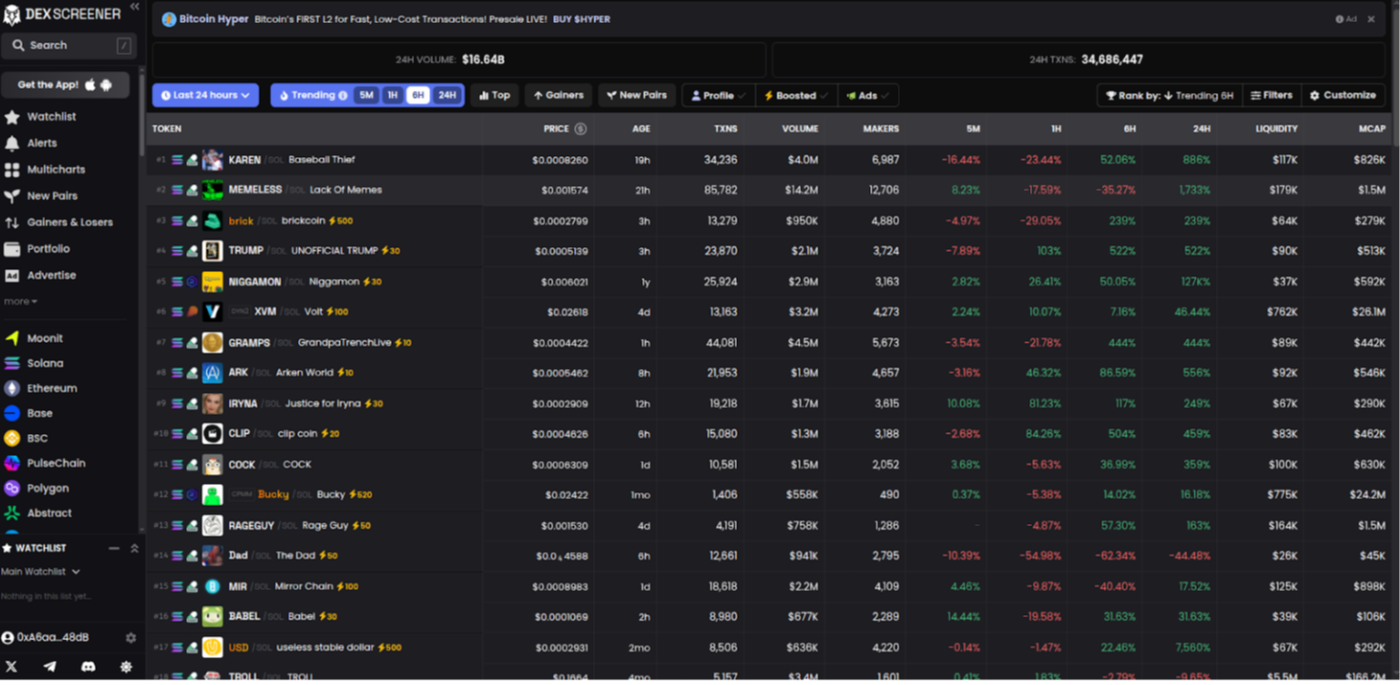
Building a DEXScreener Clone: A Step-by-Step Guide

Building a DEXScreener Clone: A Step-by-Step Guide

DEX Screener is used by crypto traders who need access to on-chain data like trading volumes, liquidity, and token prices. This information allows them to analyze trends, monitor new listings, and make informed investment decisions. In this tutorial, I will build a DEXScreener clone from scratch, covering everything from the initial design to a functional app. We will use Streamlit, a Python framework for building full-stack apps.
Paylaş
Hackernoon2025/09/18 15:05
Which DOGE? Musk's Cryptic Post Explodes Confusion

Which DOGE? Musk's Cryptic Post Explodes Confusion

A viral chart documenting a sharp decline in U.S. federal employment during President Trump's second term has sparked unexpected confusion in cryptocurrency markets
Paylaş
Coinstats2025/12/20 01:13
Google's AP2 protocol has been released. Does encrypted AI still have a chance?

Google's AP2 protocol has been released. Does encrypted AI still have a chance?

Following the MCP and A2A protocols, the AI Agent market has seen another blockbuster arrival: the Agent Payments Protocol (AP2), developed by Google. This will clearly further enhance AI Agents' autonomous multi-tasking capabilities, but the unfortunate reality is that it has little to do with web3AI. Let's take a closer look: What problem does AP2 solve? Simply put, the MCP protocol is like a universal hook, enabling AI agents to connect to various external tools and data sources; A2A is a team collaboration communication protocol that allows multiple AI agents to cooperate with each other to complete complex tasks; AP2 completes the last piece of the puzzle - payment capability. In other words, MCP opens up connectivity, A2A promotes collaboration efficiency, and AP2 achieves value exchange. The arrival of AP2 truly injects "soul" into the autonomous collaboration and task execution of Multi-Agents. Imagine AI Agents connecting Qunar, Meituan, and Didi to complete the booking of flights, hotels, and car rentals, but then getting stuck at the point of "self-payment." What's the point of all that multitasking? So, remember this: AP2 is an extension of MCP+A2A, solving the last mile problem of AI Agent automated execution. What are the technical highlights of AP2? The core innovation of AP2 is the Mandates mechanism, which is divided into real-time authorization mode and delegated authorization mode. Real-time authorization is easy to understand. The AI Agent finds the product and shows it to you. The operation can only be performed after the user signs. Delegated authorization requires the user to set rules in advance, such as only buying the iPhone 17 when the price drops to 5,000. The AI Agent monitors the trigger conditions and executes automatically. The implementation logic is cryptographically signed using Verifiable Credentials (VCs). Users can set complex commission conditions, including price ranges, time limits, and payment method priorities, forming a tamper-proof digital contract. Once signed, the AI Agent executes according to the conditions, with VCs ensuring auditability and security at every step. Of particular note is the "A2A x402" extension, a technical component developed by Google specifically for crypto payments, developed in collaboration with Coinbase and the Ethereum Foundation. This extension enables AI Agents to seamlessly process stablecoins, ETH, and other blockchain assets, supporting native payment scenarios within the Web3 ecosystem. What kind of imagination space can AP2 bring? After analyzing the technical principles, do you think that's it? Yes, in fact, the AP2 is boring when it is disassembled alone. Its real charm lies in connecting and opening up the "MCP+A2A+AP2" technology stack, completely opening up the complete link of AI Agent's autonomous analysis+execution+payment. From now on, AI Agents can open up many application scenarios. For example, AI Agents for stock investment and financial management can help us monitor the market 24/7 and conduct independent transactions. Enterprise procurement AI Agents can automatically replenish and renew without human intervention. AP2's complementary payment capabilities will further expand the penetration of the Agent-to-Agent economy into more scenarios. Google obviously understands that after the technical framework is established, the ecological implementation must be relied upon, so it has brought in more than 60 partners to develop it, almost covering the entire payment and business ecosystem. Interestingly, it also involves major Crypto players such as Ethereum, Coinbase, MetaMask, and Sui. Combined with the current trend of currency and stock integration, the imagination space has been doubled. Is web3 AI really dead? Not entirely. Google's AP2 looks complete, but it only achieves technical compatibility with Crypto payments. It can only be regarded as an extension of the traditional authorization framework and belongs to the category of automated execution. There is a "paradigm" difference between it and the autonomous asset management pursued by pure Crypto native solutions. The Crypto-native solutions under exploration are taking the "decentralized custody + on-chain verification" route, including AI Agent autonomous asset management, AI Agent autonomous transactions (DeFAI), AI Agent digital identity and on-chain reputation system (ERC-8004...), AI Agent on-chain governance DAO framework, AI Agent NPC and digital avatars, and many other interesting and fun directions. Ultimately, once users get used to AI Agent payments in traditional fields, their acceptance of AI Agents autonomously owning digital assets will also increase. And for those scenarios that AP2 cannot reach, such as anonymous transactions, censorship-resistant payments, and decentralized asset management, there will always be a time for crypto-native solutions to show their strength? The two are more likely to be complementary rather than competitive, but to be honest, the key technological advancements behind AI Agents currently all come from web2AI, and web3AI still needs to keep up the good work!
Paylaş
PANews2025/09/18 07:00