RWA

RWA (Real World Assets) refers to the tokenization of tangible assets—such as real estate, private credit, and government bonds—on the blockchain. By bringing traditional financial instruments on-chain, RWA protocols like Ondo and Centrifuge provide DeFi users with stable, real-yield opportunities. In 2026, the RWA sector is a multi-trillion-dollar bridge between TradFi and DeFi, enabling fractional ownership and global liquidity for previously illiquid assets. Follow this tag for insights into on-chain credit markets, regulatory compliance, and asset-backed security innovations.

42317 Articles
Created: 2026/02/02 18:52
Updated: 2026/02/02 18:52
Polkadot Targets Financial Institutions with a New Division Launch

Polkadot Targets Financial Institutions with a New Division Launch

The post Polkadot Targets Financial Institutions with a New Division Launch appeared on BitcoinEthereumNews.com. Polkadot has launched a new division, Polkadot Capital Group, to attract traditional financial institutions and investment firms to its ecosystem.  The move directly responds to increasing institutional interest in blockchain technology and the development of regulatory clarity in the United States. Polkadot Establishes New Institutional Arm Today, Polkadot officially announced a new institutional arm to bridge the gap between traditional finance and Web3.  The Polkadot Capital Group will be led by a team of experts in traditional and digital assets. It intends to provide financial institutions with the resources they need to confidently engage with the Polkadot ecosystem. “Our goal is to lead through data-driven education, driving adoption through knowledge transfer, and adapting in real-time to the dynamic priorities of institutional market participants,” said Polkadot Capital Group Lead David Sedacca in a press release. Specifically targeted at users such as asset managers, banks, and venture capitalists, Polkadot Capital Group’s initiative will provide educational content, market insights, and opportunities for strategic partnerships.  Key Offerings for Traditional Finance Polkadot Capital Group will focus on key areas to drive institutional adoption. These include providing information on centralized and decentralized exchange technologies and exploring real-world asset (RWA) tokenization. Additionally, the group will educate institutions on the benefits of staking and decentralized finance (DeFi). Polkadot just opened doors for Wall Street! Polkadot Capital Group has launched in the U.S. Banks, funds, OTC desks, and exchanges now have direct access to the Polkadot ecosystem: – DOT token – Strategic partnerships– Staking – DeFi – RWA Just before the launch… pic.twitter.com/uUGBrEyKlj — The Dots (@TheDotsTalks) August 19, 2025 By showcasing these practical applications, Polkadot aims to demonstrate how its network can modernize financial infrastructure and create new opportunities for institutional investors. The launch of Polkadot Capital Group coincides with major changes in the underlying network itself. Modernizing…

Author: BitcoinEthereumNews
Flamengo Moves Four Points Clear In Brazilian Série A Title Race

Flamengo Moves Four Points Clear In Brazilian Série A Title Race

The post Flamengo Moves Four Points Clear In Brazilian Série A Title Race appeared on BitcoinEthereumNews.com. Flamengo’s forward #27 Bruno Henrique celebrates scoring his team’s first goal during the Copa Libertadores round of 16 first leg all-Brazilian football match between Flamengo and Internacional at the Maracana stadium in Rio de Janeiro, Brazil, on August 13, 2025. AFP via Getty Images Flamengo is top of the Brazilian Série A at the midway point in the season. The Rio de Janeiro club leads by four points, with Palmeiras and Cruzeiro joining a three horse race for the title. Flamengo Stays On Top Flamengo has been in dominant form as of late. The team on top of the league isn’t showing any signs of weakness after 19 games of this campaign and is certainly favourite to go on and win this title. PORTO ALEGRE, BRAZIL – AUGUST 17: Gonzalo Plata of Flamengo celebrates after scoring the third goal of his team during the match between Internacional and Flamengo as part of Brasileirao 2025 at Beira-Rio Stadium on August 17, 2025 in Porto Alegre, Brazil. (Photo by Pedro H. Tesch/Getty Images) Getty Images This weekend Flamengo picked up three important points away at Internacional, a team who Flamengo also leads in the Copa Libertadores round of 16. The team has suffered just one league defeat since the FIFA 2025 Club World Cup in June and only two in total all season, the least by any side. Flamengo’s defence has been in spectacular form. It has conceded just nine goals in 19 league games, the the lowest tally in the league by far, whilst also scoring the most goals in the Sèrie A. This club is hurting from four seasons without a league title but on current form that bad run will come to an end this year. Never Write Off Palmeiras Despite infighting at the club and star player Estêvão’s…

Author: BitcoinEthereumNews
Ethereum Price Analysis: ETH Drops 5.77% Amid Coldware’s Scalable RWA Ecosystem Attracting New Buyers

Ethereum Price Analysis: ETH Drops 5.77% Amid Coldware’s Scalable RWA Ecosystem Attracting New Buyers

Ethereum dips 5.77% to $4,350 after $1.7B liquidations, while Coldware’s RWA ecosystem draws buyers eyeing real-world adoption and 100x potential.

Author: Blockchainreporter
Kendra Scott And The Vision And Discipline Of Growth

Kendra Scott And The Vision And Discipline Of Growth

The post Kendra Scott And The Vision And Discipline Of Growth appeared on BitcoinEthereumNews.com. It’s news today that Kendra Scott is stepping back into the role of interim chief executive officer of her company. The departures of CEO Tom Nolan, CFO Jason Friesen, and Chief People Officer Danielle Stewart were confirmed, along with Scott’s return to day-to-day leadership supported by longtime executive Neal Bronzo as interim CFO and COO, and the return of Beth Ley as Chief People Officer. The company described this as the start of an exciting new chapter of expansion following a year of record growth and a new private equity investment, a moment that will test the importance of vision and discipline in growth. I have no insider knowledge about why these changes were made. What I am offering here is interpretation, based on extensive experience working with companies that are facing the very challenges Kendra Scott is navigating now: how to expand rapidly while maintaining cultural integrity, brand vision, and profitability. AUSTIN, TEXAS – SEPTEMBER 24: Kendra Scott, CEO, designer and philanthropist attends the unveiling of the Women’s Entrepreneurial Leadership Institute At The University Of Texas At Austin on September 24, 2019 in Austin, Texas. (Photo by Rick Kern/Getty Images for Kendra Scott) Getty Images for Kendra Scott Vision and Discipline in Growth:Why Founders Step Back In It is not unusual for a founder to return to the CEO role. Sometimes the reason is crisis. In this case, the company is not in trouble, but is expanding aggressively. The risk is not decline, but dilution of identity and purpose. I often say the most dangerous thing a company can do is grow, because if you do not lay the track before the train, the momentum of growth can take you off course. That is when the founder’s hand can be most valuable. Kendra Scott is no ordinary founder. She…

Author: BitcoinEthereumNews
Morning Minute: Solana Hits 100K TPS

Morning Minute: Solana Hits 100K TPS

The post Morning Minute: Solana Hits 100K TPS appeared on BitcoinEthereumNews.com. Morning Minute is a daily newsletter written by Tyler Warner. The analysis and opinions expressed are his own and do not necessarily reflect those of Decrypt. Subscribe to the Morning Minute on Substack. GM! Today’s top news: Crypto majors are slightly green after volatile day; BTC at $115,600 Tom Lee buys $1.7B in ETH in the past week, becomes 2nd largest DAT Tether signs on former White House crypto director Bo Hines as advisor Chamath launches $250M SPAC, includes DeFi as 1 of 4 pillars LIGHT jumps 50% to a new ATH as revenue & buybacks increase ⚡ Solana Hits 100K TPS The Solana network just set a new throughput record. And it’s coming at a very important time. 📌 What Happened Solana briefly processed over 100,000 transactions per second (TPS) in a live stress test. That’s well above Visa’s ~65,000 TPS benchmark and 25x Solana’s normal throughput. But the test used “no-op” transactions – empty instructions that don’t represent real-world transfers or swaps. Today, actual economic activity on Solana still averages closer to 1,000–1,400 TPS once validator votes are excluded. 🗣️ What They’re Saying “The main point I want to get across is that Solana needs more efficient programs and an efficient token standard. High capacity enables the world’s markets to all be on-chain. Without the capacity, we can only ever hope to support a handful.” – Dr. Cavey PHD He added that with efficient programs, Solana could realistically hit 80k–100k token transfers per second, or 10k–20k swaps, estimating deployment could happen “three months at best, six months at worst.” “It means that Solana is ready to support web-scale applications today.” – Kyle Samani (Multicoin Capital) 🧠 Why It Matters There are a few key items of note here. First, this milestone shows Solana’s raw technical ceiling but also the gap between stress-test performance and live…

Author: BitcoinEthereumNews
Flight Attendants Get Deal At Air Canada And Talk At American Partner

Flight Attendants Get Deal At Air Canada And Talk At American Partner

The post Flight Attendants Get Deal At Air Canada And Talk At American Partner appeared on BitcoinEthereumNews.com. A PSA flight attendant demonstrates at Philadelphia International Airport on Monday. AFA Flight attendants at Air Canada reached a tentative agreement early Tuesday morning, but flight attendants at a key American Airlines regional partner are still battling for some of the same contract improvements. Flight attendants at PSA Airlines, one of three wholly-owned regional carriers for American Airlines, demonstrated Monday in five cities including Charlote, where the airline is based. The Association of Flight Attendants represents the airline’s 1,600 flight attendants. The union’s demands are very similar to what the Air Canada flight attendants sought: boarding pay, wage gains and some work rule improvements. Boarding pay, for time spent on the aircraft before departure, has become an industry standard over the last few years. It is in the American Airlines contract with the Association of Professional Flight Attendants, the Alaska Airline contract with the AFA and the tentative contract with AFA which United Airlines flight attendants recently rejected. Delta and SkyWest also offer boarding pay to their non-union flight attendants. The rate in all five cases is 50%. The figure was also on the table in the Air Canada talks, although details of the tentative agreement have not been released. However, at PSA, “Boarding pay is on the table at 25% of our pay rates,” said Sean Griffin, the Charlotte-based 20-year PSA flight attendant who is vice president of the master executive council and a negotiator. Also, he said, “the company is still only willing to offer low single digit wage increases.” Other groups have received double digit increases. The first three-year wages at PSA, where about 70% of flight attendants have three years or less, are $27.06 hourly or about $24,000 a year. “It’s frustrating for junior flight attendants,” Griffin said. Flight attendants top out at $43.51 hourly after…

Author: BitcoinEthereumNews
Bitcoin dreigt nieuwe correctie in augustus 2025 – analisten waarschuwen voor crash naar $100k

Bitcoin dreigt nieuwe correctie in augustus 2025 – analisten waarschuwen voor crash naar $100k

i Kennisgeving: Dit artikel bevat inzichten van onafhankelijke auteurs en valt buiten de redactionele verantwoordelijkheid van BitcoinMagazine.nl. De informatie is bedoeld ter educatie en reflectie. Dit is geen financieel advies. Doe zelf onderzoek voordat je financiële beslissingen neemt. Crypto is zeer volatiel er zitten kansen en risicos aan deze investering. Je kunt je inleg verliezen. De Bitcoin (BTC) koers zette vorige week nog een nieuwe all-time high neer van $ 124.457. De cryptoleider kreeg echter te maken met een correctie waardoor de waarde momenteel op $ 115.520 staat. Vele crypto analisten hebben deze week van zich laten horen via X. De historische patronen van BTC wijzen volgens critici op een verdere correctie in augustus en september. Hoe zit dit? Cryptonieuws: Bitcoin bull run mogelijk afgelopen ondanks mogelijke rate cuts Terwijl sommige analisten wijzen op de stabiliteit van de BTC koers door de groei van de institutionele investeerders, liet crypto analist Benjamin Cowen via X een ander geluid horen. Hij wees vorige week via een video op YouTube al naar een historisch patroon, zichtbaar na de rally’s van 2013, 2017 en 2021. Bitcoin koers, Benjamin Cowen, TradingView" width="750" height="420" /> Bitcoin koers, bron: Benjamin Cowen, YouTube, TradingView Zoals in de grafiek te zien is, had Bitcoin in die jaren steeds te maken met een rally die tot en met augustus duurde. Daarna volgde een maand met verliezen. Dit patroon is ook duidelijk af te lezen uit de tabel hieronder. Waar juli en augustus in 2013, 2017 en 2021 in het groen stonden, noteerde de cryptoleider in september juist een verlies. Bitcoin rendementen, bron: Coinglass Hoewel het er vorige week nog op leek dat BTC ook augustus zou afsluiten in het groen, wees Cowen er gisteren op dat BTC al aan de daling begonnen was. Hij verwacht daarbij nog altijd dat de Bitcoin koers in september een verdere dip zal maken richting de 20-weken SMA. “To see BTC back at its 20-week SMA…” https://t.co/L8M6OQV3VF pic.twitter.com/Qnug45SgGW — Into The Cryptoverse (@ITC_Crypto) August 18, 2025 De crypto analist legt uit dat de eventuele renteverlagingen in de VS niet veel zullen uitmaken. Andere analisten verwachten dan een crypto rally, maar Cowen verwacht dat de 10-year yield omhoog gaat als de rate cuts er komen. Dit betekent dat de Amerikaanse staatsobligaties aantrekkelijker worden waardoor er minder oog is voor BTC. Hij legt verder uit dat de correctie volgens hem zo’n 5% tot 6% zal zijn. Bitcoin koers – Zien andere analisten ook een crypto crash aankomen?   @media (max-width: 700px) { .crypto-cta-banner { padding: 0 0 0 20px; font-size: 12px; } .crypto-cta-button { padding: 0 10px; font-size: 12px; } .crypto-desktop-text { display: none; } .crypto-mobile-text { display: block; } } @media (min-width: 701px) { .crypto-mobile-text { display: none; } } Connect met Like-minded Crypto Enthusiasts! Connect op Discord! Check onze Discord   Analist TechDev wijst op een ander historisch patroon. Volgens hem is vanaf 2011 steeds een signaal (groen) te zien die een stijging op gang brengt. Vervolgens duurt het steeds 14 maanden (ongeveer 425 dagen) voordat de boel weer omslaat (rood). Every Bitcoin top has been 14 months from this point, yet many think we’re almost done. pic.twitter.com/uWCAjVBAT0 — TechDev (@TechDev_52) August 15, 2025 Market wizard Peter Brandt verwacht ook dat BTC de top heeft bereikt van de huidige bull cyclus. Volgens hem zit er een correctie van maar liefst 50% aan te komen die tot november 2026 kan duren. I think there is a 30% chance that BTC has topped for this bull market cycle. Next stop then back to $60k to $70k by Nov 2026, then next bull thrust to $500k https://t.co/xPujqCjp9e — Peter Brandt (@PeterLBrandt) August 15, 2025 Volgens Brandt is Bitcoin echter wel degelijk een waardeopslag. De bull run die na de komende correctie volgt, zal Bitcoin volgens hem namelijk richting de $ 500k duwen. Bitcoin’s eerste layer-2 zet kracht achter BTC Tot nu toe zijn er nog geen layer-2 projecten op de Bitcoin blockchain gebouwd. Dit terwijl het succes van Ethereum en Solana hier grotendeels aan te danken is. L2’s kunnen immers het werk op het netwerk verlichten om zo kracht te zetten achter de blockchain. Nu is ook BTC aan de beurt met de eerste L2 en meme coin op Bitcoin, genaamd Bitcoin Hyper ($HYPER). Dit nieuwe project zet kracht achter Bitcoin zelf. Door de integratie van de Solana Virtual Machine (SVM), creëert Bitcoin Hyper namelijk een snelle smart contract engine en biedt het daarmee snellere en goedkopere transacties voor BTC. Bitcoin Hyper is dus niet alleen een meme coin, het verandert het hele ecosysteem voor Bitcoin. Daarom heeft de crypto presale ook al $ 10,6 miljoen opgehaald en jij kan hier nog aan meedoen. Bemachtig jouw $HYPER tokens vandaag nog voor $ 0,012755 per stuk want morgen wordt deze prijs weer opgeschroefd. Nu naar Bitcoin Hyper   Praat mee op onze socials! Chat met onze experts via Telegram, geef je mening op Twitter of "sit back and relax" terwijl je naar onze YouTube-video's kijkt. Chat met ons Geef je mening Bekijk onze video's i Kennisgeving: Dit artikel bevat inzichten van onafhankelijke auteurs en valt buiten de redactionele verantwoordelijkheid van BitcoinMagazine.nl. De informatie is bedoeld ter educatie en reflectie. Dit is geen financieel advies. Doe zelf onderzoek voordat je financiële beslissingen neemt. Crypto is zeer volatiel er zitten kansen en risicos aan deze investering. Je kunt je inleg verliezen. Het bericht Bitcoin dreigt nieuwe correctie in augustus 2025 – analisten waarschuwen voor crash naar $100k is geschreven door Christiaan Kopershoek en verscheen als eerst op Bitcoinmagazine.nl.

Author: Coinstats
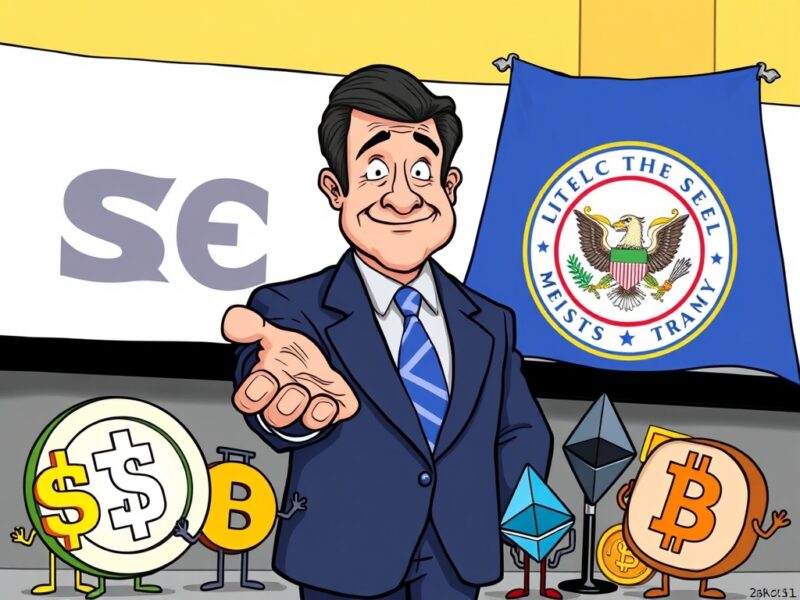
Crypto Regulation: SEC’s ‘Project Crypto’ Unveils a Game-Changing Approach

Crypto Regulation: SEC’s ‘Project Crypto’ Unveils a Game-Changing Approach

BitcoinWorld Crypto Regulation: SEC’s ‘Project Crypto’ Unveils a Game-Changing Approach The landscape of crypto regulation in the United States is on the cusp of a dramatic transformation. In a move that has sent ripples of excitement throughout the digital asset community, U.S. SEC Chair Paul Atkins recently unveiled a groundbreaking initiative: “Project Crypto.” This significant announcement, made at the Wyoming Blockchain Symposium, signals a profound shift in how the Securities and Exchange Commission plans to engage with the burgeoning cryptocurrency industry. What is Project Crypto and Why Does it Matter for Crypto Regulation? For years, the U.S. Securities and Exchange Commission (SEC) has largely adopted a “regulation by enforcement” stance towards cryptocurrencies. This approach often left crypto businesses in a state of uncertainty, leading many to consider establishing operations outside the U.S. However, the introduction of Project Crypto aims to reverse this trend, actively seeking to attract and retain crypto innovation within American borders. This ambitious new initiative represents a fundamental pivot. Instead of reacting to potential violations, the SEC under Atkins plans to offer a more proactive and supportive regulatory framework. This includes: Tailored Disclosures: Providing clear, customized guidelines for crypto projects. Exemptions: Offering specific relief from certain traditional securities laws. Safe Harbors: Creating protected spaces for certain types of crypto offerings to develop without immediate regulatory fear. This is a stark departure from previous SEC positions and offers a glimmer of hope for a more predictable regulatory environment. Redefining Tokens: Are Most Crypto Assets Not Securities? Perhaps the most impactful statement from Chair Atkins, as reported by Decrypt, was his assertion that “most crypto tokens are not securities by nature.” This declaration challenges the long-held assumption that many digital assets automatically fall under the purview of securities law. It’s a critical point for the future of crypto regulation. For a long time, the debate around whether a crypto token is a security has been a major hurdle for projects. The “Howey Test,” traditionally used to define investment contracts, has been applied to various tokens, often leading to enforcement actions. Atkins’ statement suggests a re-evaluation of this application, potentially paving the way for a more nuanced understanding of digital assets. This reclassification could significantly reduce the regulatory burden on a wide array of crypto projects, from initial coin offerings (ICOs) to network rewards and even airdrops. It recognizes the unique characteristics of decentralized technologies and their potential to operate outside traditional financial paradigms. What Benefits Could Project Crypto Bring to the US Crypto Landscape? The implications of Project Crypto are far-reaching and potentially transformative for the U.S. as a hub for blockchain innovation. A clearer, more accommodating regulatory environment could: Attract Talent and Investment: Crypto businesses, previously hesitant due to regulatory ambiguity, may now find the U.S. a more attractive destination. Foster Innovation: With reduced fear of enforcement, developers and entrepreneurs might feel more confident in launching new projects and experimenting with novel decentralized applications. Enhance Consumer Protection: By establishing clear rules, the SEC can still protect investors while fostering growth, rather than stifling it. This balanced approach is crucial for sustainable development. Boost Economic Growth: A thriving crypto sector can create jobs, generate tax revenue, and solidify the U.S.’s position as a global leader in emerging technologies. This proactive approach to crypto regulation is a welcome change for an industry eager for clarity. Navigating the Path Ahead: Challenges and Opportunities for Crypto Regulation While the announcement of Project Crypto is overwhelmingly positive, the path forward will undoubtedly present its own set of challenges. Implementing these tailored disclosures, exemptions, and safe harbors will require significant effort and collaboration between regulators and industry participants. Defining the precise criteria for what constitutes a non-security token will be paramount. Moreover, ensuring that this new approach maintains robust investor protections while fostering innovation will be a delicate balancing act. The crypto space is dynamic, and regulations must be adaptable to keep pace with technological advancements. This initiative signals a commitment from the SEC to engage more constructively, fostering an environment where both innovation and integrity can thrive. In conclusion, SEC Chair Paul Atkins’ unveiling of “Project Crypto” marks a monumental shift in U.S. crypto regulation. Moving away from a punitive “regulation by enforcement” model towards a more supportive and tailored approach could unlock immense potential for the digital asset industry within the United States. This commitment to clarity and innovation offers a compelling future for crypto businesses and enthusiasts alike. Frequently Asked Questions (FAQs) Q1: What exactly is “Project Crypto”? A1: “Project Crypto” is a new initiative announced by U.S. SEC Chair Paul Atkins aimed at fundamentally shifting the SEC’s approach to cryptocurrency regulation. It seeks to attract crypto businesses to the U.S. by moving away from “regulation by enforcement” towards offering tailored disclosures, exemptions, and safe harbors. Q2: Who announced this new initiative? A2: U.S. SEC Chair Paul Atkins unveiled “Project Crypto” during his address at the Wyoming Blockchain Symposium. Q3: How will Project Crypto change the SEC’s regulatory approach? A3: Instead of primarily relying on enforcement actions after issues arise, the SEC plans to proactively provide clearer guidelines, specific exemptions, and safe harbors for various crypto offerings like ICOs, airdrops, and network rewards. This aims to provide more certainty and reduce regulatory friction. Q4: Does “Project Crypto” mean all crypto tokens are no longer considered securities? A4: SEC Chair Atkins stated that “most crypto tokens are not securities by nature,” marking a significant shift. However, this does not automatically mean all tokens are exempt. The initiative aims to provide clearer frameworks for distinguishing between securities and non-securities, and to offer pathways for compliance for those that are. Q5: What are “safe harbors” in the context of Project Crypto? A5: Safe harbors are specific provisions within regulations that protect certain activities or entities from liability, provided they meet defined conditions. For crypto, this could mean creating a temporary period or specific conditions under which certain token offerings can operate without being immediately subject to full securities laws, allowing them to develop and mature. Q6: What does this policy shift mean for crypto businesses operating in or considering the U.S.? A6: This shift is largely positive. It suggests a more welcoming and predictable regulatory environment, potentially reducing legal risks and operational uncertainties. Businesses may find it easier to launch new projects, raise capital, and innovate within the U.S., making the country a more attractive hub for blockchain development. If you found this insight into the future of crypto regulation helpful, please share this article with your network! Let’s spread the word about this significant development in the digital asset space. To learn more about the latest crypto market trends, explore our article on key developments shaping crypto regulation and its impact on institutional adoption. This post Crypto Regulation: SEC’s ‘Project Crypto’ Unveils a Game-Changing Approach first appeared on BitcoinWorld and is written by Editorial Team

Author: Coinstats
Bitcoin Bull Run Hinges On Trump’s Pick For Fed Chair: Analyst

Bitcoin Bull Run Hinges On Trump’s Pick For Fed Chair: Analyst

Bitcoin’s next major leg higher may depend less on halving lore and more on personnel politics in Washington. In an August 18 market note on X, economist and crypto analyst Alex Krüger argued that the cycle’s duration will be set by the Federal Reserve’s leadership change—specifically, who President Trump nominates to replace Jerome Powell—rather than by any fixed four-year pattern. “I have a high degree of confidence this cycle is not over because I am expecting changes in the Fed to bring on considerably more dovish monetary policy, which is not priced in at the moment; this would start to get priced in once Trump announces his nominee to replace Powell,” Krüger wrote. Bitcoin Bull Run Depends On New Fed Chair Krüger dismissed worries that a pullback from record highs marks the top, calling it “remarkable how every time you get a correction from new highs so many people start to fret about the cycle top. Over and over again.” He reiterated his longstanding critique of the halving-cycle orthodoxy: “The concept of a 4 year cycle in 2025 is misplaced; [it] died two cycles ago, and 2021 was a coincidence, as it was macro driven.” In his view, the last cycle ended because the Fed turned “ultra-hawkish in January 2022,” not because of any endogenous Bitcoin dynamic. Related Reading: Crypto Braces For Impact As JPow’s Jackson Hole Speech Looms The nomination clock is visible. Powell’s current four-year term as chair ends on May 15, 2026, and reporting over the past two weeks indicates the White House has narrowed a shortlist to “three or four” names, with an announcement potentially coming sooner than expected. Candidates floated in mainstream coverage include former Fed governor Kevin Warsh and NEC Director Kevin Hassett among others, underscoring the market’s focus on how dovish—or not—the next chair might be. In the nearer term, the policy calendar still drives the tape. Powell’s final Jackson Hole appearance, scheduled during the Aug. 21–23 symposium, is widely framed as a tone-setting moment before the September FOMC. Consensus coverage flags the risk that Powell leans hawkish to preserve optionality, even as rates markets handicap a cut next month; Krüger leans “slightly bearish into it as a hawkish speech (to reduce the odds of a September cut) makes sense, for the Fed to retain optionality and not let the market push itself into a corner.” Technically, Bitcoin has cooled after printing fresh all-time highs in mid-July and again last week. Traders are watching the previous $112,000 high as initial downside cushion, with the psychologically critical $100,000 level, the overhead reference remains the $122,000–$124,000 zone of recent peaks. Krüger also highlights that “BTC is having a very hard time going up sans leverage without triggers,” a point echoed by derivatives signals showing compressed risk appetite. Related Reading: Bitcoin Bulls Must Survive Brutal September Before Q4 Hope, Analyst Predicts Derivatives and volatility gauges corroborate the “low-vol, slow ascent” regime he describes. Implied volatility on BTC options (DVOL/BVIV) has sat near two-year lows, and open interest on institutional venues remains off July highs, signaling a more measured stance from levered players into Jackson Hole. Krüger also observed that futures basis had eased alongside the pullback—a classic sign of froth leaking out—while options markets show a renewed bid for downside protection on dips. The macro through-line is straightforward: if the Fed chair nomination tilts dovish, markets will begin discounting a looser stance well before the first policy move, extending the cycle; if the candidate (and subsequent guidance) skews restrictive, the liquidity impulse that powered Bitcoin’s post-ETF advance will fade at the margin. For now, the immediate catalysts are stacked—Powell at Jackson Hole, followed by PCE, NFP, CPI and PPI into September’s FOMC—while price trades between well-defined levels with volatility suppressed. As Krüger put it, bull markets “don’t end because of valuations or over-extension; the end needs a major trigger.” In 2025, that trigger may well be a name. At press time, BTC traded at $115,683. Featured image created with DALL.E, chart from TradingView.com

Author: NewsBTC
Revolutionary: Fed Employees Crypto Holdings Proposal Sparks Debate

Revolutionary: Fed Employees Crypto Holdings Proposal Sparks Debate

BitcoinWorld Revolutionary: Fed Employees Crypto Holdings Proposal Sparks Debate A fascinating and potentially revolutionary discussion is unfolding within the highest echelons of the U.S. financial system. U.S. Federal Reserve Governor Michele Bowman recently put forward a compelling idea: allow Fed employees crypto holdings in small amounts. This isn’t just a casual suggestion; it’s a strategic move aimed at enhancing the central bank’s understanding of the rapidly evolving digital asset landscape. Bowman’s remarks, delivered ahead of the Wyoming Blockchain Symposium, underscore a critical shift. She emphasized that “change is coming” and that embracing technologies like artificial intelligence and cryptocurrency is essential. Therefore, for the Federal Reserve to truly grasp crypto-based products and their implications, direct experience among Fed employees crypto seems a logical next step. Why Empower Fed Employees with Crypto Knowledge? The core rationale behind Governor Bowman’s proposal is straightforward: practical experience breeds deeper understanding. It’s difficult to regulate or even comprehend a technology without hands-on interaction. Allowing Fed employees crypto exposure could offer numerous benefits: Enhanced Understanding: Employees gain firsthand insight into how crypto products function, their underlying technology, and user experience. Informed Policymaking: Direct engagement can lead to more nuanced, effective, and forward-thinking regulatory frameworks. Staying Ahead: The Fed, as a key financial regulator, needs to remain at the forefront of technological innovation to adequately protect consumers and maintain financial stability. Bridging the Gap: It helps bridge the conceptual divide between traditional finance and the burgeoning world of digital assets. Currently, strict rules govern financial holdings for Federal Reserve employees to prevent conflicts of interest. These rules typically restrict or prohibit investments in certain assets that could be influenced by Fed policy decisions. The discussion around Fed employees crypto holdings would necessitate a careful review and potential amendment of these existing guidelines. Navigating the Challenges of Fed Crypto Policy While the benefits of allowing Fed employees crypto holdings are clear, the proposal also brings potential challenges that require careful consideration. Maintaining public trust and preventing perceived conflicts of interest are paramount for any central bank. Here are some key concerns: Conflict of Interest: Even small holdings could raise questions about impartiality in policy decisions affecting the crypto market. Market Influence: Though individual holdings would be small, the aggregate effect or public perception could be sensitive. Security Risks: Employees would need robust education on securing digital assets to prevent personal losses or data breaches. To mitigate these risks, any policy allowing Fed employees crypto would likely include stringent safeguards. These could involve very low investment caps, strict disclosure requirements, and perhaps limitations on the types of cryptocurrencies employees could hold. Transparency and clear ethical guidelines would be crucial for successful implementation. What Does This Mean for Future Crypto Regulation? Governor Bowman’s statement signals a growing recognition within traditional financial institutions that cryptocurrencies are not a fleeting trend but a significant technological shift. Her advocacy for Fed employees crypto participation suggests a more proactive, rather than reactive, approach to digital asset regulation. This initiative could pave the way for more innovative and adaptive regulatory frameworks in the United States. If Fed employees gain practical experience, they can contribute to policies that are not only robust but also foster innovation. This could accelerate the development of clearer guidelines for stablecoins, central bank digital currencies (CBDCs), and broader digital asset markets. The move reflects a pragmatic understanding that regulation thrives on knowledge. In conclusion, the proposal to allow Fed employees crypto holdings represents a forward-thinking approach by the Federal Reserve. It acknowledges the inevitable integration of digital assets into the financial landscape. While challenges exist, careful implementation with clear guidelines can transform this initiative into a powerful tool for informed policymaking, ultimately benefiting the entire financial ecosystem. This bold step could truly redefine how traditional institutions engage with the future of finance. Frequently Asked Questions (FAQs) What did Fed Governor Michele Bowman say about crypto? Governor Michele Bowman stated that Fed employees should be allowed to hold small amounts of cryptocurrency to better understand crypto-based products. Why does Bowman believe Fed employees should hold crypto? She believes direct experience helps employees better understand crypto products, which is crucial for informed policymaking and embracing technological change. Are Fed employees currently allowed to hold cryptocurrency? Generally, strict rules prevent conflicts of interest, often restricting or prohibiting such investments. Bowman’s proposal would require a review of these existing guidelines. What are the potential benefits of this proposal? Benefits include enhanced understanding, more informed policymaking, staying ahead of technological trends, and bridging the gap between traditional finance and digital assets. What are the potential challenges or concerns? Concerns include potential conflicts of interest, public perception issues, and the need for robust security education for employees holding digital assets. Did you find this insight into the Federal Reserve’s evolving view on digital assets compelling? Share this article with your network to spark further discussion about the future of crypto policy! To learn more about the latest crypto market trends, explore our article on key developments shaping Bitcoin institutional adoption. This post Revolutionary: Fed Employees Crypto Holdings Proposal Sparks Debate first appeared on BitcoinWorld and is written by Editorial Team

Author: Coinstats