Dapp

Dapps are digital applications that run on a P2P network of computers rather than a single server, typically utilizing smart contracts to ensure transparency and uptime. In 2026, Dapps have achieved mass-market appeal through Account Abstraction, allowing for a "Web2-like" user experience with the security of Web3. This tag covers the entire ecosystem of decentralized software—from social media and productivity tools to governance platforms and identity management.

4958 Articles
Created: 2026/02/02 18:52
Updated: 2026/02/02 18:52
Bitcoin Hyper Could Be the Explosive Fix for Bitcoin’s Biggest Problems

Bitcoin Hyper Could Be the Explosive Fix for Bitcoin’s Biggest Problems

What to Know: Bitcoin Hyper has raised over $23.7M in its presale, with tokens priced at $0.013115. The project introduces a Solana-powered Layer-2 that brings sub-second transactions and near-zero fees to Bitcoin. Holders of $HYPER can stake for up to 50% APY, earn governance rights, and access exclusive airdrops and dApps. By merging Bitcoin’s security with Solana’s speed, Bitcoin Hyper could transform Bitcoin from a static store of value into a full programmable economy. Bitcoin still undoubtedly leads crypto. It’s the original, the most trusted, and valued at over $2.2T. Yet it moves as if it’s stuck in 2013. The network processes only seven transactions per second (TPS), with confirmation times averaging ten minutes. Previous solutions have failed, making Bitcoin almost unusable for DeFi or dApps. Despite its dominance, Bitcoin remains slow, expensive, and limited. That’s where Bitcoin Hyper ($HYPER) comes in, as a Solana-based Layer-2 designed to finally bring Bitcoin the speed, scale, and flexibility of modern blockchains. $HYPER seems ready to be the next big crypto surge. The Problem: Bitcoin’s Strength Has Become Its Bottleneck Bitcoin’s architecture was designed for security, not speed. Its Proof-of-Work system remains the benchmark for decentralization, but it’s painfully slow, averaging just 4.58 TPS in real time, with block times now exceeding 17 minutes. During network congestion, such as the 2021 bull run or the 2024 Runes minting craze, fees have surged past $100 per transaction, freezing small payments and causing frustration for users. When compared to other blockchains, the difference is striking. Solana handles 859 TPS live and can reach up to 65K TPS theoretically. BNB Chain achieves 295 TPS, and Tron processes 168 TPS, all with sub-second block times. Even Base, Coinbase’s Layer 2, surpasses 107 TPS in real-time. Bitcoin looks prehistoric in comparison to these. This gap has both cultural and economic consequences. Developers have historically avoided building on Bitcoin because it lacks the infrastructure for smart contracts, dApps, and liquidity tools that characterize modern cryptocurrency ecosystems. The Lightning Network was meant to bridge the gap, but its channel-based design makes it unsuitable for large-scale DeFi or NFT platforms. So Bitcoin remains the ‘digital gold,’ but gold itself doesn’t move quickly. For Bitcoin to truly develop into a usable and programmable economy, it requires more than just a few adjustments. It needs an execution layer designed to meet today’s blockchain needs. The Solution – Bitcoin Hyper ($HYPER) Unlocks Bitcoin’s Full Potential Bitcoin Hyper ($HYPER) claims to be the first full Layer-2 built for Bitcoin using Solana’s Virtual Machine (SVM). The same technology that powers Solana’s sub-second block times and 65K TPS capacity. In other words, it brings Solana-like performance to Bitcoin without losing Bitcoin’s security. Here’s how it works: You transfer your $BTC to Bitcoin Hyper by sending it to a verified address. Smart contracts automatically read Bitcoin blocks and confirm your deposit. Once verified, the same amount of $BTC is mirrored 1:1 on the Hyper Layer-2. From there, you can send, stake, or trade Bitcoin instantly with nearly zero gas fees. Transactions are later bundled, validated using zero-knowledge (ZK) proofs, and committed back to Bitcoin’s Layer-1 chain, preserving the network’s trustlessness and verifiability. Unlike wrapped tokens or sidechains that rely on custodians, Bitcoin Hyper remains fully synchronized with the Bitcoin blockchain, preserving decentralization while enhancing scalability. By using SVM, Hyper inherits Solana’s speed and efficiency. That means instant payments, DeFi lending powered by $BTC collateral, and the birth of Bitcoin-native meme coins and NFTs. Now all is possible within a single, secure framework. Developers can also build dApps that transfer assets seamlessly between Bitcoin, Ethereum, and Solana, enabling genuine cross-chain interoperability from the outset. Beyond the tech, Bitcoin Hyper also revitalizes Bitcoin’s culture. It provides builders, degenerates, and creators a space to innovate without leaving the Bitcoin ecosystem. The goal is straightforward: make Bitcoin usable and not just something to hold Read our What is Bitcoin Hyper guide for a more comprehensive overview. The Financials – $23.7M Raised and Counting The Bitcoin Hyper presale has already garnered significant attention, raising over $23.7 million with a token price of $0.013115. Momentum is rapidly growing as investors position themselves early in what could become a major infrastructure project for Bitcoin’s future evolution. Our Bitcoin Hyper price prediction forecasts the project could reach a price of $0.253 by 2030 based on expansion and continued $BTC growth. The native token, $HYPER, powers everything in the ecosystem, from gas fees and governance to staking and access to the launchpad. Holders can earn up to 50% APY through staking, providing a consistent yield in addition to the project’s high-growth potential. Early presale buyers also get first access to upcoming airdrops, staking pools, and dApp launches, effectively becoming the first citizens of Bitcoin’s new era layer. Learn how to buy Bitcoin Hyper in our step-by-step guide. This provides exposure to a Layer-2 network built to scale Bitcoin itself. It’s a rare chance given Bitcoin’s established position. If Bitcoin Hyper fulfills its promise, it could transform Bitcoin from the slowest Layer-1 into one of the fastest crypto execution environments. With prices set to increase in the next presale phase, timing matters. Early entry offers both utility and upside. Join the Bitcoin Hyper presale before the next price jump. This article is not financial advice. Crypto and presales carry inherent risks. Please do your own research (DYOR) and never invest more than you are willing to lose. Authored by Aaron Walker, NewsBTC — https://www.newsbtc.com/news/bitcoin-hyper-promises-explosive-solution-to-bitcoin-biggest-problems

Author: NewsBTC
Grok’s Bitcoin Price Prediction with Fears of $100K: Traders Rotate to Bitcoin Hyper

Grok’s Bitcoin Price Prediction with Fears of $100K: Traders Rotate to Bitcoin Hyper

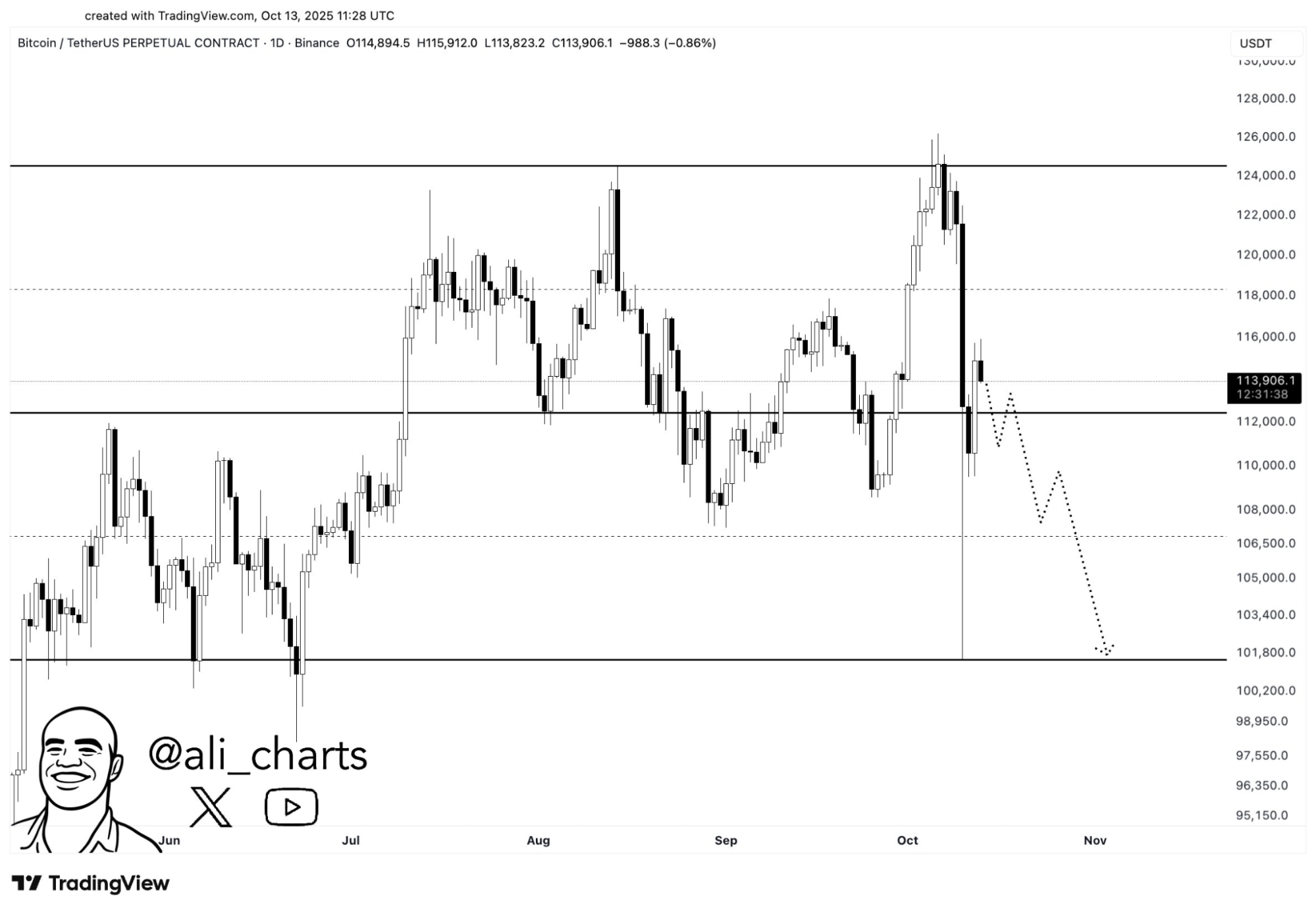
After a major period of volatility for Bitcoin, it seems as though the worst of the October 10 flash crash is over. We asked Grok to see how likely it is that Bitcoin could drop to $100K in the near future.

Author: Brave Newcoin
Dogecoin Millionaires Turn To Cheap Paydax (PDP) Altcoin At $0.015, Predict 65,000% Rally Before October Ends

Dogecoin Millionaires Turn To Cheap Paydax (PDP) Altcoin At $0.015, Predict 65,000% Rally Before October Ends

Dogecoin millionaires are backing Paydax (PDP), a new altcoin priced at $0.015, predicting a massive 65,000% rally before October ends as its presale heats up.

Author: Cryptodaily
U.S’s Biggest Crypto Capture Impacts the Market

U.S’s Biggest Crypto Capture Impacts the Market

Takeaways: The U.S. government seized a record $15B in Bitcoin from a major international crime ring.  The criminal organization allegedly […] The post U.S’s Biggest Crypto Capture Impacts the Market appeared first on Coindoo.

Author: Coindoo
Best Crypto Presales to Buy as Peter Brandt Predicts Bitcoin Dip Before ATH

Best Crypto Presales to Buy as Peter Brandt Predicts Bitcoin Dip Before ATH

The post Best Crypto Presales to Buy as Peter Brandt Predicts Bitcoin Dip Before ATH appeared on BitcoinEthereumNews.com. Good things come to those who wait when it comes to Bitcoin’s resurgence, at least according to veteran trader Peter Brandt. KEY POINTS: ➡️ Bitcoin could see a new ATH within the next week, according to veteran trader Peter Brandt – but a slide to $50K is still possible. ➡️ Several factors could influence Bitcoin’s price in the foreseeable future, including new rate cuts by the US Fed that investors expect. ➡️ In the meantime, the best crypto presales to buy, like Bitcoin Hyper and Snorter Token, offer viable alternatives to investors looking for coins with predictable returns. Peter Brandt was quoted by Cointelegraph as saying that a new ATH could be on the table within the next week or so, although he didn’t entirely dismiss the possibility of a slide to the $50K to $60K level. For traders who are looking to continue investing in crypto and but prefer more predictable returns, presales could be the way to go. As such, the likes of Bitcoin Hyper ($HYPER) and Snorter Token ($SNORT) are two of the best crypto presales to get into right now. There are also other silver linings on the horizon apart from presales. This includes the potential for further rate cuts by the US Federal Reserve. In a speech yesterday, US Fed Chair Jerome Powell said that the country is seeing ‘very low levels of job creation, and yet people are spending,’ adding that they are going to see how things will play out. Investors take this as a strong signal that the Fed could announce rate cuts in the next two weeks. Should this happen, it could fuel risk-on sentiment among investors and revive the crypto market, which saw $19B of positions liquidated over the weekend. In the meantime, here are several presales that continue to…

Author: BitcoinEthereumNews
Mentre JPMorgan Apre il Trading di Bitcoin ai Clienti, Bitcoin Hyper ($HYPER) Cavalca l’Onda Istituzionale

Mentre JPMorgan Apre il Trading di Bitcoin ai Clienti, Bitcoin Hyper ($HYPER) Cavalca l’Onda Istituzionale

JPMorgan, tramite il suo Global Head of Markets Digital Assets, ha dichiarato a CNBC che in futuro permetterà ai clienti di trattare Bitcoin e altre criptovalute. La banca sta promuovendo l’adozione della blockchain attraverso il suo deposit token JPMD, progettato per liquidazioni transfrontaliere 24/7 e come collaterale on-chain.  Con JPMorgan che avanza verso l’integrazione blockchain […]

Author: Bitcoinist
Check Out the Best Presales to Buy Now as Peter Brandt Predicts New ATH for Bitcoin

Check Out the Best Presales to Buy Now as Peter Brandt Predicts New ATH for Bitcoin

Good things come to those who wait when it comes to Bitcoin’s resurgence, at least according to veteran trader Peter Brandt.

Author: Brave Newcoin
Avalanche Whales Buy $6M in AVAX as Blazpay Presale Heats Up – Analysts Say It’s the Best Crypto Coin to Buy Now

Avalanche Whales Buy $6M in AVAX as Blazpay Presale Heats Up – Analysts Say It’s the Best Crypto Coin to Buy Now

Timing separates the watchers from the winners in crypto. Avalanche (AVAX), now trading around $28.20 after a minor 5% dip, is witnessing renewed accumulation from major wallets. Over 200,000 AVAX tokens (~$6 million) have been acquired by whales in the last 24 hours, signaling growing confidence in the network’s long-term strength. With over 44 million […] The post Avalanche Whales Buy $6M in AVAX as Blazpay Presale Heats Up – Analysts Say It’s the Best Crypto Coin to Buy Now appeared first on Live Bitcoin News.

Author: LiveBitcoinNews
Is Solana Building Crypto’s Manhattan? Grayscale Says Yes

Is Solana Building Crypto’s Manhattan? Grayscale Says Yes

The post Is Solana Building Crypto’s Manhattan? Grayscale Says Yes appeared on BitcoinEthereumNews.com. Grayscale Research has labeled Solana “crypto’s financial bazaar,” highlighting its deep on-chain economy, strong user growth, and dominant transaction activity as the foundation for long-term value creation. Meanwhile, analysts cite a notable surge in Solana’s on-chain activity, but major holders reducing futures exposure creates uncertainty around SOL’s next breakout. Sponsored Sponsored Solana’s Economic Engine Remains Hot Despite Whale Caution In a new report, Grayscale argues that the network’s diversity of decentralized applications (dApps), from DeFi to physical infrastructure, positions it as the leading smart contract platform by usage. “Solana is an active community and on-chain economy: an invisible metropolis with millions of users conducting thousands of transactions per second,” Grayscale wrote. “It’s the category leader in users, transaction volume, and transaction fees — arguably the three most important measures of blockchain activity,” read an excerpt in the report. With a market capitalization of nearly $111 billion, Solana’s native token, SOL, ranks sixth-largest cryptocurrency and the fifth-most liquid asset after Bitcoin and Ethereum. Grayscale notes that SOL has significantly outperformed its peer group since 2023, while stakers currently earn around 7% nominal rewards, which translates to a real yield near 3%. Solana’s ecosystem spans over 500 applications, powering decentralized finance, consumer apps, and real-world infrastructure. DeFi platforms like Raydium and Jupiter have facilitated over $1.2 trillion in trading volume year-to-date, while social and meme coin platforms like Pump.fun generate more than $1.2 million in daily revenue from roughly 2 million monthly users. In the DePIN sector, Helium continues to expand its decentralized wireless network with over 112,000 hotspots and major telecom partnerships with AT&T and Telefonica. Collectively, the Solana ecosystem generates an estimated $5 billion in annualized transaction fees, a direct reflection of on-chain demand, hence Grayscale’s crypto bazaar thesis. Sponsored Sponsored Competitive Design and Developer Growth Meanwhile, Solana’s speed, processing…

Author: BitcoinEthereumNews
Sreeram Kannan: Building a Trust Layer for Ethereum

Sreeram Kannan: Building a Trust Layer for Ethereum

Despite the controversy, EigenLayer remains at the core of Ethereum’s evolution. Written by Thejaswini MA Compiled by: Block unicorn Preface The Caltech interviewer leaned forward and asked an interesting question. “Suppose I give you unlimited resources, unlimited talent, and 30 years. You lock yourself in a lab like a hermit. After 30 years, you come out and tell me what you invented. What would you create?” Kanan, then a postdoctoral researcher applying for faculty positions, was stunned. His mind went blank. This problem required unconstrained thinking on a scale he had never attempted before. He had been tackling computational genomics problems for years, building on existing knowledge and making incremental progress. But this problem presented no constraints. No budget constraints. No time pressures. No talent shortages. There's just one request: What would you build if there were no obstacles? “I was completely blown away by the scope of the problem,” Kanan recalls. The level of freedom terrified him. He didn’t get the Caltech position. But the problem planted a seed in him that would later grow into one of Ethereum’s most controversial innovations: EigenLayer. Yet, the journey from a Caltech interview room to running a multi-billion dollar crypto company required Kanan to answer the 30-year-old question in three separate stages, changing his answer with each new phase. Academic Journey and Transformation Kannan grew up in Chennai, southern India, where pure mathematics captured his imagination early on. He remained in India to pursue his undergraduate degree at the Guidance College of Engineering, where he participated in the development of ANUSAT, India's first student-designed microsatellite. This project sparked his interest in complex systems and coordination problems. He arrived in the United States in 2008 with just $40 in funding. He studied telecommunications engineering at the Indian Institute of Science in Bangalore and went on to earn a master's degree in mathematics and a doctorate in electrical and computer engineering from the University of Illinois at Urbana-Champaign. His doctoral research focused on network information theory, or how information flows through networks of nodes. He spent six years solving long-standing problems in the field. When he finally cracked them, only twenty people in his subfield took notice. No one else paid attention. The disappointment prompted a moment of reflection. He had been pursuing curiosity and intellectual beauty, not impact. If you don't deliberately pursue it, you can't expect real-world changes to appear as random byproducts. He drew a two-dimensional graph. The X-axis represented technical depth, and the Y-axis represented impact. His work fell firmly into the high-depth, low-impact quadrant. It was time to move on. In 2012, he attended a lecture on synthetic genomics by Craig Venter, one of the founders of the Human Genome Project. The field was creating new species, talking about making biological robots rather than mechanical ones. Why waste time optimizing download speeds when you could reprogram life itself? He transitioned completely to computational genomics, focusing on it during his postdoctoral research at Berkeley and Stanford, where he investigated DNA sequencing algorithms and built mathematical models to understand gene structure. Then, artificial intelligence caught him off guard. A student proposed using AI to solve the DNA sequencing problem. Kanan rejected the idea. How could his carefully crafted mathematical model be outperformed by a neural network? The student built the model anyway. Two weeks later, the AI crushed Kanan's best benchmark. The message was: within ten years, AI will replace all his mathematical algorithms. Everything he relied on for his career will be obsolete. He faced a choice: delve deeper into AI-driven biology or try a new direction. In the end, he chose the new one. From Buffalo to Earth The Caltech question had always troubled him. Not because he couldn't answer it, but because he had never thought about it that way before. Most people work incrementally. You have X capabilities, and you try to build X plus incrementally. Making small improvements on what you already have. The 30-year question requires a completely different kind of thinking. It asks us to imagine a destination without worrying about the path. After joining the University of Washington as an assistant professor in 2014, Kanan set out on his first 30-year project: decoding how information is stored in living systems. He gathered collaborators and made progress. Everything seemed to be on track. Then, in 2017, his PhD advisor called and told him about Bitcoin. It had throughput and latency issues—exactly what Kanan had studied during his PhD. His first reaction? Why would he abandon genomics for "wild guesswork"? The technological fit was clear, but it seemed far removed from his grand vision. Then he reread Yuval Noah Harari's "Sapiens: A Brief History of Humankind." One idea struck him: What makes humans special isn't our innovation or cleverness, but our ability to coordinate on a massive scale. Coordination requires trust. The internet connected billions of people, but it left a gap. It allowed us to communicate instantly across continents, but it provided no mechanism to ensure people would keep their promises. Email could transmit promises in milliseconds, but enforcing them still required lawyers, contracts, and centralized institutions. Blockchains fill this gap. They're not just databases or digital currencies; they're execution engines that transform promises into code. For the first time, strangers can reach binding agreements without relying on banks, governments, or platforms. The code itself holds people accountable. This became Kanan's new 30-year goal: to build a coordination engine for humanity. But here, Cannan learned something that many academics often overlook. Having a 30-year vision doesn't mean you can jump straight to 30 years. You have to gain an advantage to solve bigger problems. Moving the Earth requires a million times more energy than moving a buffalo. If you want to eventually move the Earth, you can't just declare it and hope the resources arrive. According to Kannan, you must first move a buffalo. Then maybe a car. Then a building. Then a city. Each success gives you a bigger chip to take on the next challenge. The world is designed this way for a reason. Give someone who has never moved a buffalo the power to move the Earth, and the whole world might explode. Incremental leverage prevents catastrophic failure. Kanan's first attempt at moving buffaloes was Trifecta, a high-throughput blockchain he and two other professors were building. They proposed a blockchain capable of 100,000 transactions per second. But no one funded it. Why? Because no one needed it. The team optimized the technology without understanding market incentives or identifying the customer. They hired people who thought like them—all PhDs who were solving theoretical problems. Trifecta failed. Kanan returned to academia and research. He tried again, creating an NFT marketplace called Arctics. He was previously an advisor to Dapper Labs (which runs NBA Top Shot). The NFT space seemed promising. But as he built the marketplace, he kept running into infrastructure challenges. How could he get reliable price oracles for NFTs? How could he bridge NFTs between different chains? How could he run different execution environments? This market also failed. He didn’t understand the mindset of NFT traders. If you are not your own customer, you can’t build a meaningful product. Every problem requires the same thing: a network of trust. Should he build an oracle? A bridge? Or should he build the metathing that solves all these problems—the trust network itself? He understood this. He was exactly the kind of person who could build an oracle or a bridge. He could become his own client. In July 2021, Kanan founded Eigen Labs. The name comes from the German word for "own," meaning that anyone can build whatever they want. Its core philosophy is to enable open innovation through shared security. The technological innovation is re-staking. Ethereum validators lock up ETH to secure the network. What if they could also use those assets to secure other protocols? Instead of building their own security from scratch, new blockchains or services could leverage Ethereum's established validator set. Kanan pitched the idea to a16z five times before securing funding. One early pitch was memorable for the wrong reasons. Kanan wanted to build on Cardano because it had an $80 billion market cap but no working smart contracts. An a16z partner answered the phone from outside the Solana conference. Their reaction: "That's interesting. Why did you choose Cardano?" The feedback forced Kanan to think about focus. Startups are exponential games. You want to transform linear work into exponential impact. If you think you have three exponential ideas, you probably don't have one. You need to choose the one with the highest exponential value and go all in. He refocused on Ethereum, a decision that proved to be a good one. By 2023, EigenLayer had raised over $100 million from firms including Andreessen Horowitz. The protocol was rolled out in phases, reaching a total value locked of $20 billion at its peak. Developers are beginning to build “Active Verification Services” (AVS) on EigenLayer, from data availability layers to AI inference networks, each of which can leverage Ethereum’s security pool without having to build a validator from scratch. However, with success comes scrutiny. In April 2024, EigenLayer announced its EIGEN token distribution, which sparked a backlash. The airdrop locked up tokens for months, preventing recipients from selling them. Geographic restrictions excluded users in jurisdictions like the United States, Canada, and China. Many early adopters, who deposited billions of dollars, felt the distribution favored insiders over community members. The reaction caught Kanan off guard. The protocol's total locked value plummeted by $351 million, and users withdrew their funds in protest. The controversy exposed the gap between Kanan's academic thinking and the expectations of the crypto world. Then came the conflict of interest scandal. In August 2024, CoinDesk reported that Eigen Labs employees received nearly $5 million in airdrops from projects built on EigenLayer. Employees collectively claimed hundreds of thousands of tokens from projects like EtherFi, Renzo, and Altlayer. At least one project, under pressure, included its employees in its distribution. The revelation sparked accusations that EigenLayer was compromising its “trusted neutrality” stance by using influence to reward projects that offered tokens to employees. Eigen Labs responded by banning ecosystem projects from airdropping to employees and implementing a lock-up period. But its reputation has been damaged. Despite these controversies, EigenLayer remains at the heart of Ethereum’s evolution. The protocol has already secured partnerships with major players like Google Cloud and Coinbase, which serves as a node operator. Kanan’s vision goes far beyond restaking. “Crypto is our coordination superhighway,” he said. “Blockchains are commitment engines. They enable you to make and keep commitments.” He thinks in terms of quantity, diversity, and verifiability. How many promises can humans make and keep? How diverse can those promises be? And how easily can we verify them? “This is a crazy, century-long project,” Kanan said. “It’s going to upgrade the human species.” The protocol launched EigenDA, a data availability system designed to handle the aggregate throughput of all blockchains. The team introduced a subjective governance mechanism to resolve disputes that cannot be verified solely on-chain. But Kanan admits the work is far from done. “Until you can run education and healthcare on the blockchain, the work is not done. We are far from done.” His approach combines top-down vision with bottom-up execution. You need to know where the mountain is. But you also need to find the slope leading there from where you stand today. “If you can’t do anything with your long-term vision today, it’s useless,” he explains. Verifiable cloud is the next frontier for EigenLayer. Traditional cloud services require trust in Amazon, Google, or Microsoft. Kanan's version lets anyone run cloud services—storage, compute, AI inference—and cryptographically prove they're executing correctly. Validators stake their integrity. Malicious actors lose their stake. Now in his 40s, Kanan remains an affiliated professor at the University of Washington and runs Eigen Labs. He still publishes research and thinks in terms of information theory and distributed systems. But he's no longer the academic who couldn't answer Caltech's 30-year-old question. He's now answered it three times—with genomics, with blockchain, and with the Coordination Engine. Each answer builds on the lessons learned from the previous attempt. The buffalo had been moved. The car had been turned on. The building had begun to move. Whether he could ultimately move the Earth remained to be seen. But Kanan had learned something many scholars never did: the path to solving big problems begins with solving small ones, which build upon the foundations for solving even bigger ones. This is the story about the founder of EigenLayer.

Author: PANews