CEX

CEXs are platforms managed by centralized organizations that facilitate the trading of cryptocurrencies, offering high liquidity and user-friendly fiat on-ramps. Leaders like Binance, OKX, and Coinbase serve as the primary gateways for institutional and retail entry. In 2026, the industry focus is on Proof of Reserves (PoR), enhanced regulatory compliance, and hybrid models that offer self-custody options. This tag provides updates on exchange security, listings, and global market trends.

4242 Articles
Created: 2026/02/02 18:52
Updated: 2026/02/02 18:52

Best Crypto to Buy Right Now for Maximum ROI Heading Into 2026

Best Crypto to Buy Right Now for Maximum ROI Heading Into 2026

Remittix gains attention with its PayFi model, active beta wallet, audits, and focus on real world crypto to fiat payments heading into 2026.

Author: Blockchainreporter
6 Best Crypto Presales Entering the Market This Year – Which Ones Are Worth Tracking?

6 Best Crypto Presales Entering the Market This Year – Which Ones Are Worth Tracking?

Remittix stands out among 2025 presales with its PayFi focus, live beta wallet, audits, and growing adoption in global crypto to fiat payments.

Author: Blockchainreporter
Galaxy Digital in Talks to Provide Liquidity for Polymarket and Kalshi

Galaxy Digital in Talks to Provide Liquidity for Polymarket and Kalshi

TLDR Galaxy Digital is in talks with Polymarket and Kalshi to become a liquidity provider for their prediction market platforms CEO Mike Novogratz said Galaxy is doing small-scale experiments with market-making and plans to provide broader liquidity Polymarket and Kalshi have generated around $42.4 billion in combined trading volume Other major trading firms like Jump [...] The post Galaxy Digital in Talks to Provide Liquidity for Polymarket and Kalshi appeared first on Blockonomi.

Author: Blockonomi
THENA introduces onchain stop-loss and take-profit orders with Orbs protocol

THENA introduces onchain stop-loss and take-profit orders with Orbs protocol

THENA becomes first DEX on BNB Chain to integrate Orbs' dSLTP, enabling automated stop-loss and take-profit trading.

Author: coincheckup
Galaxy Digital Eyes Polymarket and Kalshi Market Making Role

Galaxy Digital Eyes Polymarket and Kalshi Market Making Role

TLDR Galaxy Digital is in talks to become a liquidity provider for prediction market platforms Polymarket and Kalshi The two platforms have seen about $42.4 billion in combined trading volume and control roughly 97% of the global prediction market sector Polymarket is raising funds at a potential $12-15 billion valuation while Kalshi recently closed a [...] The post Galaxy Digital Eyes Polymarket and Kalshi Market Making Role appeared first on CoinCentral.

Author: Coincentral
The New Battleground for Parallel EVMs: A Look at 12 Emerging Forces in the Monad Ecosystem

The New Battleground for Parallel EVMs: A Look at 12 Emerging Forces in the Monad Ecosystem

Author: Jae, PANews Monad, the high-performance public blockchain that the community has been eagerly anticipating this year, has finally launched. On the evening of November 24th, the Monad mainnet and MON token officially launched. Previously, as Coinbase's first Launchpad project, it attracted 85,820 participants who invested $269 million. Even in a sluggish market environment, the oversubscription of the Monad token sale demonstrates its ability to attract funds and its popularity. As a leader in the parallel EVM track, Monad has been touting a throughput promise of up to 10,000 TPS (transactions per second) and a final confirmation time of 1 second. Now, it's time for the market to put its claims to the test. For Paradigm, another major investment in the public blockchain sector, Monad serves as a litmus test for its investment capabilities in the crypto market. Whether it can redeem itself from Blast's previous failure will depend on this battle. The value of a high-performance public blockchain will depend on the carrying capacity of its ecosystem. Unlike strategies that simply rely on "copying and pasting" existing EVM applications, Monad has attracted a number of emerging projects seeking to leverage its high-frequency trading capabilities thanks to its unique technical architecture. The Monad ecosystem comprises 304 protocols, 77 of which are proprietary, with DeFi protocols accounting for over 60%. PANews has compiled a list of representative emerging projects within the Monad ecosystem, considering factors such as Monad exclusivity, investment institutions, and project activity. These projects cover DeFi, Launchpad, prediction markets, DeAI, and DePin, among others. However, Monad is still in the early stages of ecosystem development, with many projects still in testing or early interaction phases. Users should be aware of potential risks before participating. Mynt (USDm) Mynt (USDm) is a zero-knowledge proof stablecoin protocol powered by Succinct's SP1 zkVM (Zero-Knowledge Virtual Machine) and incorporating a collateralized minting model. Users can mint USDm using MON tokens as collateral while earning yield from reserve assets. Mynt prioritizes verifiable privacy, collaborating with Fairblock to use additive homomorphic encryption (PHE) and multi-party computation (MPC) to encrypt transaction amounts, avoiding the risk of front-running. Mynt also introduced the concept of "state liquidity." Thanks to ZK technology, USDm can achieve seamless combination of rents across different protocols, meaning that users do not need to frequently transfer tokens between different DeFi protocols; liquidity can be reused and verified simply through state proofs. During the testnet phase, Myn processed over 1 million transactions, generating $250,000 in revenue. Kintsu Kintsu is positioned as a liquidity staking protocol focused on maximizing capital efficiency. Users who stake MON receive sMON, a circulating token that accumulates staking rewards over time. The sMON token model is designed for deep DeFi integration. By allowing sMON to circulate and trade across various DeFi applications, Kintsu not only maintains the liquidity of staked assets but also allows users to deploy assets to yield markets without sacrificing the base staking rewards. Since its mainnet launch, Kintsu has demonstrated a strong early lead, with a TVL of 17.5 million MON (approximately $540,000) and 605 sMON holders. The protocol previously secured $4 million in seed funding led by Castle Island Ventures. Magma Magma is a liquidity staking platform that allows users to earn circulating staking tokens (gMON) by staking MON tokens. gMON not only represents staking rewards but is also composable, serving as collateral across various dApps (decentralized applications) within the Monad ecosystem for activities such as lending and trading. Since its mainnet launch, Magma's TVL (Total Value Locked) has exceeded 7.13 million MON (approximately $200,000), with over 800 gMON holders across 800 unique addresses and over 1,000 transactions. The protocol previously secured $3.9 million in seed funding from investors including Animoca Ventures. Kuru Kuru is a CLOB DEX (Centralized Order Book Decentralized Exchange) that executes entirely on-chain. Its unique feature lies in leveraging Monad's parallel execution and low latency to provide a CEX-like user experience while maintaining self-custody. Kuru's design allows market makers to place and cancel limit orders at high frequency with low, constant gas costs, addressing the core pain points of traditional DEXs in efficiency and price discovery. Keone Hon, co-founder and CEO of Monad Labs, has stated that Kuru can help DEXs narrow the execution gap with CEXs. After its mainnet launch, Kuru's TVL quickly surpassed $1.4 million, with 24-hour trading volume exceeding $11 million, generating approximately $9,000 in protocol revenue. Kuru previously secured $2 million in seed funding led by Electric Capital and $11.5 million in Series A funding led by Paradigm. Perpl Perpl is a full-chain Perp DEX (decentralized perpetual contract trading platform) built on Monad, and it also adopts the CLOB model. Derivatives trading has extremely high requirements for real-time price feeds, settlement, and margin; any delay can lead to high slippage or liquidation risks. The protocol leverages Monad's high throughput and sub-second finality to ensure that the entire process of order matching and trade execution can be completed on-chain, thereby eliminating reliance on centralized components such as off-chain sorters and further improving the transparency and efficiency of trading. Perpl previously secured $9.25 million in funding led by Dragonfly. Mu Digital Mu Digital is an RWA (Real-World Asset) platform designed to bring the Asian credit market on-chain, aiming to tokenize Asia's $20 trillion credit market. The protocol offers two main risk-tiered products: 1) AZND (Asian Dollar): a premium risk-tiered product backed by high-quality Asian credit instruments, offering a native yield of 6% to 7% upon launch; 2) muBOND: a basic risk-tiered product designed to provide enhanced yields of up to 15% for users seeking higher returns. The protocol had secured $1.5 million in pre-seed funding, with investors including traditional financial institution UOB Venture Management. Mu Digital launched its mainnet simultaneously, with muBond TVL (total value locked) reaching $20 million and AZND TVL reaching a staggering $80 million. Castora Castora is a decentralized P2P (peer-to-peer) prediction market, similar to platforms like Polymarket and Kalshi. It allows users to place P2P bets on real-world events, such as elections or sporting events, and settles the bets on-chain. The protocol leverages Monad's low latency to achieve real-time odds updates. Unlike traditional order book-based prediction markets, Castora employs a pool-based betting model. Users pay an "entry fee" to enter a specific prediction pool, and the system determines the winner at snapshot time. The user whose prediction is closest to the actual outcome wins the prize pool. Compared to order book-based prediction markets, Castora's mechanism is more similar to a "full share" or "pool" model, which lowers the barrier to entry for market makers, making it easier for ordinary retail investors to participate in liquidity provision and betting. Currently, Castora has launched early pools such as ETH price prediction and is one of the most frequently interacted dApps within the Monad community. Nad.fun Nad.fun is a social meme token issuance platform that allows users to deploy tokens in minutes at extremely low cost, supporting the entire process of creation, issuance, and trading, similar to pump.fun. The protocol uses classic bonding curve pricing to ensure fair early launches. Since its mainnet launch, Nad.fun has generated 30 new Meme tokens. Currently, the Meme token with the highest market capitalization is NADS, at $730,000, while ATH (its all-time high) once had a market capitalization approaching $2 million. FortyTwo Fortytwo is a DeAI inference network that utilizes "swarm inference" technology to achieve scalable, low-illusion AI through node contributions. The protocol supports distributed model training and inference, where AI agents can directly exchange data on-chain. Fortytwo operates with extremely high latency requirements. It leverages Monad's high-performance parallel execution environment to ensure that data exchange and inference tasks between AI agents are completed with very low latency. High transaction speed is also a prerequisite for achieving scalable intelligence. The protocol relies on a dynamic load balancing system to optimize resource utilization, ensuring nodes maintain high activity during light tasks such as video calls or web browsing, but automatically reducing or pausing inference when users perform heavy operations such as 4K video editing. This fine-grained resource management is only feasible if the underlying public blockchain can handle fast and inexpensive transactions. To date, Fortytwo has 450 active nodes, with over 4,500 inference tasks completed daily. The protocol previously secured $2.3 million in Pre-Seed funding led by Big Brain Holdings. Rumi Rumi aims to build an AI-driven media and advertising company. Its protocol employs a unique "watch-to-earn" model, rewarding users' content consumption behavior through a visual language model. Rumi is committed to transforming passive media content into interactive experiences, and its protocol supports intelligent media content parsing. It has already partnered with companies such as TVision and Story Protocol. Rumi's live streaming duration reached 8.5 billion hours in Q3, equivalent to 970,000 years of attention. The protocol previously secured $4.7 million in Pre-Seed funding led by a16z crypto, CSX, and EV3. Multisynq Multisynq aims to build a real-time application layer for the internet, bringing the instant collaboration experience of Google Docs to all online applications, including DeFi, gaming, and ambient coding, without relying on centralized cloud service giants. The agreement had previously secured $2.2 million in seed funding led by Manifold. Poply Poply is an NFT marketplace and distribution platform whose protocol emphasizes respect for creators' royalties and optimizes the NFT minting and listing experience based on Monad's high-frequency trading characteristics. Poply also provides AI tools (such as generative artwork based on prompts, which can be minted into series of NFTs) and user-friendly real-time bidding and trading functions. The protocol will launch 6,000 Poply Otters series NFTs on November 24, and will give holders user benefits such as lower transaction fees, higher token allocation, and exclusive airdrops.

Author: PANews
Beyond just trading volume, "asset turnover" reveals the true strength and inflated claims of an exchange.

Beyond just trading volume, "asset turnover" reveals the true strength and inflated claims of an exchange.

In traditional finance, asset turnover is generally used to measure the efficiency of asset utilization, and then to evaluate sales, conversion rates, and so on; but what would happen if we applied the same metric to the cryptocurrency field? You will discover a completely new perspective. This article is a companion piece to the NVIDIA financial statement analysis (https://x.com/agintender/status/1991890344653570186?s=20), aiming to demonstrate to practitioners the diversity of data and the application of "financial techniques" in the crypto world. This article is 4500 words long. If you're too lazy to read the main text, just look at the table below: Disclaimer: This article draws its conclusions from publicly available information and is based on the author's own estimations. The conclusions are bound to contain errors and may even be incorrect; please do not rely on this information as a basis for your research. This article is for academic exchange purposes only. I. Theory From the perspective of business supply, the size of assets held in custody by an exchange should be positively correlated with its trading volume. Liquidity supply: Assets held in custody on exchanges (especially those held by market makers) are deployed to the order book to facilitate trading. More assets typically mean a deeper order book and higher trading volume capacity. User activity: Users deposit funds into CEXs primarily for trading. While some users use CEXs as wallets (HODLing), in active exchanges, the velocity of money means that a portion of reserves are turned over daily. Trust magnetism: High trading volume attracts liquidity, which in turn demands deposits. Conversely, high deposit amounts signal active traders. In addition, there is an urban legend circulating in the industry that the current period's exchange revenue = current period's assets x 20-30% (commonly known as asset accumulation). II. Metric: Definition of "Crypto Asset Turnover Rate" (CATR) For horizontal comparison, the Crypto Exchange Asset Turnover Ratio (CATR) is as follows: CATR = Monthly Trading Volume (Contracts + Spot) / User Assets (POR Value) From a traditional accounting perspective, asset turnover measures how quickly a company generates sales revenue from its total assets within a given period. It is typically calculated by dividing "net sales revenue" by "average total assets." A higher ratio indicates higher asset utilization efficiency, stronger conversion capabilities, better sales performance, and higher table turnover rate. However, on cryptocurrency exchanges, while the turnover rate also represents asset utilization efficiency, its meaning is completely different. This money belongs to the users, and a higher turnover rate means higher user willingness (and enthusiasm?) to trade, resulting in higher unit efficiency for more transactions. Generally speaking, market makers have high requirements for capital efficiency (arbitrage, market making, and other transactions), while retail investors have lower capital efficiency. Low turnover efficiency may mean that the exchange is primarily used for custody and deposits, or that user engagement is extremely low. High turnover efficiency indicates an extreme speed of capital flow. This is typically seen on platforms that primarily use contracts (high leverage), indicating strong user trading intentions and high execution efficiency for market makers. However, extreme turnover efficiency may indicate wash trading or wash trading. This article is intended merely to spark discussion and hopefully inspire readers to explore more interesting and efficient metrics and data dimensions. It's not that the crypto market is too difficult, but rather that we haven't taken a systematic approach to it. III. Data Explanation Samples: Binance, OKX, Bybit, Bitget, Gate, MEXC, and HTX Data source: Sources of exchange's October monthly trading volume: https://data.coindesk.com/reports/exchange-review-november https://www.scribd.com/document/831768086/CCdata-crypto-exchange-review-12-24 Based on the data sources above, estimate the spot and contract trading volumes of each exchange. POR data source: Disclosures from various exchanges. https://www.binance.com/en/proof-of-reserves https://www.okx.com/en-sg/proof-of-reserves https://www.bybit.com/app/user/proof-of-reserve https://www.mexc.com/proof-of-reserve https://www.bitget.com/support/articles/12560603840435 https://www.gate.com/proof-of-reserves https://www.htx.com/en-us/proof-of-reserve Note: The core assets of POR users in this article are only BTC, ETH, USDT and USDC, so there may be differences from the total asset data actually disclosed by the exchange. IV. CATR data from various exchanges 4.1 Binance 4.1.1 Proof of Asset (PoR) Analysis Snapshot data as of October 2025: BTC: 593,851 ETH: 4,095,663 USDT: 34.7 billion (collateralization ratio 107.45%) USDC: 7.8 billion (collateralization ratio as high as 133.79%) The user's core total assets are estimated at US$115 billion. 4.1.2 Transaction Volume Analysis In October 2025, activity on centralized exchanges surged. CCData data shows that total spot and futures trading volume on global CEXs climbed to $10.3 trillion. Binance typically holds approximately 40%-50% of the market share. Spot trading: Data indicates that Binance's monthly trading volume in October was approximately $810.4 billion. Contract trading: Contracts are typically 3-4 times the volume of spot trading. According to data from TokenInsight and CryptoQuant, Binance's quarterly trading volume reached $8.39 trillion, equivalent to approximately $2.8 trillion per month. Overall estimates: Binance's total trading volume (spot + contracts) in October is conservatively estimated at around $3.6 trillion. 4.1.3 Calculation of Crypto Asset Turnover Rate (CATR) 36000 / 1150 = 31.304x 4.2 OKX 4.2.1 Proof of Asset (PoR) Analysis Snapshot data as of October 2025: BTC: 133,087 (collateralization ratio 105%) ETH: 1,622,674 USDT: 10 billion (collateralization ratio of 106%) USDC: 120 million The user's core total assets are estimated at US$30 billion. 4.2.2 Transaction Volume Analysis According to a CCData report, OKX's spot trading volume in November was $163 billion (similar to October's figure). OKX's contract business has historically been strong, typically 4-5 times that of spot trading. Overall estimates: If the spot market is worth $163 billion, the contract market is estimated at $700-800 billion. The total monthly trading volume is approximately $1 trillion. 4.2.3 Calculation of Crypto Asset Turnover Rate (CATR) 10000 / 290 = 34.48x 4.3 Bybit 4.3.1 Proof of Asset (PoR) Analysis Data as of October 22, 2025: USDT: User assets are 5.8 billion, and wallet balance is 6.38 billion (110%). USDC: User assets: $600 million. Wallet balance: $680 million (135%) BTC: 61,976 BTC (approximately $5.6 billion). ETH: 532,000 ETH (approximately $1.5 billion). Total assets estimated at approximately US$13.5 billion. 4.3.2 Transaction Volume Analysis Bybit's growth has been extremely rapid, with CCData data showing that its spot trading volume reached $208 billion in November. Considering that Bybit is a contract-first platform, its contract trading volume is typically 3-4 times that of spot trading. Overall estimate: Spot market value of 200 billion + Contract value of 800 billion ≈ 1 trillion USD. Given that Bybit counts each buy and sell transaction as one, the transaction volume should be divided by 2, which is $500 billion. 4.3.3 Calculation of Crypto Asset Turnover Rate (CATR) 5000 / 135 = 37.31x 4.4 Bitget 4.4.1 Proof of Asset (PoR) Analysis October 2025 data: BTC: Users hold 10,275 BTC, and the platform has 31,556 BTC (fun fact: Bitget's BTC reserve ratio is as high as 307%, is this to show that it has abundant funds?!). ETH: The platform has nearly 300,000 ETH, with users holding 134,000 (the ETH reserve ratio has reached a staggering 224%). USDT: 1.78 billion + USDC: 110 million Total user assets estimated at approximately $3.2 billion. (Platform assets estimated at $5.2 billion) 4.4.2 Transaction Volume Analysis Bitget reported that its US stock futures trading volume surpassed $200 million in October. While the absolute value is not large, it demonstrates the company's product diversification. CCData shows its spot trading volume is approximately $80.2 billion. Regarding contracts, Bitget previously reported monthly futures trading volume of $92 billion, which could be even higher in a bull market. Overall estimate: Spot market value of 80 billion + Contract value of 320 billion ≈ 400 billion USD. Given that Bitget counts each buy and sell transaction as one transaction, the transaction volume should be divided by 2, which is $200 billion. 4.4.3 Calculation of Crypto Asset Turnover Rate (CATR) 2000 / 32 = 62.5x 4.5 Gate.io: 4.5.1 Proof of Asset (PoR) Analysis As of October 28, Gate.io reported a total reserve value of $11.676 billion, with a reserve ratio of 124%. Interestingly, Gate's core asset collateralization ratios all far exceed 100%, meaning the platform's asset content > user assets. The user's core assets are as follows: BTC 18,536 (collateralization ratio 133.96%) ETH 332,801 USDT 1.332 billion USDC 0.67 billion (collateralization ratio nearly 250%) Total user core assets: approximately US$4 billion; platform assets: US$6.3 billion. 4.5.2 Transaction Volume Analysis Gate.io's spot trading volume surged 39.1% in October, reaching a record high of $163 billion. On the futures front, May's figure was $264 billion, with October's estimated at around $400 billion. (https://www.globenewswire.com/news-release/2025/06/23/3103369/0/en/Gate-s-Nearly-70-MoM-Growth-in-Derivatives-Volume-Tops-Global-Charts-Featured-in-CoinDesk-s-Latest-Report.html) Overall estimate: Spot market value of 163 billion + Contract value of 400 billion ≈ 560 billion USD. Given that each transaction on the Gate is counted as one buy and one sell, the transaction volume should be divided by 2, which is $280 billion. 4.5.3 Calculation of Crypto Asset Turnover Rate (CATR) 2800 / 40 = 70x 4.6 MEXC 4.6.1 User Core Asset Data USDT: User assets total $1.723 billion (platform assets $2.245 billion, collateralization ratio 130%) BTC: User assets 3,555 BTC (approximately $300 million). ETH: User assets total 54,357 ETH (approximately $160 million) USDC: Around 100 million Total assets estimated at: approximately US$2.3 billion 4.6.2 Transaction Volume Analysis According to Coingecko's spot data, the average daily trading volume over the past 30 days was 3.3 billion, with an estimated monthly trading volume of 100 billion; the average daily trading volume for contracts was 45 billion, with an estimated monthly trading volume of 1.35 trillion. (I really couldn't find a reliable data source, so please bear with me.) Given that MEXC counts buy and sell transactions as one transaction each, the trading volume should be divided by 2, resulting in $675 billion. Interestingly, a TokenInsight report states that MEXC ranks second globally in spot trading, with a market share of approximately 9% (https://www.globenewswire.com/news-release/2025/10/30/3177141/0/en/TokenInsight-MEXC-Ranks-Second-in-Global-Spot-Trading-Capturing-11-of-Market-Share-in-Q3-2025.html). 4.6.3 Calculation of Crypto Asset Turnover Rate (CATR) 6750 / 23 = 293.48x 4.7 HTX 4.7.1 User Core Asset Data According to HTX's disclosure in October, user assets are as follows: 19,867 BTC 115,278 ETH USDT 1.35 billion USDC 37 million Total user core assets are estimated at $3.5 billion. 4.7.2 Transaction Volume Analysis According to Coingecko data, HTX's average daily contract trading volume is $8.5 billion, and its 30-day volume is $255 billion; the average daily spot trading volume is around $4 billion, and its 30-day volume is $120 billion. Overall estimate: Monthly transaction volume is approximately US$337.5 billion. Given that HTX counts each buy and sell transaction as one transaction, the trading volume should be calculated as 3750/2, or $187.5 billion. 4.7.3 Calculation of Asset Turnover Ratio (ATR) 1875 / 35 = 53.57x This article is intended merely to spark discussion and hopefully inspire readers to explore more interesting and efficient metrics and data dimensions. It's not that the crypto market is too difficult, but rather that we haven't taken a systematic approach to it.

Author: PANews
Pump.fun Pushes Back Against Lookonchain Claims…

Pump.fun Pushes Back Against Lookonchain Claims…

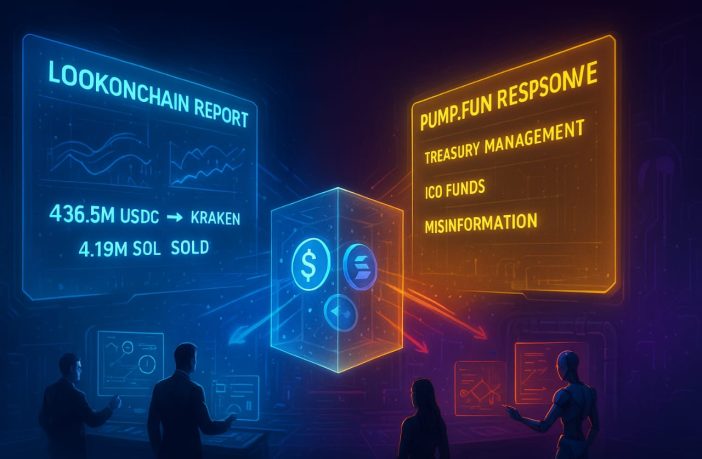
The post Pump.fun Pushes Back Against Lookonchain Claims… appeared on BitcoinEthereumNews.com. A new on-chain report from Lookonchain has reignited debate around Pump.fun’s treasury activity. But the team behind the memecoin launchpad is openly rejecting the claims, calling the circulating numbers “misinformation” and insisting the large transfers reflect internal treasury management, not cash-outs. Lookonchain’s report surfaced major USDC and SOL outflows over the last year, sparking speculation across X. Pump.fun quickly responded, denying any wrongdoing and arguing that the movements stem from reorganizing treasury funds raised during the PUMP ICO. The conflicting narratives are now driving one of the platform’s biggest transparency tests to date. Lookonchain Reports Over $1B in Combined USDC + SOL Movements Lookonchain’s thread presents a detailed breakdown of on-chain activity involving Pump.fun wallets. The core claims: 436.5M USDC sent to Kraken since October 15 Between October 15 and today, Lookonchain tracked 436.5M USDC flowing from Pump.fun-linked wallets into Kraken. The on-chain flow also showed:  537.6M USDC leaving Kraken and moving into Circle through wallet DTQK7G  A nearly matching inflow/outflow pattern that raised questions around whether Pump.fun was off-ramping proceeds Lookonchain framed the activity as part of a broader pattern of exchange deposits and potential cash-outs. It appears https://t.co/C909I8882s has cashed out at least 436.5M $USDC since Oct 15. Since Oct 15, https://t.co/C909I8882s has deposited 436.5M $USDC into#$Kraken. During the same period, 537.6M $USDC flowed from #Kraken to #Circle through wallet DTQK7G. Between May 19, 2024… pic.twitter.com/WQGnUcA8l4 — Lookonchain (@lookonchain) November 24, 2025 4.19M SOL sold between May 2024 and August 2025 The report also highlighted long-term SOL selling: 4.19M SOL sold in total since May 19, 2024 Valued at $757M at an average price of $181 Of that: 264,373 SOL was sold directly on-chain (~$41.64M) 3.93M SOL (~$715.5M) was deposited into Kraken This multi-year accumulation of transactions intensified concerns that Pump.fun has been liquidating assets steadily. The thread…

Author: BitcoinEthereumNews
Pump.fun Pushes Back Against Lookonchain Claims as Treasury Movements Trigger Debate

Pump.fun Pushes Back Against Lookonchain Claims as Treasury Movements Trigger Debate

A new on-chain report from Lookonchain has reignited debate around Pump.fun’s treasury activity. But the team behind the memecoin launchpad is openly rejecting the claims, calling the circulating numbers “misinformation” and insisting the large transfers reflect internal treasury management, not cash-outs. Lookonchain’s report surfaced major USDC and SOL outflows over the last year, sparking speculation [...]

Author: Null TX
What happened to crypto market today – Mild recovery, but where is smart money?

What happened to crypto market today – Mild recovery, but where is smart money?

The post What happened to crypto market today – Mild recovery, but where is smart money? appeared on BitcoinEthereumNews.com. Key Takeaways What’s happening in the crypto market today? Despite a mild rebound, extreme fear shows that broader capital hasn’t entered the crypto market today, keeping smart money cautious. What signals suggest optimism? Bullish signs like rising whale holdings and institutional interest in DOGE/XRP ETFs indicate the market still has upside potential. The crypto market today registered a mild rebound.  Bitcoin [BTC] retested $88,000, sparking debate over whether it has bottomed or if selling pressure is still weighing on the market. Ethereum [ETH] followed, climbing back above $2,800.  All in all, has the market turned bullish? Analyzing trends in the crypto market today On the macro side, nearly $50 billion flowed into the crypto market over the last 24 hours.  Notably, $30 billion of that went straight into Bitcoin. That’s 60% of inflows, a sign that traders are still favoring BTC over altcoins, keeping this cycle BTC-led. The result? The Altcoin Season Index slipped by 3 points to 39. In short, the minor rebound of the crypto market today isn’t broad-based. The inflows seemed to be too concentrated, making it premature to call a market bottom yet, with the TOTAL index already down 0.38% intraday.  Source: TradingView (TOTAL/USDT) Simply put, the overall market participation has been cautious. BlackRock, for example, has been selling aggressively, moving 2,822 BTC and 36k ETH into Coinbase Prime. On the ETF side, inflows for both BTC and ETH have been  flat, showing that big money isn’t jumping in yet. Reinforcing this, the Fear and Greed Index ticked up just 2 points to 12. However, it’s still in “extreme” fear, matching market positioning, with 95% of 24-hour liquidations in the crypto market today coming from longs. Market pause, not panic? Despite bearish signals though, the crypto market today did see some signs of optimism. On the…

Author: BitcoinEthereumNews