

Top 4 Reasons Why All Is Not Lost For Bitcoin
Key Insights
- A Satoshi-era whale bought $1 billion in BTC, and if the whale accumulation pattern persists, we expect a new price range around current levels of $73K.
- JP Morgan is bullish on Bitcoin mining stocks as a Norwegian firm bets on BTC through MSTR, Metaplanet, MARA, and other stocks.
- Bitcoin-backed loans are shifting from emergency liquidity to structured financial use.
The recent market crash with Bitcoin (BTC) falling below $75,000 may have eroded a lot of confidence among participants. This is especially true for retail traders whose capital is less compared to that of institutions and whales.
Over the past week, the crypto market has continued to weaken. However, on-chain data indicates that Bitcoin price may still show signs of potential recovery. Will Bitcoin hold for a reversal?
Accumulation Continues: Satoshi-era Whales and Sharks In Action
As per Bitfinex, the number of addresses holding 1,000 or more BTC grew to 2,047. This happened even though BTC hit a yearly low of $73,060, which was 42% less than its all-time high.
In fact, Satoshi-era whales who had been dormant since the early days of Bitcoin were awakening. One of these famous holders bought over 20,000 BTC in the last 48 hours. The deal included a single purchase of 10,114 BTC, worth $1 billion, amid widespread retail panic.
Satoshi-era whales put money to work decisively at what they saw as generational lows. In contrast, newer whale groups tended to build their positions more slowly through exchanges or structured vehicles.
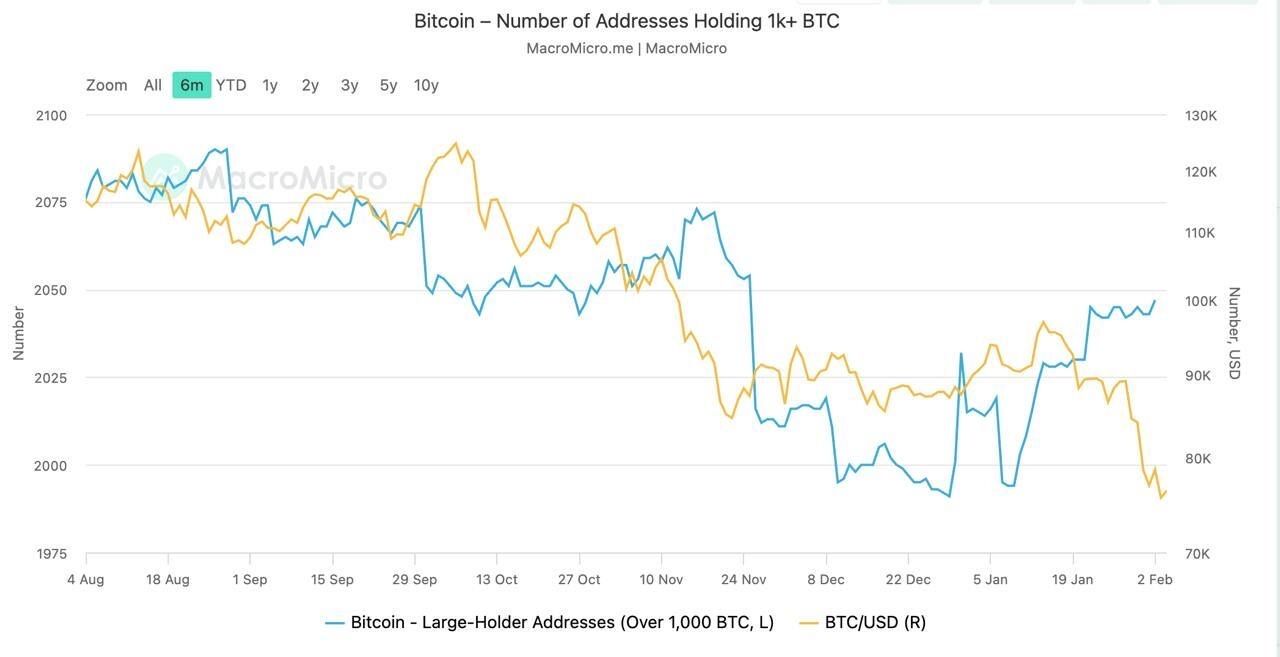 Number of addresses holding 1k+ BTC | Source: Bitfinex
These patterns together showed that strong hands were taking in supply and may be able to limit losses. In the long run, persistent accumulation could stabilize prices and make them less volatile.
However, as always, cryptocurrency markets were dominantly uncertain after the recent crash. That was not all there was, as institutions were also slowly coming back.
Institutions Betting on Bitcoin and Bitcoin Mining Stocks
JP Morgan was clearly bullish on Bitcoin mining stocks and BTC itself. According to its new report, 14 major U.S. miners saw their market cap rise by about $60 billion, or 23% month-over-month.
JP Morgan discussed short-term momentum and operational leverage that enabled miners to make more money when Bitcoin prices rose. The result showed that patients, long-term institutional capital, are looking for a store of value.
This was no different from Norway’s wealth fund. The $1.8 trillion fund set aside money for BTC investment through holdings. These moves showed that institutions were becoming more confident.
 JP Morgan on BTC mining | Source: BSCNews/X
Steady inflows from sovereign and Wall Street sources could stabilize demand. They could also reduce volatility and make Bitcoin a more stable part of diversified portfolios, even though no asset is immune to market cycles.
Bitcoin-backed Loans Shifting BTC’s Use As Collateral
Furthermore, the use of Bitcoin-backed loans in emergencies was gradually declining. They were now being used as regular, structured financial products.
The chart made this change very clear. Structured, ongoing lending was becoming the most common type of lending, far surpassing the spikes in emergency borrowing that happened during previous drawdowns.
This change meant that holders could get fiat or stablecoins without having to sell BTC. This in turn directly lowered the amount of selling pressure on exchanges. Thus, price floors for BTC were supported by fewer forced sales when liquidity was needed.
 Members’ BTC holdings per region | Source: X
On the one hand, this made Bitcoin more resilient and embedded it more deeply in traditional finance. Still, the more leverage, the higher the risk of liquidation if prices drop sharply, amplifying the moves. In general, the maturation of BTC collateral is a beneficial structural change, but it does come with some of the usual market risks.
Altogether, these factors meant that, despite the market weakness on BTC, there was still potential for recovery.
The post Top 4 Reasons Why All Is Not Lost For Bitcoin appeared first on The Market Periodical.
Ayrıca Şunları da Beğenebilirsiniz

Why Multicoin Capital’s Kyle Samani Is Leaving Crypto for AI and Robotics

SUI Price Rebounds Above $1 as HashKey Enables Trading Support

BitGo wins BaFIN nod to offer regulated crypto trading in Europe
BitGo’s move creates further competition in a burgeoning European crypto market that is expected to generate $26 billion revenue this year, according to one estimate. BitGo, a digital asset infrastructure company with more than $100 billion in assets under custody, has received an extension of its license from Germany’s Federal Financial Supervisory Authority (BaFin), enabling it to offer crypto services to European investors. The company said its local subsidiary, BitGo Europe, can now provide custody, staking, transfer, and trading services. Institutional clients will also have access to an over-the-counter (OTC) trading desk and multiple liquidity venues.The extension builds on BitGo’s previous Markets-in-Crypto-Assets (MiCA) license, also issued by BaFIN, and adds trading to the existing custody, transfer and staking services. BitGo acquired its initial MiCA license in May 2025, which allowed it to offer certain services to traditional institutions and crypto native companies in the European Union.Read more