South Korea is fighting back against the flood of low-cost robots from China and Japan, which are handicapping its local makers. Officials of the Korea Trade CommissionSouth Korea is fighting back against the flood of low-cost robots from China and Japan, which are handicapping its local makers. Officials of the Korea Trade Commission

South Korea has decided to impose tariffs on Japanese and Chinese robots

2026/03/27 05:13
3 min read
For feedback or concerns regarding this content, please contact us at crypto.news@mexc.com

South Korea is fighting back against the flood of low-cost robots from China and Japan, which are handicapping its local makers.

Officials of the Korea Trade Commission (KTC) said Thursday it will impose antidumping duties as much as 15.96-19.85% on Chinese robots and 17.45-18.64% on Japanese robots, citing damages to the local market.

“We have conducted an investigation since May, including overseas on-site inspections and visits to domestic demand industries, and determined the level of antidumping duties based on our findings,” an official said.

Why is Korea targeting China and Japan?

The Korean trade watchdog began its probe into the matter following anti-dumping complaints filed by HD Hyundai Robotics and four others earlier last year. Therein, the South Korean firms accused Chinese and Japanese suppliers of selling vertically articulated industrial robots with four or more axes at unfairly low prices.

An HD Hyundai official said they started suffering damages in the first half of 2024, with Chinese companies selling products nearly 60% cheaper than locally-made ones. 

“Chinese companies appear to be dumping their products into the Korean market to reduce their inventories amid the prolonged weakening of consumption in their own country,” the official said at the time. 

South Korea happens to be the fourth largest market for industrial robots, led by China, Japan, and the United States, according to a market insight by the International Federation of Robotics.
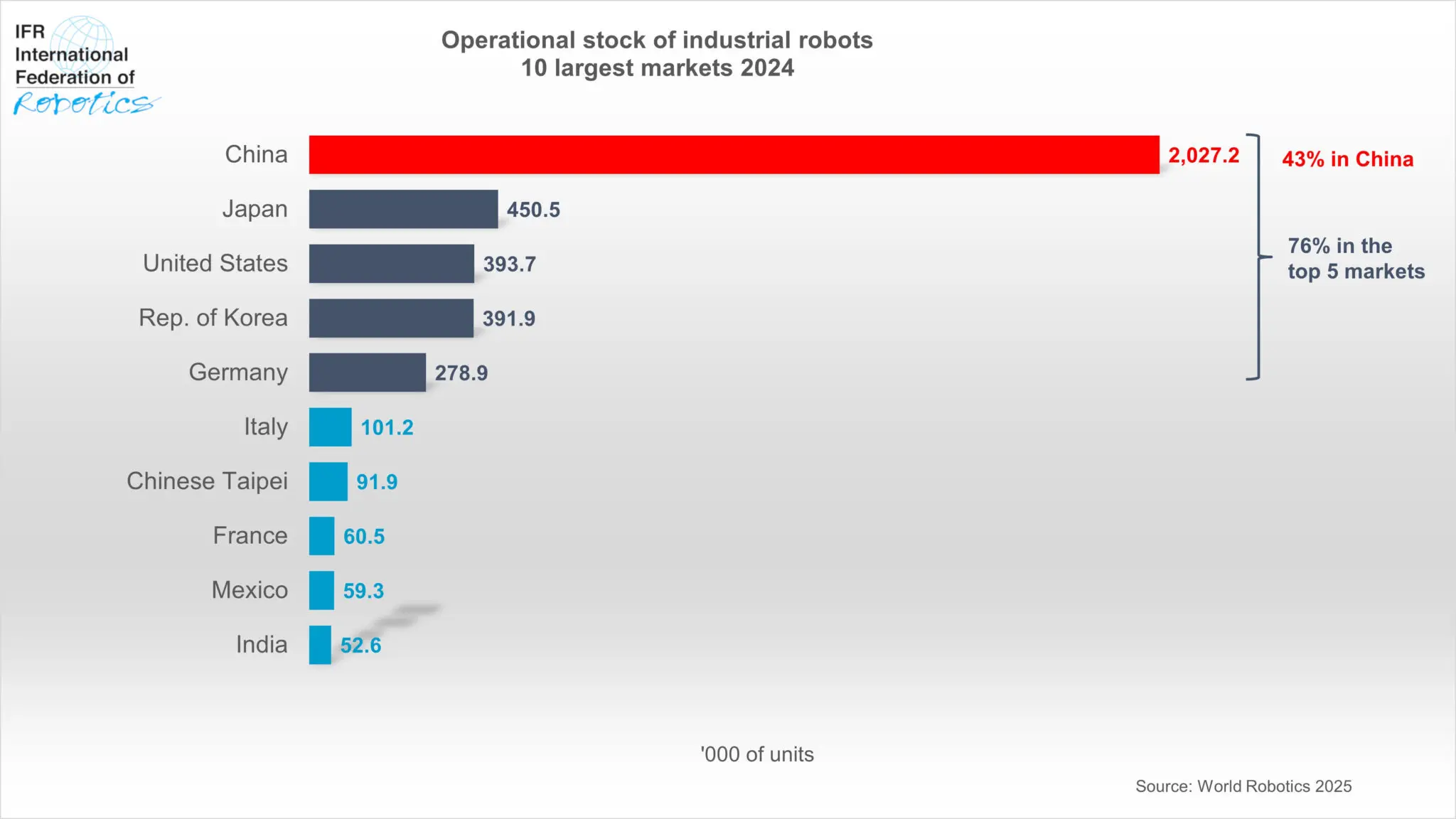
Korea slams Japan and China with tariffs to save local robot makersSouth Korea follows China, Japan, and the US as the largest markets for industrial robots. Source: International Federation of Robotics

As of 2024, Korea had 391,900 operational units. China alone accounted for 43% or 2,027,200 units, followed by Japan with 450,500 units, and the U.S. with 391,900 units.

U.S. is also calling for tariffs on Chinese robots

The U.S. robotics firms are also pushing for similar measures as Korea against Chinese products. 

Last year, U.S. robot makers, including Tesla, urged lawmakers to implement national strategies to bolster the domestic market and subsidize local robots, just as China does. 

While testifying to Congress last December, New York-based Standard Bots CEO Evan Beard complained that U.S. quotes are ten times higher than Chinese suppliers, which makes it difficult for U.S. suppliers to compete globally.  

Beard recommended the U.S. government increase funding, and also implement a ban or tariffs on industrial Chinese robots to create a “fair competitive landscape for American suppliers.”

The Trump administration is expected to issue an executive order on robotics this year, but some U.S. robotics execs say there may not be any major policy push until President Trump meets with Chinese leader Xi Jinping – a meeting that was postponed due to the escalation of the US-Iran conflict. 

In other news, two U.S. lawmaker has put forward a bill to ban the government from buying or operating humanoid robots made by Chinese firms, saying they pose a national security risk, Cryptopolitan reported Thursday.

There’s a middle ground between leaving money in the bank and rolling the dice in crypto. Start with this free video on decentralized finance.

Market Opportunity
Polytrade Logo
Polytrade Price(TRADE)
$0.03959
$0.03959$0.03959
-0.77%
USD
Polytrade (TRADE) Live Price Chart
Disclaimer: The articles reposted on this site are sourced from public platforms and are provided for informational purposes only. They do not necessarily reflect the views of MEXC. All rights remain with the original authors. If you believe any content infringes on third-party rights, please contact crypto.news@mexc.com for removal. MEXC makes no guarantees regarding the accuracy, completeness, or timeliness of the content and is not responsible for any actions taken based on the information provided. The content does not constitute financial, legal, or other professional advice, nor should it be considered a recommendation or endorsement by MEXC.
Tags:

You May Also Like

Headwind Helps Best Wallet Token

Headwind Helps Best Wallet Token

The post Headwind Helps Best Wallet Token appeared on BitcoinEthereumNews.com. Google has announced the launch of a new open-source protocol called Agent Payments Protocol (AP2) in partnership with Coinbase, the Ethereum Foundation, and 60 other organizations. This allows AI agents to make payments on behalf of users using various methods such as real-time bank transfers, credit and debit cards, and, most importantly, stablecoins. Let’s explore in detail what this could mean for the broader cryptocurrency markets, and also highlight a presale crypto (Best Wallet Token) that could explode as a result of this development. Google’s Push for Stablecoins Agent Payments Protocol (AP2) uses digital contracts known as ‘Intent Mandates’ and ‘Verifiable Credentials’ to ensure that AI agents undertake only those payments authorized by the user. Mandates, by the way, are cryptographically signed, tamper-proof digital contracts that act as verifiable proof of a user’s instruction. For example, let’s say you instruct an AI agent to never spend more than $200 in a single transaction. This instruction is written into an Intent Mandate, which serves as a digital contract. Now, whenever the AI agent tries to make a payment, it must present this mandate as proof of authorization, which will then be verified via the AP2 protocol. Alongside this, Google has also launched the A2A x402 extension to accelerate support for the Web3 ecosystem. This production-ready solution enables agent-based crypto payments and will help reshape the growth of cryptocurrency integration within the AP2 protocol. Google’s inclusion of stablecoins in AP2 is a massive vote of confidence in dollar-pegged cryptocurrencies and a huge step toward making them a mainstream payment option. This widens stablecoin usage beyond trading and speculation, positioning them at the center of the consumption economy. The recent enactment of the GENIUS Act in the U.S. gives stablecoins more structure and legal support. Imagine paying for things like data crawls, per-task…
Share
BitcoinEthereumNews2025/09/18 01:27
Why Digital Payments Are Expanding Globally

Why Digital Payments Are Expanding Globally

Digital payment transactions surpassed 1.3 trillion globally in 2024, a 22% increase from the prior year, according to Capgemini’s World Payments Report. The growth
Share
Techbullion2026/03/27 07:29
The Evolution of Blockchain Ecosystems

The Evolution of Blockchain Ecosystems

Blockchain Ecosystems Have Grown Into Multi-Billion Dollar Economies The combined economic activity across blockchain ecosystems exceeded $3.5 trillion in market
Share
Techbullion2026/03/27 07:39
