Selling pressure in Sei (SEI) has extended into a rare streak on the weekly timeframe, with the asset now recording nine consecutive red weekly candles. The prolongedSelling pressure in Sei (SEI) has extended into a rare streak on the weekly timeframe, with the asset now recording nine consecutive red weekly candles. The prolonged

SEI Prints Nine Consecutive Red Weeks as Price Tests Macro Channel Support

2026/03/16 08:44
3 min read
For feedback or concerns regarding this content, please contact us at crypto.news@mexc.com

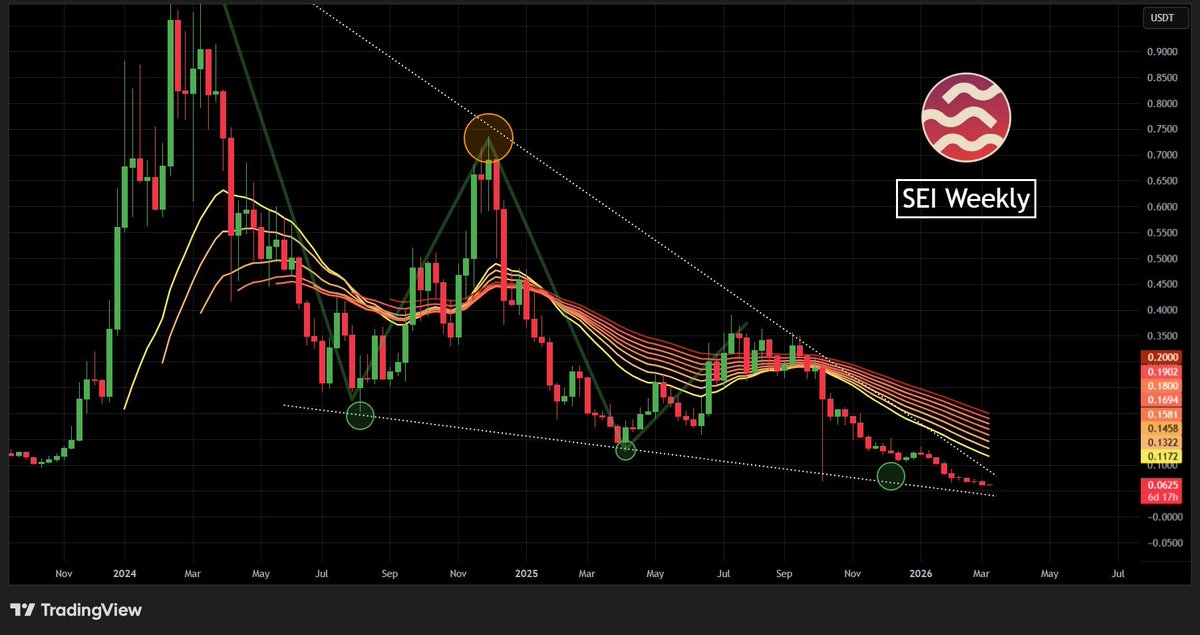
Selling pressure in Sei (SEI) has extended into a rare streak on the weekly timeframe, with the asset now recording nine consecutive red weekly candles.

The prolonged decline is pushing price toward a major structural area that traders are watching closely on the higher timeframe chart.

According to chart analysis shared by Bitcoinsensus, the recent sequence of losses suggests that SEI may be approaching the lower boundary of its long-term macro channel, a zone that has previously acted as structural support during earlier market phases.

At the time of the chart snapshot, SEI was trading around $0.062, continuing a gradual downtrend that has developed since the asset’s previous cycle highs.
Persistent Downtrend Defines Current Structure

The weekly chart shows a steady decline following the peak recorded during the earlier expansion phase of the market cycle.

Since that high, SEI has formed a clear series of lower highs and lower lows, confirming the continuation of a downward macro structure. The latest nine-week red streak reflects sustained selling pressure rather than isolated volatility.

Price is also trading below a cluster of moving averages on the weekly timeframe, which are currently sloping downward and acting as dynamic resistance levels.

This positioning indicates that rallies continue to encounter selling pressure before the market can regain meaningful upward momentum.

Macro Channel Support Comes Into Focus

Despite the persistent downtrend, the chart highlights a long-term descending channel, where the lower boundary has previously served as a reaction point for buyers.

SEI now appears to be approaching that support line again, suggesting the possibility of another test of the macro channel floor.

Based on the current structure, the chart indicates that the next potential downside area could lie within the $0.035 to $0.040 range if price continues moving toward the lower boundary of the channel.

Bitcoin Has Been Declared Dead 471 Times: Buying Each Time Would Have Turned $47,100 Into $74 Million

Key Levels to Watch

Several structural levels stand out on the chart as the market approaches this potential support zone.

Immediate resistance appears around the declining moving average cluster between approximately $0.11 and $0.19, which currently caps any recovery attempts.

On the downside, the macro channel support highlighted on the chart aligns with the $0.035–$0.040 region, which could become the next major reaction area if selling pressure persists.

Market Approaching Technical Decision Point

The combination of extended downside momentum and the proximity of macro support places SEI in a critical technical phase.

Extended sequences of weekly declines often indicate exhaustion phases within longer-term cycles. However, confirmation of a bottom typically requires either a strong reaction from support or a structural shift such as the formation of higher highs on the lower timeframes.

For now, the chart suggests that the asset remains inside its broader downtrend, with the lower boundary of the macro channel becoming the next key level that may determine whether the market stabilizes or continues its decline.

The post SEI Prints Nine Consecutive Red Weeks as Price Tests Macro Channel Support appeared first on ETHNews.

Disclaimer: The articles reposted on this site are sourced from public platforms and are provided for informational purposes only. They do not necessarily reflect the views of MEXC. All rights remain with the original authors. If you believe any content infringes on third-party rights, please contact crypto.news@mexc.com for removal. MEXC makes no guarantees regarding the accuracy, completeness, or timeliness of the content and is not responsible for any actions taken based on the information provided. The content does not constitute financial, legal, or other professional advice, nor should it be considered a recommendation or endorsement by MEXC.
Tags:

You May Also Like

President Trump’s Critical Talks With 7 Nations Revealed

President Trump’s Critical Talks With 7 Nations Revealed

The post President Trump’s Critical Talks With 7 Nations Revealed appeared on BitcoinEthereumNews.com. Strait Of Hormuz Crisis: President Trump’s Critical Talks
Share
BitcoinEthereumNews2026/03/16 11:25
Fed rate decision September 2025

Fed rate decision September 2025

The post Fed rate decision September 2025 appeared on BitcoinEthereumNews.com. WASHINGTON – The Federal Reserve on Wednesday approved a widely anticipated rate cut and signaled that two more are on the way before the end of the year as concerns intensified over the U.S. labor market. In an 11-to-1 vote signaling less dissent than Wall Street had anticipated, the Federal Open Market Committee lowered its benchmark overnight lending rate by a quarter percentage point. The decision puts the overnight funds rate in a range between 4.00%-4.25%. Newly-installed Governor Stephen Miran was the only policymaker voting against the quarter-point move, instead advocating for a half-point cut. Governors Michelle Bowman and Christopher Waller, looked at for possible additional dissents, both voted for the 25-basis point reduction. All were appointed by President Donald Trump, who has badgered the Fed all summer to cut not merely in its traditional quarter-point moves but to lower the fed funds rate quickly and aggressively. In the post-meeting statement, the committee again characterized economic activity as having “moderated” but added language saying that “job gains have slowed” and noted that inflation “has moved up and remains somewhat elevated.” Lower job growth and higher inflation are in conflict with the Fed’s twin goals of stable prices and full employment.  “Uncertainty about the economic outlook remains elevated” the Fed statement said. “The Committee is attentive to the risks to both sides of its dual mandate and judges that downside risks to employment have risen.” Markets showed mixed reaction to the developments, with the Dow Jones Industrial Average up more than 300 points but the S&P 500 and Nasdaq Composite posting losses. Treasury yields were modestly lower. At his post-meeting news conference, Fed Chair Jerome Powell echoed the concerns about the labor market. “The marked slowing in both the supply of and demand for workers is unusual in this less dynamic…
Share
BitcoinEthereumNews2025/09/18 02:44
TSMC taps AI for energy-efficient chips as Qualcomm targets enterprise PCs

TSMC taps AI for energy-efficient chips as Qualcomm targets enterprise PCs

The post TSMC taps AI for energy-efficient chips as Qualcomm targets enterprise PCs appeared on BitcoinEthereumNews.com. TSMC rolled out a new AI-based chip design method on Wednesday in Silicon Valley, aiming to cut the power demands of AI chips by up to tenfold. The company, which manufactures chips for Nvidia and other tech giants, says this change is necessary as current systems burn too much electricity. At full load, Nvidia’s AI servers can use up to 1,200 watts, the same as keeping 1,000 U.S. homes running non-stop. That kind of energy drain isn’t sustainable, and TSMC is reportedly trying to fix it with smarter design. The approach revolves around building chips with smaller pieces called chiplets, each made with different tech, all packaged into one. But it’s not just about throwing pieces together. These new packages are being designed by AI software from firms like Cadence Design Systems and Synopsys, not by engineers alone. Cadence and Synopsys beat engineers on speed and accuracy Jim Chang, deputy director at TSMC’s 3DIC Methodology Group, showed off the results. Using Cadence and Synopsys software, chip designs that once took two days of human effort were finished by AI in five minutes. “That helps to max out TSMC technology’s capability, and we find this is very useful,” Jim said during his talk. The company sees this speed boost as key to getting more efficient chips to market faster. But not every problem can be solved with smarter code.Kaushik Veeraraghavan, an engineer at Meta’s infrastructure division, said during his keynote that the current chip manufacturing model is hitting physical walls.Moving data in and out of chips with traditional wires is slowing things down. Switching to optical connections could fix that, but right now, they’re still too unreliable for large data centers. “Really, this is not an engineering problem,” Kaushik said. “It’s a fundamental physical problem.” At the same event, Qualcomm launched…
Share
BitcoinEthereumNews2025/09/25 11:46