Author: Umbrella, Deep Tide TechFlow In recent days, there has been a trend of practicing spoken English in the crypto community. An AI voice input project called Poseidon has officially launched. At the current stage, users can obtain their points through voice input every day and obtain future airdrop shares. As a star project incubated by Story Protocol and led by a16z, Poseidon targets the currently scarce high-quality and clear AI voice data, and is committed to helping train AI to understand speech in different languages, dialects and environments. After the experience, the author summarized the background of the Poseidon project and how to participate. Perhaps there is the next opportunity to "make a lot of money for free" hidden in it. Project Background According to its official website, the project's chief scientist, Sandeep Chinchali, holds a Ph.D. from Stanford and is currently an assistant professor at the University of Texas at Austin, specializing in edge computing, artificial intelligence, and generative AI. Poseidon product manager Sarick Shah was a software engineer at LotusFlare and Roadz. He has a background in Johns Hopkins University and was responsible for Story's AI engineering before joining the Poseidon team. LJW, the head of operations for the Poseidon project, was formerly the co-director of Harvard University's Crypto Lab and a senior researcher at Harvard Business School. He has extensive experience in operating AI and Web3 business models. SY Lee, head of the Poseidon project, is also the founder and CEO of Story Protocol. His first entrepreneurial project, Radish, is a mobile serial novel application with millions of downloads. It was sold to South Korean technology giant Kakao for US$440 million in 2021. He then served as the global strategy officer of Kakao Entertainment and is also a venture partner of Hashed Ventures, South Korea's largest blockchain fund. Poseidon's significant attention is also due to the incubation and support of Story Protocol. As an ecosystem focused on on-chain IP, Story Protocol has provided significant support for Poseidon's future development. The connection between the two extends beyond incubation. Story Protocol founder SY Lee's personal involvement as Poseidon project leader underscores its significant role within the Story ecosystem. The financing information announced by Poseidon a few days ago also brought market attention and confidence to this project. On July 23, the Poseidon team announced that its seed round was led by the well-known crypto investment institution a16z, with an amount of US$15 million. Why did a16z take a fancy to such a voice data collection project? The answer to this question begins with one of the core challenges facing the AI industry today: available data. In a research report on Poseidon, a16z partner Chris Dixon pointed out that the AI industry is facing a bottleneck of "data exhaustion," which is precisely the core problem Poseidon aims to solve. Specifically, current AI training faces three major data dilemmas: Slowing Data Growth: The current rate of internet content data production is far slower than the rate at which AI can learn and digest it. The dilemma of AI running out of data to learn from may loom in the near future. In 2024, former OpenAI scientist Sutskever noted that the growth rate of internet content data is slowing, and this "fossil fuel" that has fueled AI's rapid growth is gradually running out. High-quality data is scarce: Compared to text data, clear multilingual language data is an even more scarce resource. Higher-quality voice content data can enable AI to understand what we express more quickly in voice conversations, thereby improving efficiency. Lack of diversity: Most of the existing voice data materials on the Internet are "Mandarin versions", and language data in different dialects, accents and environments are seriously lacking in this field. Poseidon's solution addresses this data demand pain point by encouraging users to contribute multilingual voice data from real scenarios, providing AI models with richer and higher-quality training materials. This model of "everyone contributes data and everyone gets rewards" not only solves the data needs of AI companies, but also creates opportunities for ordinary users to participate in the dividends of AI development. Participate in the tutorial In addition to the web version, Poseidon has also launched a mini-App store within the mobile World Coin App. Users can add applications to log in within the World Coin App. However, this method is more complicated than the official website participation process. This article will use the web version interaction process as an example. Poseidon official website link After entering the project's official website, you can complete the registration via email. Currently, there is no need to bind an encrypted wallet, which is very user-friendly for new users. The first login requires you to enable microphone permission and read a few English words. After passing, you can enter the main interface of the project and select the language you want to input in the "Home" column in the left navigation bar. Currently, Poseidon supports 16 languages including English, Chinese, German, Japanese, etc. The English language, which has the largest number of participants, has more than 24,000 users. After selecting the language you want to input, you can enter the material reading interface. Click "Start Recording" to start reading. After recording for at least 10 seconds, you can click "Submitting" to submit and get 10 points. After submitting the recording, AI will conduct a voice review. If the voice review is passed, you can get an additional 50-250 points. Points acquisition strategy According to the current language reward information on the Poseidon website, English, which has the most participants, receives the lowest points: 10 (for submission) + 50 (for review). Other languages, including Chinese, receive 10 + 250 points. Therefore, for users in the Chinese-speaking region, choosing Chinese voice input is both simpler and more rewarding. It should be noted that the daily recording submission limit is 5 times. Through active interaction (such as submitting high-quality recording content), users can obtain up to 20 recording submissions per day. At the same time, after the author's testing, if the recording is not clear or a blank recording is submitted, the full points reward cannot be obtained, and the daily submission times will also be consumed. Through the "Profile" interface on the left side of the official website, users can view their points acquisition details and exclusive invitation links. The leaderboard interface on the left navigation bar allows you to view the points rankings. It can be seen that there are not many participants at present. The author obtained a total of 3985 points in two days of interaction and ranked 435th on the leaderboard. As the number of participating users increases in the future, the competition may become more and more competitive. Airdrop Expectations Although Poseidon has not yet announced the token issuance time, its official website shows that points for participating in interactions will be converted into rewards or token airdrops after the token economy is determined. With the rapid development of AI in recent years, related encryption projects have emerged in an endless stream, and the basic data for AI development is being continuously consumed. AI urgently needs high-quality voice data in real scenarios. This demand has given birth to the Poseidon project. From the user's perspective, this may be an early opportunity with low risk and high potential. Currently, you only need to invest time and voice to obtain future airdrop expectations.Author: Umbrella, Deep Tide TechFlow In recent days, there has been a trend of practicing spoken English in the crypto community. An AI voice input project called Poseidon has officially launched. At the current stage, users can obtain their points through voice input every day and obtain future airdrop shares. As a star project incubated by Story Protocol and led by a16z, Poseidon targets the currently scarce high-quality and clear AI voice data, and is committed to helping train AI to understand speech in different languages, dialects and environments. After the experience, the author summarized the background of the Poseidon project and how to participate. Perhaps there is the next opportunity to "make a lot of money for free" hidden in it. Project Background According to its official website, the project's chief scientist, Sandeep Chinchali, holds a Ph.D. from Stanford and is currently an assistant professor at the University of Texas at Austin, specializing in edge computing, artificial intelligence, and generative AI. Poseidon product manager Sarick Shah was a software engineer at LotusFlare and Roadz. He has a background in Johns Hopkins University and was responsible for Story's AI engineering before joining the Poseidon team. LJW, the head of operations for the Poseidon project, was formerly the co-director of Harvard University's Crypto Lab and a senior researcher at Harvard Business School. He has extensive experience in operating AI and Web3 business models. SY Lee, head of the Poseidon project, is also the founder and CEO of Story Protocol. His first entrepreneurial project, Radish, is a mobile serial novel application with millions of downloads. It was sold to South Korean technology giant Kakao for US$440 million in 2021. He then served as the global strategy officer of Kakao Entertainment and is also a venture partner of Hashed Ventures, South Korea's largest blockchain fund. Poseidon's significant attention is also due to the incubation and support of Story Protocol. As an ecosystem focused on on-chain IP, Story Protocol has provided significant support for Poseidon's future development. The connection between the two extends beyond incubation. Story Protocol founder SY Lee's personal involvement as Poseidon project leader underscores its significant role within the Story ecosystem. The financing information announced by Poseidon a few days ago also brought market attention and confidence to this project. On July 23, the Poseidon team announced that its seed round was led by the well-known crypto investment institution a16z, with an amount of US$15 million. Why did a16z take a fancy to such a voice data collection project? The answer to this question begins with one of the core challenges facing the AI industry today: available data. In a research report on Poseidon, a16z partner Chris Dixon pointed out that the AI industry is facing a bottleneck of "data exhaustion," which is precisely the core problem Poseidon aims to solve. Specifically, current AI training faces three major data dilemmas: Slowing Data Growth: The current rate of internet content data production is far slower than the rate at which AI can learn and digest it. The dilemma of AI running out of data to learn from may loom in the near future. In 2024, former OpenAI scientist Sutskever noted that the growth rate of internet content data is slowing, and this "fossil fuel" that has fueled AI's rapid growth is gradually running out. High-quality data is scarce: Compared to text data, clear multilingual language data is an even more scarce resource. Higher-quality voice content data can enable AI to understand what we express more quickly in voice conversations, thereby improving efficiency. Lack of diversity: Most of the existing voice data materials on the Internet are "Mandarin versions", and language data in different dialects, accents and environments are seriously lacking in this field. Poseidon's solution addresses this data demand pain point by encouraging users to contribute multilingual voice data from real scenarios, providing AI models with richer and higher-quality training materials. This model of "everyone contributes data and everyone gets rewards" not only solves the data needs of AI companies, but also creates opportunities for ordinary users to participate in the dividends of AI development. Participate in the tutorial In addition to the web version, Poseidon has also launched a mini-App store within the mobile World Coin App. Users can add applications to log in within the World Coin App. However, this method is more complicated than the official website participation process. This article will use the web version interaction process as an example. Poseidon official website link After entering the project's official website, you can complete the registration via email. Currently, there is no need to bind an encrypted wallet, which is very user-friendly for new users. The first login requires you to enable microphone permission and read a few English words. After passing, you can enter the main interface of the project and select the language you want to input in the "Home" column in the left navigation bar. Currently, Poseidon supports 16 languages including English, Chinese, German, Japanese, etc. The English language, which has the largest number of participants, has more than 24,000 users. After selecting the language you want to input, you can enter the material reading interface. Click "Start Recording" to start reading. After recording for at least 10 seconds, you can click "Submitting" to submit and get 10 points. After submitting the recording, AI will conduct a voice review. If the voice review is passed, you can get an additional 50-250 points. Points acquisition strategy According to the current language reward information on the Poseidon website, English, which has the most participants, receives the lowest points: 10 (for submission) + 50 (for review). Other languages, including Chinese, receive 10 + 250 points. Therefore, for users in the Chinese-speaking region, choosing Chinese voice input is both simpler and more rewarding. It should be noted that the daily recording submission limit is 5 times. Through active interaction (such as submitting high-quality recording content), users can obtain up to 20 recording submissions per day. At the same time, after the author's testing, if the recording is not clear or a blank recording is submitted, the full points reward cannot be obtained, and the daily submission times will also be consumed. Through the "Profile" interface on the left side of the official website, users can view their points acquisition details and exclusive invitation links. The leaderboard interface on the left navigation bar allows you to view the points rankings. It can be seen that there are not many participants at present. The author obtained a total of 3985 points in two days of interaction and ranked 435th on the leaderboard. As the number of participating users increases in the future, the competition may become more and more competitive. Airdrop Expectations Although Poseidon has not yet announced the token issuance time, its official website shows that points for participating in interactions will be converted into rewards or token airdrops after the token economy is determined. With the rapid development of AI in recent years, related encryption projects have emerged in an endless stream, and the basic data for AI development is being continuously consumed. AI urgently needs high-quality voice data in real scenarios. This demand has given birth to the Poseidon project. From the user's perspective, this may be an early opportunity with low risk and high potential. Currently, you only need to invest time and voice to obtain future airdrop expectations.

Poseidon, the AI voice input project led by a16z, is a great way to practice speaking and get free airdrops.

2025/09/05 14:00
7 min read

Author: Umbrella, Deep Tide TechFlow

In recent days, there has been a trend of practicing spoken English in the crypto community.

An AI voice input project called Poseidon has officially launched. At the current stage, users can obtain their points through voice input every day and obtain future airdrop shares.

As a star project incubated by Story Protocol and led by a16z, Poseidon targets the currently scarce high-quality and clear AI voice data, and is committed to helping train AI to understand speech in different languages, dialects and environments.

After the experience, the author summarized the background of the Poseidon project and how to participate. Perhaps there is the next opportunity to "make a lot of money for free" hidden in it.

Project Background

According to its official website, the project's chief scientist, Sandeep Chinchali, holds a Ph.D. from Stanford and is currently an assistant professor at the University of Texas at Austin, specializing in edge computing, artificial intelligence, and generative AI.

Poseidon product manager Sarick Shah was a software engineer at LotusFlare and Roadz. He has a background in Johns Hopkins University and was responsible for Story's AI engineering before joining the Poseidon team.

LJW, the head of operations for the Poseidon project, was formerly the co-director of Harvard University's Crypto Lab and a senior researcher at Harvard Business School. He has extensive experience in operating AI and Web3 business models.

SY Lee, head of the Poseidon project, is also the founder and CEO of Story Protocol. His first entrepreneurial project, Radish, is a mobile serial novel application with millions of downloads. It was sold to South Korean technology giant Kakao for US$440 million in 2021. He then served as the global strategy officer of Kakao Entertainment and is also a venture partner of Hashed Ventures, South Korea's largest blockchain fund.

Poseidon's significant attention is also due to the incubation and support of Story Protocol. As an ecosystem focused on on-chain IP, Story Protocol has provided significant support for Poseidon's future development. The connection between the two extends beyond incubation. Story Protocol founder SY Lee's personal involvement as Poseidon project leader underscores its significant role within the Story ecosystem.

The financing information announced by Poseidon a few days ago also brought market attention and confidence to this project. On July 23, the Poseidon team announced that its seed round was led by the well-known crypto investment institution a16z, with an amount of US$15 million.

Why did a16z take a fancy to such a voice data collection project?

The answer to this question begins with one of the core challenges facing the AI industry today: available data. In a research report on Poseidon, a16z partner Chris Dixon pointed out that the AI industry is facing a bottleneck of "data exhaustion," which is precisely the core problem Poseidon aims to solve.

Specifically, current AI training faces three major data dilemmas:

Slowing Data Growth: The current rate of internet content data production is far slower than the rate at which AI can learn and digest it. The dilemma of AI running out of data to learn from may loom in the near future. In 2024, former OpenAI scientist Sutskever noted that the growth rate of internet content data is slowing, and this "fossil fuel" that has fueled AI's rapid growth is gradually running out.

High-quality data is scarce: Compared to text data, clear multilingual language data is an even more scarce resource. Higher-quality voice content data can enable AI to understand what we express more quickly in voice conversations, thereby improving efficiency.

Lack of diversity: Most of the existing voice data materials on the Internet are "Mandarin versions", and language data in different dialects, accents and environments are seriously lacking in this field.

Poseidon's solution addresses this data demand pain point by encouraging users to contribute multilingual voice data from real scenarios, providing AI models with richer and higher-quality training materials.

This model of "everyone contributes data and everyone gets rewards" not only solves the data needs of AI companies, but also creates opportunities for ordinary users to participate in the dividends of AI development.

Participate in the tutorial

In addition to the web version, Poseidon has also launched a mini-App store within the mobile World Coin App. Users can add applications to log in within the World Coin App. However, this method is more complicated than the official website participation process. This article will use the web version interaction process as an example.

Poseidon official website link

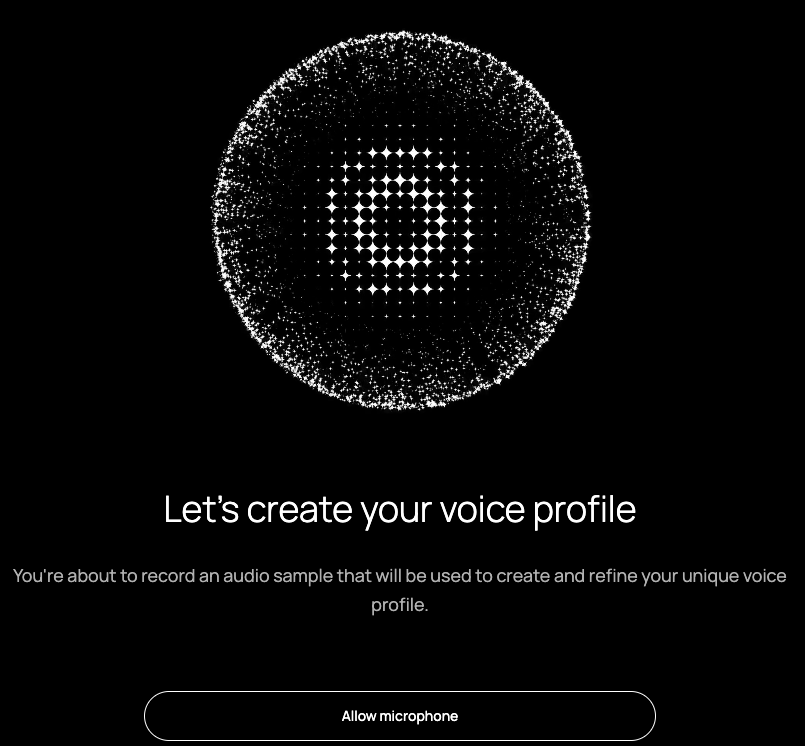
After entering the project's official website, you can complete the registration via email. Currently, there is no need to bind an encrypted wallet, which is very user-friendly for new users. The first login requires you to enable microphone permission and read a few English words.
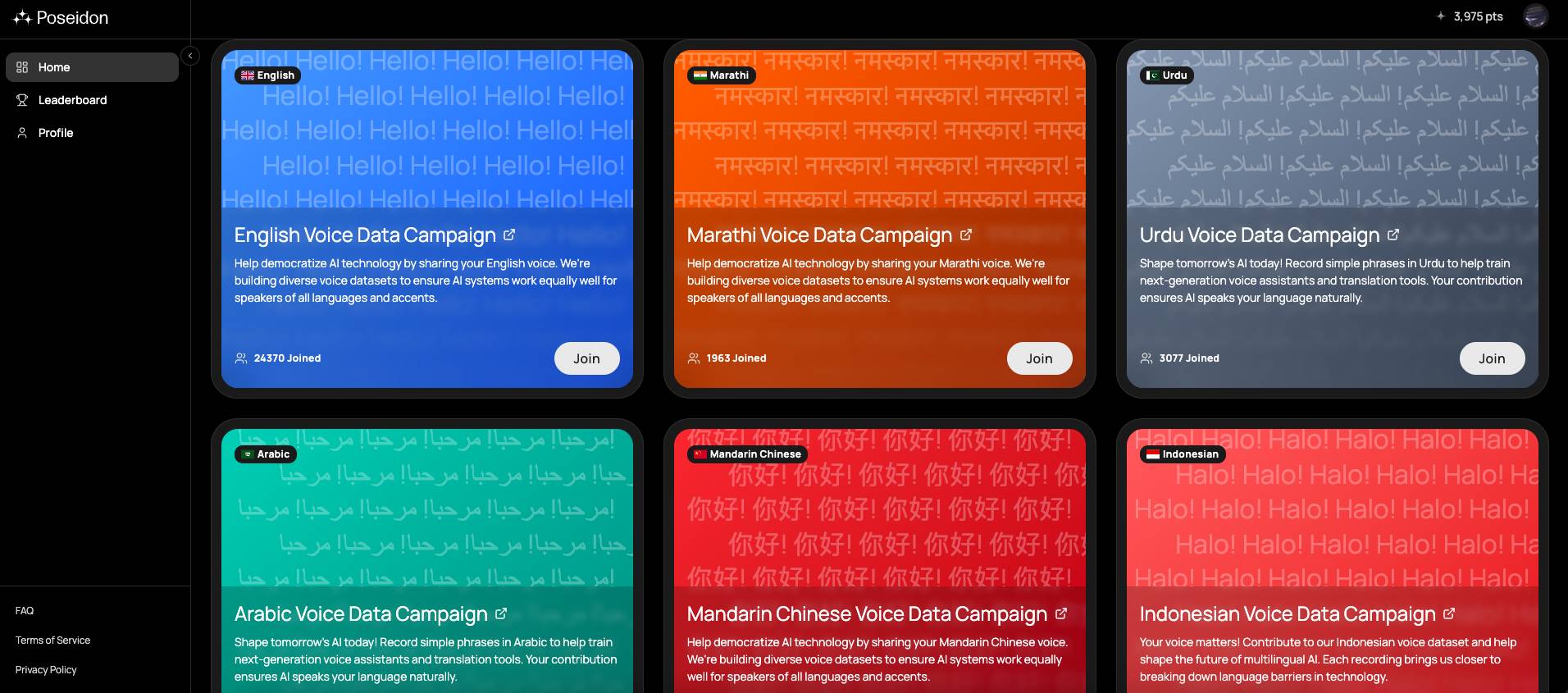
After passing, you can enter the main interface of the project and select the language you want to input in the "Home" column in the left navigation bar. Currently, Poseidon supports 16 languages including English, Chinese, German, Japanese, etc. The English language, which has the largest number of participants, has more than 24,000 users.
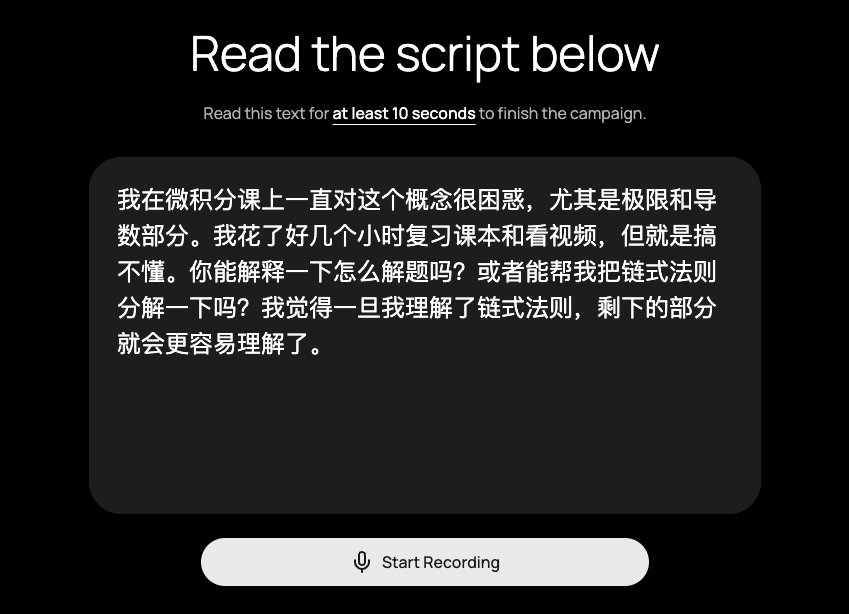
After selecting the language you want to input, you can enter the material reading interface. Click "Start Recording" to start reading. After recording for at least 10 seconds, you can click "Submitting" to submit and get 10 points.
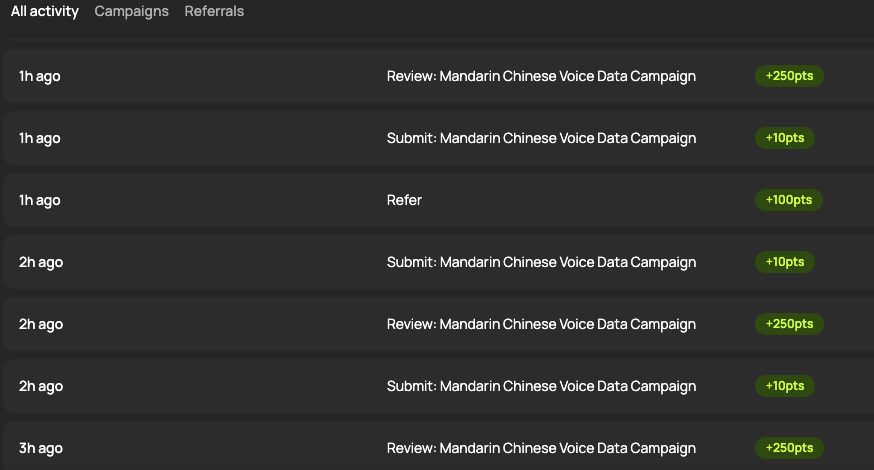
After submitting the recording, AI will conduct a voice review. If the voice review is passed, you can get an additional 50-250 points.
Points acquisition strategy

According to the current language reward information on the Poseidon website, English, which has the most participants, receives the lowest points: 10 (for submission) + 50 (for review). Other languages, including Chinese, receive 10 + 250 points. Therefore, for users in the Chinese-speaking region, choosing Chinese voice input is both simpler and more rewarding.
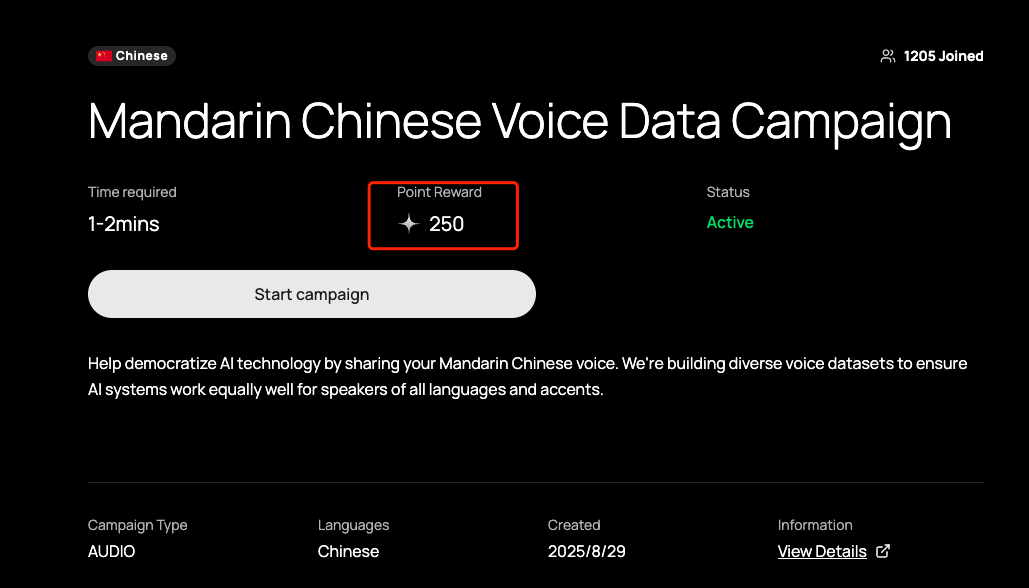
It should be noted that the daily recording submission limit is 5 times. Through active interaction (such as submitting high-quality recording content), users can obtain up to 20 recording submissions per day.

At the same time, after the author's testing, if the recording is not clear or a blank recording is submitted, the full points reward cannot be obtained, and the daily submission times will also be consumed.

Through the "Profile" interface on the left side of the official website, users can view their points acquisition details and exclusive invitation links.
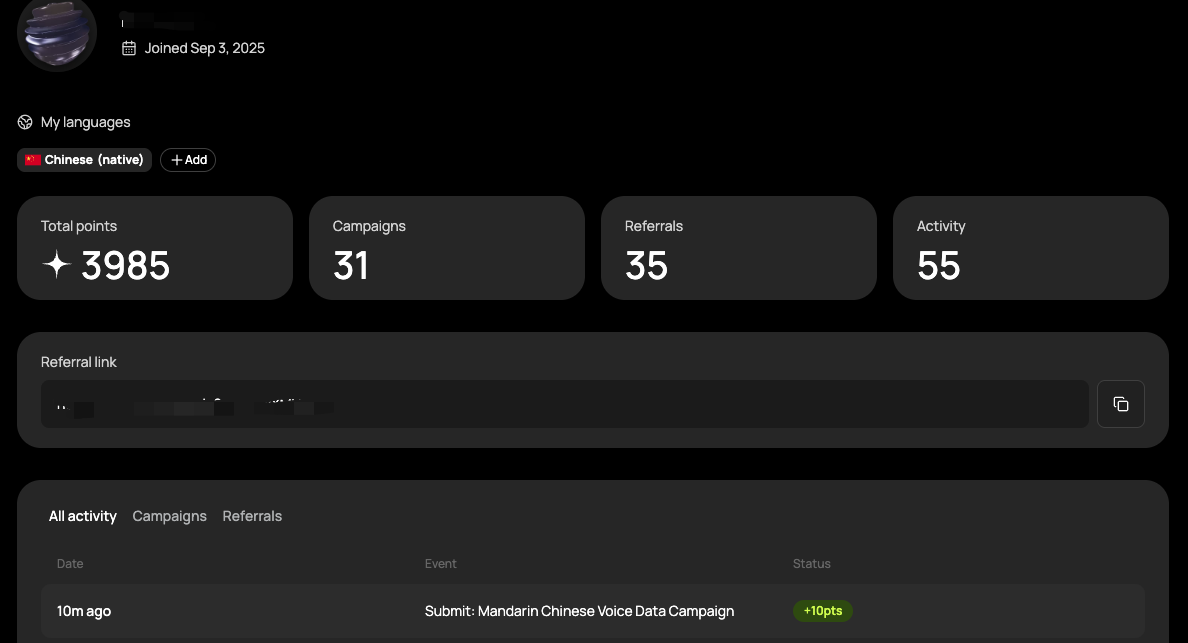
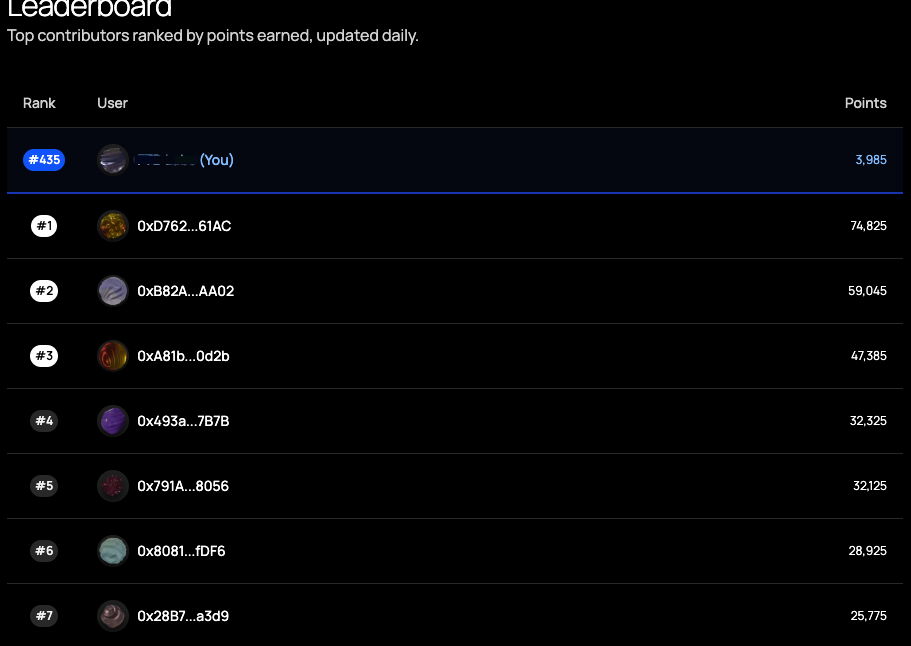
The leaderboard interface on the left navigation bar allows you to view the points rankings. It can be seen that there are not many participants at present. The author obtained a total of 3985 points in two days of interaction and ranked 435th on the leaderboard. As the number of participating users increases in the future, the competition may become more and more competitive.
Airdrop Expectations

Although Poseidon has not yet announced the token issuance time, its official website shows that points for participating in interactions will be converted into rewards or token airdrops after the token economy is determined.

With the rapid development of AI in recent years, related encryption projects have emerged in an endless stream, and the basic data for AI development is being continuously consumed. AI urgently needs high-quality voice data in real scenarios. This demand has given birth to the Poseidon project.

From the user's perspective, this may be an early opportunity with low risk and high potential. Currently, you only need to invest time and voice to obtain future airdrop expectations.

Market Opportunity
NEAR Logo
NEAR Price(NEAR)
$1.015
$1.015$1.015
-4.33%
USD
NEAR (NEAR) Live Price Chart
Disclaimer: The articles reposted on this site are sourced from public platforms and are provided for informational purposes only. They do not necessarily reflect the views of MEXC. All rights remain with the original authors. If you believe any content infringes on third-party rights, please contact service@support.mexc.com for removal. MEXC makes no guarantees regarding the accuracy, completeness, or timeliness of the content and is not responsible for any actions taken based on the information provided. The content does not constitute financial, legal, or other professional advice, nor should it be considered a recommendation or endorsement by MEXC.

You May Also Like

The Next Bitcoin Story Of 2025

The Next Bitcoin Story Of 2025

The post The Next Bitcoin Story Of 2025 appeared on BitcoinEthereumNews.com. Crypto News 18 September 2025 | 07:39 Bitcoin’s rise from obscure concept to a global asset is the playbook every serious investor pores over, and it still isn’t done writing; Bitcoin now trades above $115,000, a reminder that the life-changing runs begin before most people are even looking. T The question hanging over this cycle is simple: can a new contender compress that arc, faster, cleaner, earlier, while the window is still open for those willing to move first? Coins still on presales are the ones can repeat this story, and among those coins, an Ethereum based meme coin catches most of the attention, as it’s team look determined to make an impact in today’s market, fusing culture with working tools, with a design built to reward early movers rather than late chasers. If you’re hunting the next asymmetric shot, this is where momentum and mechanics meet, which is why many traders quietly tag this exact meme coin as the best crypto to buy now in a crowded market. Before we dive deeper, take a quick rewind through the case study every crypto desk knows by heart: how Bitcoin went from about $0.0025 to above $100,000, and turned a niche experiment into the story that still sets the bar for everything that follows. Bitcoin 2010-2025 Price History Back to first principles: a strange internet money appears in 2010 and then, step by step, rewires the entire market, Bitcoin’s arc from about $0.0025 to above $100,000 is the case study every desk still cites because it proves one coin can move the entire game. In 2009 almost no one guessed the destination; launched on January 3, 2009, Bitcoin picked up a price signal in 2010 when the pizza trade valued BTC near $0,0025 while early exchange quotes lived at fractions of…
Share
BitcoinEthereumNews2025/09/18 12:41
Strategy Defines Its Bitcoin Stress Point After Q4 Volatility

Strategy Defines Its Bitcoin Stress Point After Q4 Volatility

During Strategy’s Q4 2025 earnings call on February 5, management addressed concerns around a $17.4 billion unrealized Bitcoin loss by reframing risk around time
Share
Ethnews2026/02/06 16:16
XRP Retests $1.29 Support: Is $2 Still in Play or Will LiquidChain Capture the Momentum?

XRP Retests $1.29 Support: Is $2 Still in Play or Will LiquidChain Capture the Momentum?

Quick Facts: ➡️ XRP’s dip to $1.29 is a technical retest of support; holding here is key for a potential run toward $2.00. ➡️ Regulatory clarity (post-SEC changes
Share
Bitcoinist2026/02/06 16:33