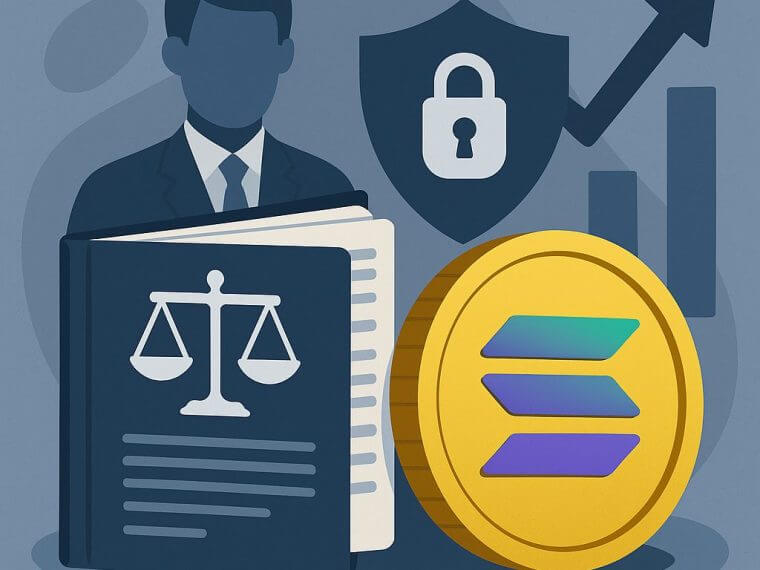
$3 billion-Anchorage Digital, the first crypto firm to secure a US national bank in 2021, has announced its support for STRK staking on Starknet. Now, STRK staking is officially live on the Anchorage Digital platform. The support allows institutions to securely custody and stake STRK. According to Starknet, “A massive milestone opening the door to […]$3 billion-Anchorage Digital, the first crypto firm to secure a US national bank in 2021, has announced its support for STRK staking on Starknet. Now, STRK staking is officially live on the Anchorage Digital platform. The support allows institutions to securely custody and stake STRK. According to Starknet, “A massive milestone opening the door to […]

$3 billion-Anchorage Digital announces its support for STRK staking on Starknet

3 min read

$3 billion-Anchorage Digital, the first crypto firm to secure a US national bank in 2021, has announced its support for STRK staking on Starknet. Now, STRK staking is officially live on the Anchorage Digital platform.

The support allows institutions to securely custody and stake STRK. According to Starknet, “A massive milestone opening the door to institutional players seeking trusted access to Starknet.”

Meanwhile, the announcement comes just two weeks after StarkNet revealed its plans to integrate Bitcoin staking into its ecosystem under proposal SNIP-31. The community approved the developments with a 93.6% vote in favor.

The integration will allow wrapped Bitcoin assets such as WBTC, LBTC, tBTC, and SolvBTC to participate in the network’s staking system. The consensus model will give Bitcoin a 25% weighting in staking power, while StarkNet’s native token STRK will hold the remaining 75%.

STRK users have regained confidence- STRK coin up 2%

The adoption follows the rollout of the Grinta upgrade, also referred to as v0.14.0. The upgrade aimed to overhaul core infrastructure with features like a decentralized sequencer, updated fee markets, and a new mempool system.

However, as reported by Cryptopolitan, the upgrade came with an unexpected outage that outraged users. Starknet’s status page says that between 2:23 AM and 4:36 AM UTC, users had gateways that weren’t working and transactions that weren’t accepted. 

Following this, developers had to reorganize the chain starting at block number 1,960,612, which erased almost an hour of network activity. Any transactions sent during that period had to be resubmitted.

That was the second time Starknet had gone down in less than two months. The network went down for 13 minutes on July 18 because of slow block creation and gateway delays. In April 2024, a rounding error problem caused a four-hour outage, which was worse than the previous one.

While developers assured users that block production had resumed and RPC providers were operational, confidence in the network’s reliability was shaken. Starknet’s native token, STRK, fell more than 3% during the downtime. However, now it is up 2.4% trading at 0.1249.

STRK price chart    Source: Coinmarketcap

Starknet’s Ethereum Layer 2 network leverages ZK-rollups with STARK proofs to speed up transactions and lower fees. The protocol has been pushing new projects, like improving the SN Stack for appchain development.

Anchorage Digital to back early on-chain protocols

On the other hand, Anchorage Digital announced its plans to get into venture capital. Applications are already available, and a review will be placed this month. Accepted candidates will have to provide a demo at Token2049 in Singapore, which will take place in the first two days of October 2025.

According to the announcement, the initiative is intended to be a “true partnership,” including hands-on help with product development, engineering, and go-to-market plans. Teams will get assistance with picking market makers and building liquidity strategies. If the protocols integrate with Anchorage later, they gain access to its institutional clients immediately.

This announcement comes after the US Office of the Comptroller of the Currency (OCC) lifted its consent order against Anchorage Digital three years after it was first issued in April 2022. The order was related to deficiencies in the crypto bank’s anti-money laundering (AML) controls and compliance with the Bank Secrecy Act (BSA). 

Meanwhile, in the first half of 2025, the company made $29.4 million in fiduciary income, showing that it is a reliable custodian for BlackRock’s spot crypto ETFs and other funds.

The smartest crypto minds already read our newsletter. Want in? Join them.

Market Opportunity
STRK Logo
STRK Price(STRK)
$0.05622
$0.05622$0.05622
-1.95%
USD
STRK (STRK) Live Price Chart
Disclaimer: The articles reposted on this site are sourced from public platforms and are provided for informational purposes only. They do not necessarily reflect the views of MEXC. All rights remain with the original authors. If you believe any content infringes on third-party rights, please contact service@support.mexc.com for removal. MEXC makes no guarantees regarding the accuracy, completeness, or timeliness of the content and is not responsible for any actions taken based on the information provided. The content does not constitute financial, legal, or other professional advice, nor should it be considered a recommendation or endorsement by MEXC.

You May Also Like

FCA komt in 2026 met aangepaste cryptoregels voor Britse markt

FCA komt in 2026 met aangepaste cryptoregels voor Britse markt

De Britse financiële waakhond, de FCA, komt in 2026 met nieuwe regels speciaal voor crypto bedrijven. Wat direct opvalt: de toezichthouder laat enkele klassieke financiële verplichtingen los om beter aan te sluiten op de snelle en grillige wereld van digitale activa. Tegelijkertijd wordt er extra nadruk gelegd op digitale beveiliging,... Het bericht FCA komt in 2026 met aangepaste cryptoregels voor Britse markt verscheen het eerst op Blockchain Stories.
Share
Coinstats2025/09/18 00:33
Cashing In On University Patents Means Giving Up On Our Innovation Future
Cashing In On University Patents Means Giving Up On Our Innovation Future

The post Cashing In On University Patents Means Giving Up On Our Innovation Future appeared on BitcoinEthereumNews.com. “It’s a raid on American innovation that would deliver pennies to the Treasury while kneecapping the very engine of our economic and medical progress,” writes Pipes. Getty Images Washington is addicted to taxing success. Now, Commerce Secretary Howard Lutnick is floating a plan to skim half the patent earnings from inventions developed at universities with federal funding. It’s being sold as a way to shore up programs like Social Security. In reality, it’s a raid on American innovation that would deliver pennies to the Treasury while kneecapping the very engine of our economic and medical progress. Yes, taxpayer dollars support early-stage research. But the real payoff comes later—in the jobs created, cures discovered, and industries launched when universities and private industry turn those discoveries into real products. By comparison, the sums at stake in patent licensing are trivial. Universities collectively earn only about $3.6 billion annually in patent income—less than the federal government spends on Social Security in a single day. Even confiscating half would barely register against a $6 trillion federal budget. And yet the damage from such a policy would be anything but trivial. The true return on taxpayer investment isn’t in licensing checks sent to Washington, but in the downstream economic activity that federally supported research unleashes. Thanks to the bipartisan Bayh-Dole Act of 1980, universities and private industry have powerful incentives to translate early-stage discoveries into real-world products. Before Bayh-Dole, the government hoarded patents from federally funded research, and fewer than 5% were ever licensed. Once universities could own and license their own inventions, innovation exploded. The result has been one of the best returns on investment in government history. Since 1996, university research has added nearly $2 trillion to U.S. industrial output, supported 6.5 million jobs, and launched more than 19,000 startups. Those companies pay…
Share
BitcoinEthereumNews2025/09/18 03:26
Trump foe devises plan to starve him of what he 'craves' most

Trump foe devises plan to starve him of what he 'craves' most

A longtime adversary of President Donald Trump has a plan for a key group to take away what Trump craves the most — attention. EX-CNN journalist Jim Acosta, who
Share
Rawstory2026/02/04 01:19