

Address Poisoning in Crypto: How the Scam Works and How to Protect Your Wallet
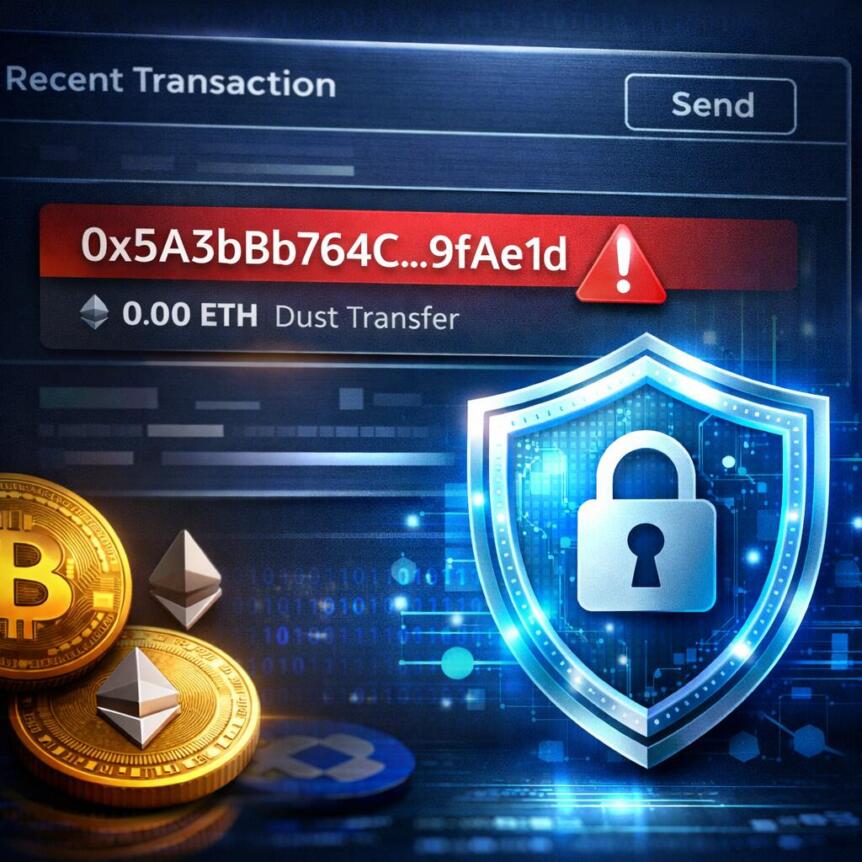
Address poisoning is reshaping risk in crypto wallets by shifting focus from private keys to how users interact with interfaces. Rather than breaking encryption, attackers exploit human habits and design flaws to misdirect funds. In 2025, a victim lost about $50 million in Tether’s USDt after copying a poisoned address. In February 2026, a phishing campaign tied to Phantom Chat drained roughly 3.5 Wrapped Bitcoin (wBTC) worth more than $264,000. These episodes underscore how small UI cues—copy buttons, visible transaction histories, and dust transfers—can seduce users into repeating trusted patterns and handing over assets they believe they are sending to legitimate contacts.
Key takeaways
- Address poisoning operates on user behavior and UI cues, not on private key theft or code flaws.
- Two high-profile losses illustrate the scale: a $50 million hit in 2025 and a February 2026 incident involving about 3.5 Wrapped Bitcoin ($WBTC) worth over $264,000.
- Copy buttons, visible transaction histories, and unfiltered dust transfers can make poisoned addresses look legitimate within wallet UIs.
- Because blockchains are permissionless, attackers can send tokens to any address, and many wallets display all incoming activity, including spam, which can seed trust in fake entries.
- Mitigations hinge on better UX and guardrails: explicit address verification, dust-filtering, proactive warnings, and recipient-address checks during sending flows.
Tickers mentioned: $USDT, $WBTC
Sentiment: Neutral
Market context: The cases underscore ongoing UX-driven security challenges in a market where on-chain activity is highly transparent and attackers increasingly target everyday user workflows. As stablecoins and tokenized assets gain prominence, wallet design and on-chain visibility will be central to risk management, alongside traditional education and phishing countermeasures.
Why it matters
The essence of address poisoning lies in the reproducible, human-centered mistakes that occur when users manage crypto transfers. Private keys remain secure in these scenarios; the vulnerability emerges when recipients or senders rely on partial address fragments or familiar transaction patterns. The attack chain typically unfolds with attackers locating valuable wallets, crafting near-identical recipient addresses, and initiating a tiny or zero-value transfer to insert their spoofed address into the victim’s recent-history view. The attacker then waits for the user to copy the address from that history and accidentally paste it into a new transfer, thereby sending funds to the wrong destination. The absence of a cryptographic breach highlights a fundamental truth: the security model of public blockchains hinges on user judgment as much as cryptography.
UX design decisions amplify the risk. Many wallets provide one-click copy buttons adjacent to recent transactions, a convenience that can backfire when spam or dusting entries appear in the same list. Investigators have long noted that victims often “trust” their own transaction history, presuming it signals legitimacy. In cases like the 2025 loss of USDt and the 2026 wBTC incident, the cost of this cognitive shortcut becomes starkly clear. The broader lesson is that user interfaces—the way addresses are displayed, verified, and confirmed—play a pivotal role in security outcomes, sometimes more so than key management alone.
Industry voices have urged wallets to adopt stronger safeguards. Tech leaders, including Changpeng “CZ” Zhao, have publicly called for enhanced protections to curb address poisoning, signaling a potential shift in wallet governance toward more rigorous recipient verification and anti-poisoning features. The tension is real: developers must balance smooth UX with robust safety checks, ensuring users can transact efficiently without becoming victims of lookalike addresses or suspicious dust transfers. In the meantime, the onus remains on users to verify destinations beyond quick-glance cues and to adopt disciplined sending practices.
At the core, the risk is not about breaking cryptography but about breaking user habits in high-friction moments—entering long addresses, approving approvals, and acting on incomplete information. The public and permissionless nature of blockchains makes every address accessible, and the legibility of transactions often lags behind the complexity of strings that represent keys and addresses. The result is a security rhythm in which attackers rely on social and UX dynamics, not on bypassing cryptographic barriers.
What address poisoning really involves
Address poisoning scams hinge on manipulating a victim’s transaction history to misdirect funds, rather than compromising keys or exploiting software vulnerabilities. The typical playbook unfolds as follows:
- Attackers first identify high-value wallets using publicly visible on-chain data.
- They generate a lookalike address that closely resembles a recipient the victim uses regularly, matching several leading and trailing characters to maximize recognizability at a glance.
- They initiate a small or zero-value transfer from the fake address to seed legitimacy and appear in the recipient’s recent activity.
- The attacker then relies on the victim copying the address from the recent transfers list when preparing a legitimate payment to someone else.
- The final step is when the victim pastes the attacker’s address and authorizes the transfer, unwittingly sending funds to the malicious destination.
The victim’s wallet and private keys remain untouched—the crypto-cryptographic layer is intact. The scam thrives on human error, habitual behavior, and trust built from familiar patterns. In some instances, the exploit is reinforced by dusting operations, where tiny transfers flood a user’s activity feed, nudging them toward interacting with suspicious entries without suspicion.
Did you know? Address poisoning scams have gained visibility in parallel with the expansion of Ethereum layer-2 networks, where reduced fees enable mass small transfers that populate users’ histories with fodder for identity-based deception.
How attackers craft deceptive addresses
Crypto addresses are long hexadecimal strings, often 42 characters on Ethereum-compatible chains. Wallets typically truncate the display to a short fragment, such as “0x85c…4b7,” which attackers exploit by constructing lookalikes with identical prefixes and suffixes while altering the middle portion. A legitimate example might read 0x742d35Cc6634C0532925a3b844Bc454e4438f44e, while an almost identical poisoned variant could appear as 0x742d35Cc6634C0532925a3b844Bc454e4438f4Ae. The strategy hinges on human visual heuristics: people rarely verify the entire string and often rely on the start and end characters to judge authenticity.
Some attackers even use vanity-address generation tools to produce thousands of near-identical strings. The social engineering angle is reinforced by dusting, where small funds accompany the malicious address to create a sense of legitimacy in a user’s transaction history. In practice, this is less about AI or cryptography and more about UX trust and careful scrutiny during each sending action.
Security researchers emphasize a key distinction: the breach lies in behavior and interface design, not in the encryption or signing process. Private keys are still the powerhouse that authorizes transactions, but they cannot verify whether the destination address is correct. The result is a paradox: the strongest security on the planet (cryptography) is undermined not by a technical flaw but by a failure to verify addresses thoroughly at the moment of sending.
Practical ways to stay safer
Because address poisoning exploits human tendencies rather than technical vulnerabilities, small but deliberate changes in how you interact with crypto wallets can markedly reduce risk. Here are practical steps for users and developers alike.
For users
- Build and maintain a verified address book or whitelist for frequent recipients, then reference it instead of retyping or copying from history.
- Always verify the full address before sending. If possible, use a character-by-character comparison or an address-checking tool.
- Avoid copying addresses from recent transaction history. If you need to, double-check the source in the list, or re-enter addresses from trusted bookmarks.
- Be wary of unsolicited small transfers that appear in your history; treat them as potential poisoning attempts and isolate them from normal activity.
For wallet developers
Design choices can dramatically reduce risk by making it harder for poisoned addresses to slip through in everyday flows. Suggested safeguards include:
- Filtering or dimming or automatically isolating very low-value (dust) transactions from typical recipient lists.
- Implementing recipient-address similarity checks that flag near-identical addresses during sending.
- Providing pre-signing simulations and risk warnings when the destination looks suspicious or matches a poisoned-pattern entry.
- Integrating on-chain checks or shared blacklists to identify and block known poisoned addresses before a user confirms a transfer.
Sources & verification
- Phantom Chat address poisoning and related bitcoin phishing details: https://cointelegraph.com/news/phantom-chat-address-poisoning-bitcoin-phishing
- General phishing attack overview in crypto: https://cointelegraph.com/learn/articles/what-is-a-phishing-attack-in-crypto-and-how-to-prevent-it
- Tether price index reference: https://cointelegraph.com/tether-price-index
- Critical observations from ZachXBT on poisoning cases: https://x.com/zachxbt/status/2021022756460966139
- Industry commentary on wallet safeguards and address poisoning: https://www.binance.com/en/square/post/34142027296314
This article was originally published as Address Poisoning in Crypto: How the Scam Works and How to Protect Your Wallet on Crypto Breaking News – your trusted source for crypto news, Bitcoin news, and blockchain updates.
You May Also Like

Will Bitcoin Soar or Stumble Next?

House Judiciary Rejects Vote To Subpoena Banks CEOs For Epstein Case
