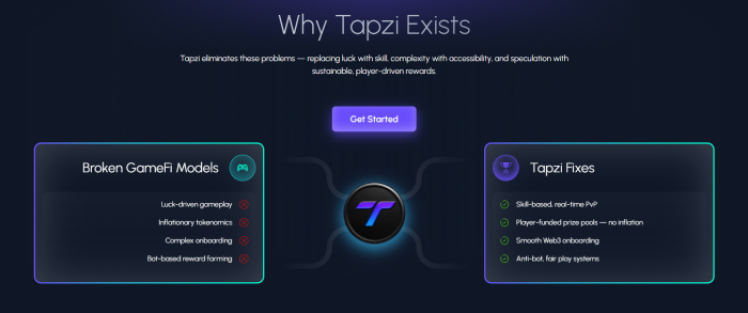
GameFi is broken – if it ever worked to begin with. Play-to-earn relied on complicated tokenomics (often inflationary), with gameplay driven largely by luck. And if you really wanted to earn more, the easiest way was by bot-powered reward farming. As a result, the GameFi sector hasn’t really gotten off the ground, mired in crappy gameplay and poor mechanics. But Tapzi ($TAPZI) could change everything, finally fulfilling GameFi’s promise. GameFi Sector Outlook: Stormy, But Rays of Light Activity in blockchain gaming has softened in recent months. DappRadar’s Q2 2025 snapshot shows daily unique active wallets (dUAW) across Web3 at 24.3M (down 2.5% quarter-over-quarter), with gaming’s share at 20% and gaming-specific dUAW down 17% quarter-over-quarter to 4.8M. Steep year-over-year funding declines and a wave of game shutdowns have been tied to weak retention and unsustainable tokenomics. But these negative stats might just be the calm before the storm. So far, the GameFi industry has stagnated due to poor games – not because of any problem with the underlying concept. And there are bright spots in the sector, too, such as the Notcoin phenomenon on TON. It pushed wallet growth and popularized simple tap-to-earn mechanics – evidence that straightforward loops and social distribution can still succeed. Another positive sign? Traditional publishers are testing on-chain features: Ubisoft rolls out Might & Magic: Fates with Immutable, and Immutable has opened ‘Immutable Play’ to Web2 studios to add on-chain rewards. Sega launched KAI: Battle of Three Kingdoms in April on the Oasys blockchain Netmarble continues to push a 2025 roadmap with seven Immutable-based blockchain games Fifa, Mythical Games, and even Cirque du Soleil are getting into Web3 games. Coming at a time when the broader market is down, these moves underscore a shift toward optional, utility-led blockchain layers rather than token-first design. And blockchain-first architecture is exactly what Tapzi offers. Tapzi: Gaming Platform and Skill-Based Winners Aware of the weaknesses of the Web3 gaming world, Tapzi sets out to solve them. One of the best crypto presales and best meme coins of 2025, Tapzi offers gasless, bot-free matches that let players stake tokens in live duels of chess, checkers, tic-tac-toe and rock-paper-scissors. The winner takes the pot, pure and simple. Tapzi’s core loop is simple: before a match of chess, checkers, rock-paper-scissors or tic-tac-toe, both players stake $TAPZI; the winner takes the prize pool. Matches are gasless (not as fees), so micro-stakes aren’t eaten by fees and are played live against human opponents (no bots). The whitepaper calls for on-chain result storage, replays and cryptographic timestamps for dispute resolution. The aim is to reward time and talent, not random number generators or loot-box dynamics. Tapzi’s not waiting around, either – a demo is already live, with gasless, real-time multiplayer and anti-bot measures to keep outcomes decided by gameplay rather than randomness or emissions. Tapzi is a platform, not just a single game. SDKs and smart-contract tools are planned so outside developers can launch skill-based titles on Tapzi’s arcade, set custom rules, and route staking-based rewards to players. That approach aligns with the sector’s tilt toward infrastructure. While simple, classic games ironically provide more reliable gameplay than many more ‘advanced’ GameFi concepts. Tapzi ($TAPZI): Future-Ready Architecture to Rejuvenate Blockchain Gaming Hold $TAPZI to enter matches, join ranked events and purchase upgrades, thereby creating in-game demand. Prize pools are player-funded (winner takes the opponent’s stake), with no additional emissions. The total supply is 5B tokens: 20% presale, 20% liquidity, 15% locked treasury, 10% for airdrops, development, marketing, and the team behind the project. An additional 5% goes towards user rewards. By delivering gasless, bot-resistant matches and verifiable results, Tapzi could ride current currents in Web3 gaming. Smaller, instantly playable loops, real stakes, and platform-first distribution drive a smooth, practiced feel to the project, in contrast to clunky interfaces of other projects. Tapzi arrives just as GameFi investors are looking for the best crypto to buy – and they’re looking for quality projects. That could explain why the presale is off to a roaring start, with tokens priced at $0.0035, with an expected listing price of $0.009. Purchase tokens with wallets like Best Wallet; crypto accepted includes $ETH, $BNB, $MATIC, $SOL, $TRX and card payments. Tapzi Launches at Perfect Time, Takes GameFi by Storm Tapzi enters a tougher, more discerning market where metrics and retention matter more than token hype. That’s perfect – Tapzi delivers the gaming experience and platform the market is looking for. Do your own research first, of course. None of this is financial advice.GameFi is broken – if it ever worked to begin with. Play-to-earn relied on complicated tokenomics (often inflationary), with gameplay driven largely by luck. And if you really wanted to earn more, the easiest way was by bot-powered reward farming. As a result, the GameFi sector hasn’t really gotten off the ground, mired in crappy gameplay and poor mechanics. But Tapzi ($TAPZI) could change everything, finally fulfilling GameFi’s promise. GameFi Sector Outlook: Stormy, But Rays of Light Activity in blockchain gaming has softened in recent months. DappRadar’s Q2 2025 snapshot shows daily unique active wallets (dUAW) across Web3 at 24.3M (down 2.5% quarter-over-quarter), with gaming’s share at 20% and gaming-specific dUAW down 17% quarter-over-quarter to 4.8M. Steep year-over-year funding declines and a wave of game shutdowns have been tied to weak retention and unsustainable tokenomics. But these negative stats might just be the calm before the storm. So far, the GameFi industry has stagnated due to poor games – not because of any problem with the underlying concept. And there are bright spots in the sector, too, such as the Notcoin phenomenon on TON. It pushed wallet growth and popularized simple tap-to-earn mechanics – evidence that straightforward loops and social distribution can still succeed. Another positive sign? Traditional publishers are testing on-chain features: Ubisoft rolls out Might & Magic: Fates with Immutable, and Immutable has opened ‘Immutable Play’ to Web2 studios to add on-chain rewards. Sega launched KAI: Battle of Three Kingdoms in April on the Oasys blockchain Netmarble continues to push a 2025 roadmap with seven Immutable-based blockchain games Fifa, Mythical Games, and even Cirque du Soleil are getting into Web3 games. Coming at a time when the broader market is down, these moves underscore a shift toward optional, utility-led blockchain layers rather than token-first design. And blockchain-first architecture is exactly what Tapzi offers. Tapzi: Gaming Platform and Skill-Based Winners Aware of the weaknesses of the Web3 gaming world, Tapzi sets out to solve them. One of the best crypto presales and best meme coins of 2025, Tapzi offers gasless, bot-free matches that let players stake tokens in live duels of chess, checkers, tic-tac-toe and rock-paper-scissors. The winner takes the pot, pure and simple. Tapzi’s core loop is simple: before a match of chess, checkers, rock-paper-scissors or tic-tac-toe, both players stake $TAPZI; the winner takes the prize pool. Matches are gasless (not as fees), so micro-stakes aren’t eaten by fees and are played live against human opponents (no bots). The whitepaper calls for on-chain result storage, replays and cryptographic timestamps for dispute resolution. The aim is to reward time and talent, not random number generators or loot-box dynamics. Tapzi’s not waiting around, either – a demo is already live, with gasless, real-time multiplayer and anti-bot measures to keep outcomes decided by gameplay rather than randomness or emissions. Tapzi is a platform, not just a single game. SDKs and smart-contract tools are planned so outside developers can launch skill-based titles on Tapzi’s arcade, set custom rules, and route staking-based rewards to players. That approach aligns with the sector’s tilt toward infrastructure. While simple, classic games ironically provide more reliable gameplay than many more ‘advanced’ GameFi concepts. Tapzi ($TAPZI): Future-Ready Architecture to Rejuvenate Blockchain Gaming Hold $TAPZI to enter matches, join ranked events and purchase upgrades, thereby creating in-game demand. Prize pools are player-funded (winner takes the opponent’s stake), with no additional emissions. The total supply is 5B tokens: 20% presale, 20% liquidity, 15% locked treasury, 10% for airdrops, development, marketing, and the team behind the project. An additional 5% goes towards user rewards. By delivering gasless, bot-resistant matches and verifiable results, Tapzi could ride current currents in Web3 gaming. Smaller, instantly playable loops, real stakes, and platform-first distribution drive a smooth, practiced feel to the project, in contrast to clunky interfaces of other projects. Tapzi arrives just as GameFi investors are looking for the best crypto to buy – and they’re looking for quality projects. That could explain why the presale is off to a roaring start, with tokens priced at $0.0035, with an expected listing price of $0.009. Purchase tokens with wallets like Best Wallet; crypto accepted includes $ETH, $BNB, $MATIC, $SOL, $TRX and card payments. Tapzi Launches at Perfect Time, Takes GameFi by Storm Tapzi enters a tougher, more discerning market where metrics and retention matter more than token hype. That’s perfect – Tapzi delivers the gaming experience and platform the market is looking for. Do your own research first, of course. None of this is financial advice.

Tapzi Launches Presale, Bets on Skill-to-Earn as Web3 Gaming Chases Sustainable Models

2025/08/19 16:13
4 min read

GameFi is broken – if it ever worked to begin with. Play-to-earn relied on complicated tokenomics (often inflationary), with gameplay driven largely by luck. And if you really wanted to earn more, the easiest way was by bot-powered reward farming.

As a result, the GameFi sector hasn’t really gotten off the ground, mired in crappy gameplay and poor mechanics.

But Tapzi ($TAPZI) could change everything, finally fulfilling GameFi’s promise.

GameFi Sector Outlook: Stormy, But Rays of Light

Activity in blockchain gaming has softened in recent months.

DappRadar’s Q2 2025 snapshot shows daily unique active wallets (dUAW) across Web3 at 24.3M (down 2.5% quarter-over-quarter), with gaming’s share at 20% and gaming-specific dUAW down 17% quarter-over-quarter to 4.8M.

Steep year-over-year funding declines and a wave of game shutdowns have been tied to weak retention and unsustainable tokenomics.
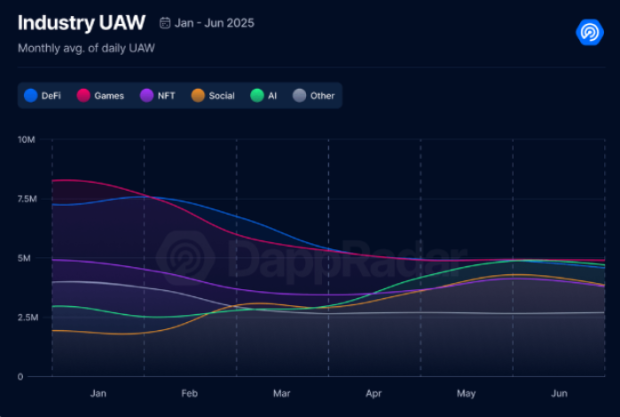
GameFi sector outlook

But these negative stats might just be the calm before the storm. So far, the GameFi industry has stagnated due to poor games – not because of any problem with the underlying concept.

And there are bright spots in the sector, too, such as the Notcoin phenomenon on TON. It pushed wallet growth and popularized simple tap-to-earn mechanics – evidence that straightforward loops and social distribution can still succeed.

Another positive sign? Traditional publishers are testing on-chain features:

  • Ubisoft rolls out Might & Magic: Fates with Immutable, and Immutable has opened ‘Immutable Play’ to Web2 studios to add on-chain rewards.
  • Sega launched KAI: Battle of Three Kingdoms in April on the Oasys blockchain
  • Netmarble continues to push a 2025 roadmap with seven Immutable-based blockchain games

Fifa, Mythical Games, and even Cirque du Soleil are getting into Web3 games. Coming at a time when the broader market is down, these moves underscore a shift toward optional, utility-led blockchain layers rather than token-first design.

And blockchain-first architecture is exactly what Tapzi offers.

Tapzi: Gaming Platform and Skill-Based Winners

Aware of the weaknesses of the Web3 gaming world, Tapzi sets out to solve them. One of the best crypto presales and best meme coins of 2025, Tapzi offers gasless, bot-free matches that let players stake tokens in live duels of chess, checkers, tic-tac-toe and rock-paper-scissors.
Tapzi presale page showing the presale widget.

The winner takes the pot, pure and simple.

Tapzi’s core loop is simple: before a match of chess, checkers, rock-paper-scissors or tic-tac-toe, both players stake $TAPZI; the winner takes the prize pool.

Matches are gasless (not as fees), so micro-stakes aren’t eaten by fees and are played live against human opponents (no bots). The whitepaper calls for on-chain result storage, replays and cryptographic timestamps for dispute resolution.

The aim is to reward time and talent, not random number generators or loot-box dynamics.

Tapzi’s not waiting around, either – a demo is already live, with gasless, real-time multiplayer and anti-bot measures to keep outcomes decided by gameplay rather than randomness or emissions.

Tapzi game dashboard

Tapzi is a platform, not just a single game. SDKs and smart-contract tools are planned so outside developers can launch skill-based titles on Tapzi’s arcade, set custom rules, and route staking-based rewards to players.

That approach aligns with the sector’s tilt toward infrastructure. While simple, classic games ironically provide more reliable gameplay than many more ‘advanced’ GameFi concepts.

Tapzi ($TAPZI): Future-Ready Architecture to Rejuvenate Blockchain Gaming

Hold $TAPZI to enter matches, join ranked events and purchase upgrades, thereby creating in-game demand. Prize pools are player-funded (winner takes the opponent’s stake), with no additional emissions.

The total supply is 5B tokens: 20% presale, 20% liquidity, 15% locked treasury, 10% for airdrops, development, marketing, and the team behind the project. An additional 5% goes towards user rewards.
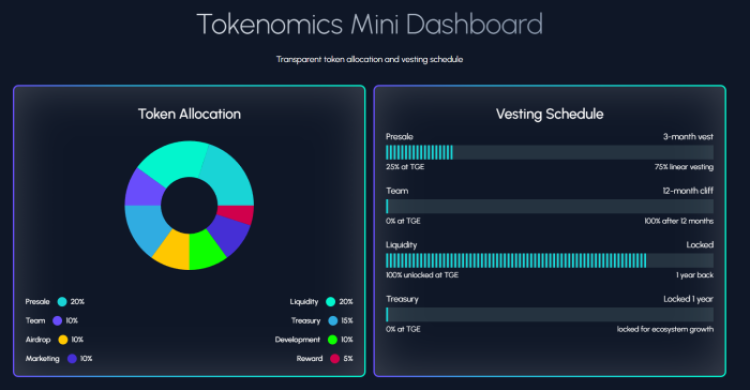
Tapzi tokenomics mini dashboard on the presale site. By delivering gasless, bot-resistant matches and verifiable results, Tapzi could ride current currents in Web3 gaming.

Smaller, instantly playable loops, real stakes, and platform-first distribution drive a smooth, practiced feel to the project, in contrast to clunky interfaces of other projects.
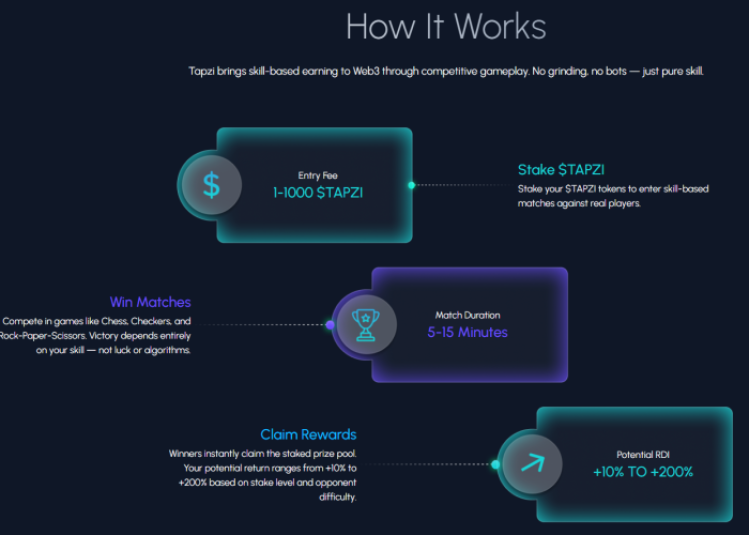
Tapzi how it works

Tapzi arrives just as GameFi investors are looking for the best crypto to buy – and they’re looking for quality projects.

That could explain why the presale is off to a roaring start, with tokens priced at $0.0035, with an expected listing price of $0.009. Purchase tokens with wallets like Best Wallet; crypto accepted includes $ETH, $BNB, $MATIC, $SOL, $TRX and card payments.

Tapzi Launches at Perfect Time, Takes GameFi by Storm

Tapzi enters a tougher, more discerning market where metrics and retention matter more than token hype.

That’s perfect – Tapzi delivers the gaming experience and platform the market is looking for.

Do your own research first, of course. None of this is financial advice.

Market Opportunity
Threshold Logo
Threshold Price(T)
$0.008074
$0.008074$0.008074
-0.73%
USD
Threshold (T) Live Price Chart
Disclaimer: The articles reposted on this site are sourced from public platforms and are provided for informational purposes only. They do not necessarily reflect the views of MEXC. All rights remain with the original authors. If you believe any content infringes on third-party rights, please contact service@support.mexc.com for removal. MEXC makes no guarantees regarding the accuracy, completeness, or timeliness of the content and is not responsible for any actions taken based on the information provided. The content does not constitute financial, legal, or other professional advice, nor should it be considered a recommendation or endorsement by MEXC.

You May Also Like

Trump MAGA statue has strange crypto backstory

Trump MAGA statue has strange crypto backstory

The post Trump MAGA statue has strange crypto backstory appeared on BitcoinEthereumNews.com. A 15-foot-tall statue of former President Donald Trump, cast in bronze
Share
BitcoinEthereumNews2026/02/04 08:22
Bitcoin 8% Gains Already Make September 2025 Its Second Best

Bitcoin 8% Gains Already Make September 2025 Its Second Best

The post Bitcoin 8% Gains Already Make September 2025 Its Second Best appeared on BitcoinEthereumNews.com. Key points: Bitcoin is bucking seasonality trends by adding 8%, making this September its best since 2012. September 2025 would need to see 20% upside to become Bitcoin’s strongest ever. BTC price volatility is at levels rarely seen before in an unusual bull cycle. Bitcoin (BTC) has gained more this September than any year since 2012, a new bull market record. Historical price data from CoinGlass and BiTBO confirms that at 8%, Bitcoin’s September 2025 upside is its second-best ever. Bitcoin avoiding “Rektember” with 8% gains September is traditionally Bitcoin’s weakest month, with average losses of around 8%. BTC/USD monthly returns (screenshot). Source: CoinGlass This year, the stakes are high for BTC price seasonality, as historical patterns demand the next bull market peak and other risk assets set repeated new all-time highs. While both gold and the S&P 500 are in price discovery, BTC/USD has coiled throughout September after setting new highs of its own the month prior. Even at “just” 8%, however, this September’s performance is currently enough to make it Bitcoin’s strongest in 13 years. The only time that the ninth month of the year was more profitable for Bitcoin bulls was in 2012, when BTC/USD gained about 19.8%. Last year, upside topped out at 7.3%. BTC/USD monthly returns. Source: BiTBO BTC price volatility vanishes The figures underscore a highly unusual bull market peak year for Bitcoin. Related: BTC ‘pricing in’ what’s coming: 5 things to know in Bitcoin this week Unlike previous bull markets, BTC price volatility has died off in 2025, against the expectations of longtime market participants based on prior performance. CoinGlass data shows volatility dropping to levels not seen in over a decade, with a particularly sharp drop from April onward. Bitcoin historical volatility (screenshot). Source: CoinGlass Onchain analytics firm Glassnode, meanwhile, highlights the…
Share
BitcoinEthereumNews2025/09/18 11:09
The real-life inspiration for the protagonist of "The Big Short": Bitcoin crash may trigger a $1 billion gold and silver sell-off.

The real-life inspiration for the protagonist of "The Big Short": Bitcoin crash may trigger a $1 billion gold and silver sell-off.

PANews reported on February 4th that, according to CoinDesk, Michael Burry, the real-life inspiration for the character in "The Big Short" (and an investor who
Share
PANews2026/02/04 08:22