Bitcoin continues to trade below the $80,000 level as the market remains under sustained selling pressure and heightened uncertainty. Recent price action reflectsBitcoin continues to trade below the $80,000 level as the market remains under sustained selling pressure and heightened uncertainty. Recent price action reflects

Bitcoin LTH Profit-Taking Collapses: Is Smart Money Done Selling?

2026/02/04 10:00
4 min read

Bitcoin continues to trade below the $80,000 level as the market remains under sustained selling pressure and heightened uncertainty. Recent price action reflects a fragile environment in which downside moves are met with limited conviction from buyers, while broader risk sentiment across crypto stays defensive. As volatility persists, analysts are increasingly focused on on-chain indicators to assess whether the market is approaching exhaustion—or if further downside still lies ahead.

A new report from CryptoQuant highlights a notable deterioration in holder profitability through the Spent Output Profit Ratio (SOPR), which has fallen to its lowest levels of the past year. The SOPR measures whether coins being spent are moving at a profit or a loss, offering insight into the behavior of different investor cohorts during periods of stress.

One key observation is the convergence between long-term holders (LTHs) and short-term holders (STHs). The SOPR ratio has dropped sharply toward the critical 1.0 level, indicating that long-term holders are realizing significantly less profit than before—or are choosing to stop selling altogether at current prices. This behavior suggests a growing reluctance to distribute coins into weakness, even as short-term participants continue to face losses.

With Bitcoin still below key psychological levels, the evolution of SOPR will be closely watched. Whether this shift marks early stabilization or simply a pause before deeper capitulation remains an open question for the weeks ahead.

SOPR Signals Selling Exhaustion, Not Capitulation

The report adds that Bitcoin’s recent price action closely mirrors the deterioration seen in SOPR. The price (black line) has reached a local low near $77,900. Aligning with the sharp drop in the ratio toward its lowest levels of the past year. This synchronization suggests that realized selling pressure has intensified alongside the decline in profitability, reinforcing the view that the market has moved into a stress phase rather than a routine pullback.

Bitcoin SOPR Ratio | Source: CryptoQuant

From a sentiment perspective, historically depressed SOPR readings have often coincided with moments when so-called “smart money” reduces selling activity. When coins are no longer being spent at a meaningful profit, long-term holders tend to step back, allowing selling pressure to subside. In past cycles, similar conditions have preceded periods of accumulation or the formation of local market floors. Although timing has varied widely.

Two scenarios now stand out. If the SOPR stabilizes around the 1.0 level, it would suggest that heavy distribution from long-term investors is largely exhausted. Creating room for a relief bounce as marginal demand returns. Alternatively, the steep, momentum-driven drop in price increases the likelihood of extended sideways consolidation, as the market digests recent volatility before establishing a clearer trend.

In summary, the data points to a flush market. With SOPR at yearly lows, weaker hands appear to have exited, shifting the balance toward longer-term value considerations over short-term fear.

Bitcoin Struggles Below Key Averages

Bitcoin’s weekly chart highlights a market under sustained pressure, despite a modest rebound off recent lows. Price is currently hovering around the $78,000 area after briefly dipping toward the mid-$70,000s, a zone that has acted as an important short-term demand pocket. This bounce, however, has so far lacked follow-through and does not yet signal a structural trend reversal.
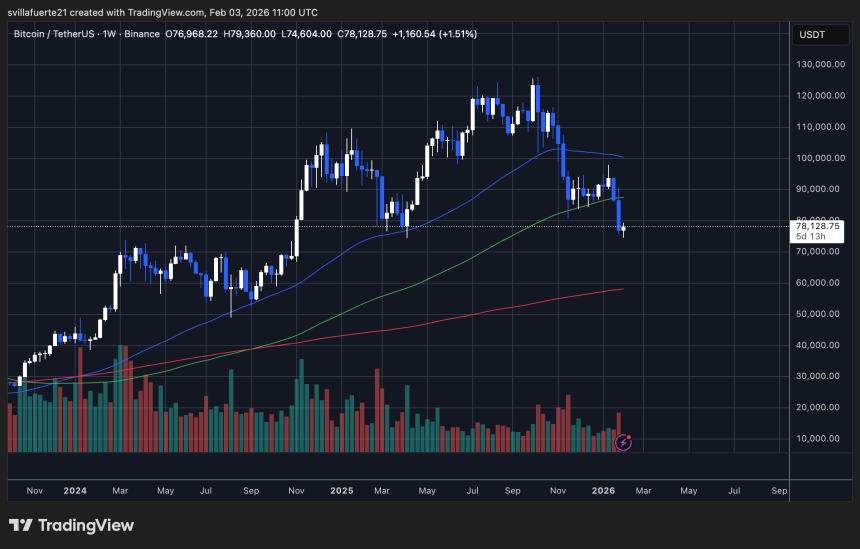
BTC testing fresh demand | Source: BTCUSDT chart on TradingView

From a technical perspective, Bitcoin remains below its major moving averages. The price is trading well under the 100-day and 200-day averages, both of which are now sloping downward. This configuration reinforces the broader bearish bias and suggests that rallies are still being sold into rather than accumulated aggressively. The prior support region between $85,000 and $90,000 has clearly flipped into resistance. Confirming a change in market structure compared to late 2025.

The sell-off into the $74,000–$76,000 range was accompanied by elevated volume. The subsequent rebound has occurred on comparatively lighter participation. This divergence implies short-covering or tactical buying rather than renewed conviction from longer-term investors.

Structurally, Bitcoin appears to be transitioning from a distribution phase into a consolidation or corrective regime. As long as the price remains below reclaimed resistance and fails to regain key moving averages, downside risks remain active.

Featured image from ChatGPT, chart from TradingView.com 

Disclaimer: The articles reposted on this site are sourced from public platforms and are provided for informational purposes only. They do not necessarily reflect the views of MEXC. All rights remain with the original authors. If you believe any content infringes on third-party rights, please contact service@support.mexc.com for removal. MEXC makes no guarantees regarding the accuracy, completeness, or timeliness of the content and is not responsible for any actions taken based on the information provided. The content does not constitute financial, legal, or other professional advice, nor should it be considered a recommendation or endorsement by MEXC.

You May Also Like

Three dormant wallets, suspected to belong to the same entity, purchased 5,970 ETH eight hours ago.
Three dormant wallets, suspected to belong to the same entity, purchased 5,970 ETH eight hours ago.

PANews reported on February 4 that, according to Lookonchain monitoring, three wallets that had been dormant for four years (likely controlled by the same entity
Share
PANews2026/02/04 11:36
NVIDIA Stock Price Analysis as OpenAI Issues Concerns About its Chips

NVIDIA Stock Price Analysis as OpenAI Issues Concerns About its Chips

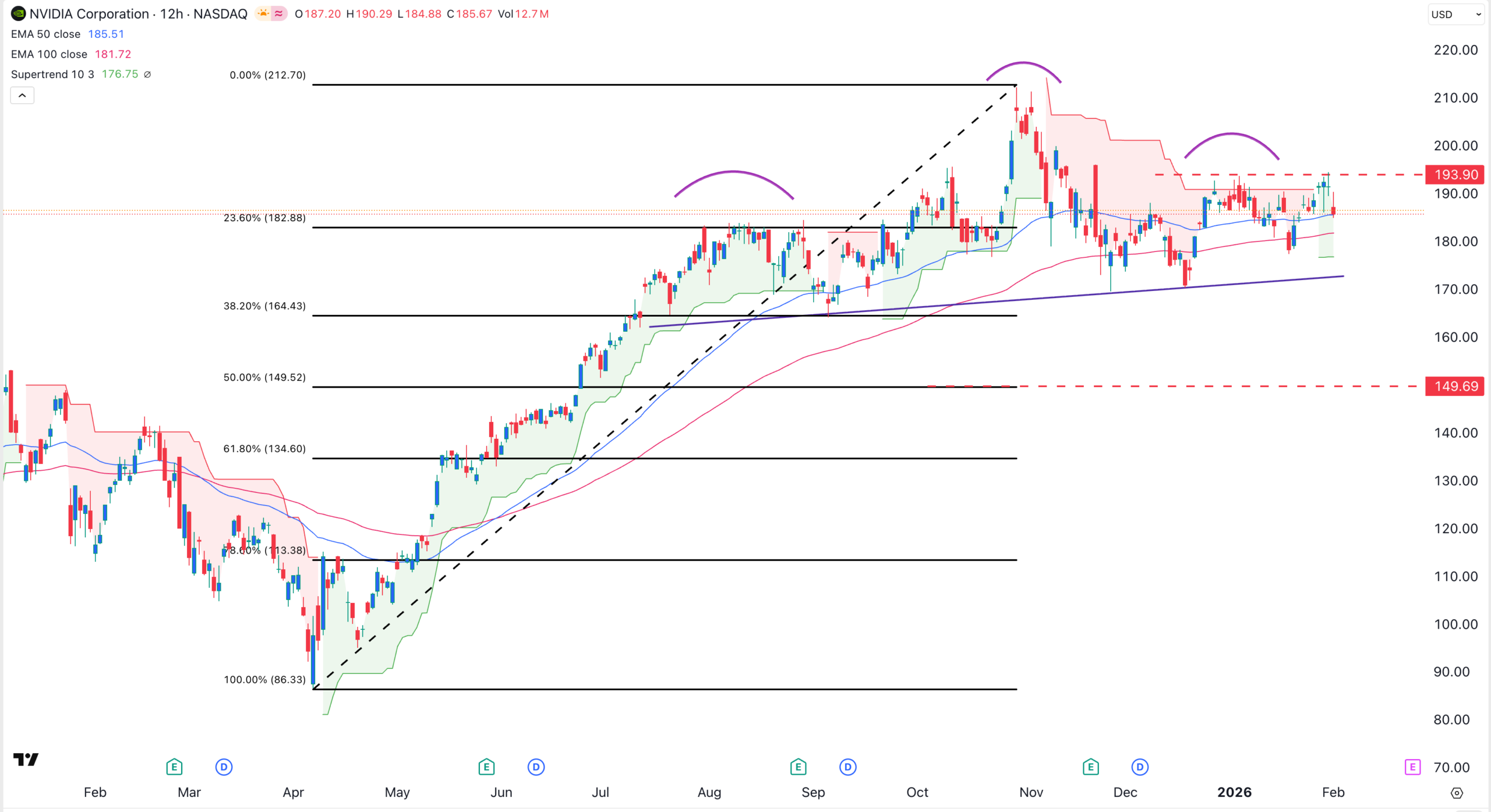
Key Insights NVIDIA stock started the week in the red. It crashed by over 2%. Meanwhile, the S&P 500, Dow Jones, and Nasdaq 100 moved close to their all-time highs
Share
Themarketperiodical2026/02/04 11:27
Ondo Finance Launches USDY Yieldcoin on Stellar, Bringing Tokenized U.S. Treasuries to Users

Ondo Finance Launches USDY Yieldcoin on Stellar, Bringing Tokenized U.S. Treasuries to Users

Ondo Finance, a U.S.-based digital asset firm specializing in bringing traditional financial products on-chain through tokenization, is expanding its yieldcoin USDY to the Stellar network. This lates update marks a step forward in merging tokenized real-world assets with a global payments infrastructure, unlocking new opportunities for users worldwide. The announcement was made at the Stellar Meridian event in Copacabana, Rio de Janeiro, on September 17. USDY Joins the Stellar Ecosystem Ondo Finance, a recognized leader in tokenized real-world assets, announced the deployment of United States Dollar Yield (USDY) on Stellar, the payments-focused blockchain known for speed and low transaction costs. USDY is the most widely available “yieldcoin,” offering investors access to onchain assets backed by U.S. Treasuries. This launch allows Stellar’s global user base to tap into permissionless, yield-bearing assets tied to one of the safest financial instruments in the world. It also aligns with Stellar’s mission of driving fast, affordable cross-border payments. Combining Yield with Payments Infrastructure “Stablecoins unlocked global access to the U.S. dollar. With USDY, we’re taking the next step by bringing U.S. Treasuries onchain in a form that combines stability, liquidity, and yield,” said Ian De Bode, Chief Strategy Officer at Ondo Finance. “Fast, affordable cross-border payments are at the center of what Stellar was designed to do. The global reach of the Stellar ecosystem combined with a yield-bearing asset like USDY levels up what is possible onchain, allowing wallets and businesses to offer yield opportunities to their users,” said Denelle Dixon, CEO of the Stellar Development Foundation. Ondo claims by pairing USDY with Stellar’s infrastructure, new possibilities open up in treasury management, collateralization, and everyday financial applications. Unlocking Institutional and Retail Use Cases USDY currently manages over $650 million in total value locked (TVL) across nine blockchains and offers a 5.3% APY. By launching on Stellar, Ondo Finance extends these benefits to global retail and institutional users. The firm explains balances on Stellar can now become productive, supporting use cases such as onchain savings, institutional treasury strategies, cost-efficient collateral for DeFi protocols, and remittance flows that carry yield rather than remaining static. A Milestone for Tokenized Treasuries With the integration of USDY, Stellar users gain more than just access to stable-value assets—they gain access to institutional-grade yield. For investors outside the U.S., the launch represents a new way to combine the safety of Treasuries with the accessibility of blockchain technology. As tokenization accelerates globally, Ondo Finance’s decision to deploy USDY on Stellar reinforces the narrative that blockchain is not just about speculation, but about reimagining the global financial system through secure, yield-bearing digital assets
Share
CryptoNews2025/09/18 00:46
