Pi Network news today has issued a fresh warning to its community about scam emails and fake messages. The Pi team said it will never contact users by email aboutPi Network news today has issued a fresh warning to its community about scam emails and fake messages. The Pi team said it will never contact users by email about

Pi Network Warns Users Against Email Scams and Passphrase Theft

3 min read

Pi Network news today has issued a fresh warning to its community about scam emails and fake messages. The Pi team said it will never contact users by email about wallet migration. It will also never ask for a passphrase. The alert appears as more users approach mainnet and complete KYC. Scammers are trying to copy official messages to deceive users into getting access. Pi leaders asked Pioneers to be cautious and report any strange requests.

Pi Says It Will Never Ask for Your Passphrase

Pi community says that Pi Network doesn’t send emails about wallet migration. They don’t ask for private keys or passphrases. Any message which claim that is a scam. The Pi team said some scammers pretend to be support staff. They send links that look real but once users click and enter details, the wallet is lost.

Because many people are now moving to mainnet, scammers see a chance. They target those who are unsure about the process itself. Pi team requested that users should only check their messages via the official app. Additionally, they asked the community to warn the users.

Palm Print KYC Moves Into Beta Testing

Will this the Pi Network is testing a new feature for palm print verification. This tool adds another way of identity verification, it doesn’t take the place of all checks. But it can be useful in situations where additional security is required. The goal is to increase privacy and reduce account theft. Palm print checks can help with account recovery and password reset. In the future, they might also support two-factor security.

For now, only a small group of KYC users can test it. The team will study results before wider use. Additionally, Pi Network said that KYC validator rewards are currently on schedule. The system is now being tested and if everything goes well. The rewards will be sent by the end of March 2026.

More Users Get Access to KYC and Mainnet

Pi Network also shared an update about migration progress. Around 2.5 million previously blocked users can now access the mainnet. These users passed the new security and compliance checks. If they are active and meet the criteria. Their balances will automatically move.

Over 700k more users will be able to submit KYC forms in the coming weeks. Some accounts may still need more review. This depends on prior activities and regional laws. Pi team stated that it lifts blocks in batches, each batch requires its own technical fix. This slow method adds to the network’s protection against abuse.

Why This Update Matters for Pioneers

These updates show two sides of Pi Network. One is growth, more users are joining the mainnet and KYC spots are opening. On the other hand it is safety. When major updates happen, scams become more frequent. Pi wants users to rely on the app, not on private messages or emails. The lesson is clear for Pioneers. Never click on unknown links or share your passphrase and check the Pi app for updates. As the network grows, security will become more important than speed.

The post Pi Network Warns Users Against Email Scams and Passphrase Theft appeared first on Coinfomania.

Disclaimer: The articles reposted on this site are sourced from public platforms and are provided for informational purposes only. They do not necessarily reflect the views of MEXC. All rights remain with the original authors. If you believe any content infringes on third-party rights, please contact service@support.mexc.com for removal. MEXC makes no guarantees regarding the accuracy, completeness, or timeliness of the content and is not responsible for any actions taken based on the information provided. The content does not constitute financial, legal, or other professional advice, nor should it be considered a recommendation or endorsement by MEXC.

You May Also Like

Victra Named 2025 Recipient of Verizon’s Best Build Compliance Award
Victra Named 2025 Recipient of Verizon’s Best Build Compliance Award

Verizon Recognizes Victra for Industry-Leading Excellence in Store Design and Brand Compliance. RALEIGH, N.C., Feb. 3, 2026 /PRNewswire/ — Verizon has named Victra
Share
AI Journal2026/02/03 20:49
Stablecoins could face yield compression after Fed’s rate cut

Stablecoins could face yield compression after Fed’s rate cut

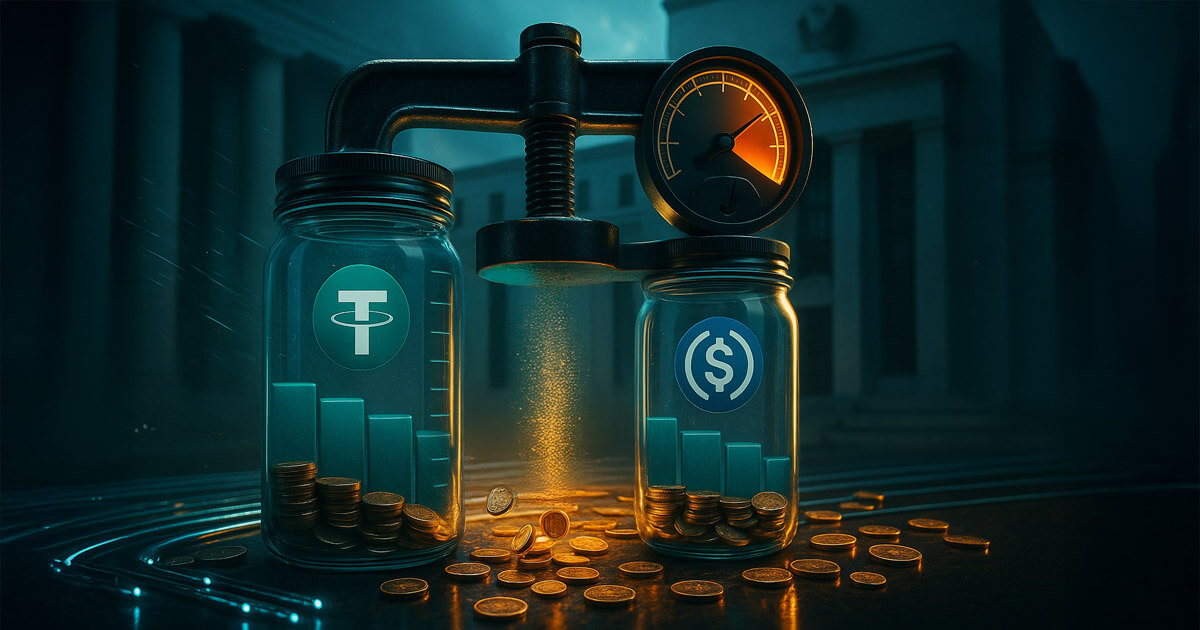
The post Stablecoins could face yield compression after Fed’s rate cut appeared on BitcoinEthereumNews.com. The Federal Reserve reduced its policy rate by 25 basis points to 4.00%–4.25%, the first rate cut this year. The move, framed as a response to weakening labor data, signals the start of a cautious easing cycle. Projections show two more cuts possible before year-end, with further reductions likely in 2026. Inflation remains above target, but Chairman Jerome Powell emphasized risk management over immediate price control, prioritizing stability in employment conditions. Stablecoins will be quickly affected by this. Issuers like Tether and Circle have generated large profits by holding reserves in short-term Treasuries during the high-rate environment of the past two years. That income stream now begins to erode. DeFi protocols that offered tokenized Treasury exposure face the same squeeze, with returns set to fall further if the Fed continues cutting into next year. A multi-cut easing cycle could substantially reduce stablecoin profitability, forcing issuers and protocols to adapt. The decline in dollar yields also alters the balance between holding stablecoins passively and seeking higher returns in risk assets. Bitcoin benefits most from this reallocation. As nominal rates move lower and inflation remains sticky, real yields decline, making non-yielding assets more attractive. The weaker dollar and improving risk appetite amplify the effect, positioning Bitcoin as a relative winner of the Fed’s shift. The September cut is modest, but it could bring significant changes to the crypto market. Stablecoin models built on Treasury income face structural headwinds after the rate cut, while Bitcoin and other high-beta assets stand to gain from falling real yields and increased liquidity. The Fed has opened an easing cycle, and crypto’s internal capital flows will move with it. The post Stablecoins could face yield compression after Fed’s rate cut appeared first on CryptoSlate. Source: https://cryptoslate.com/insights/stablecoins-could-face-yield-compression-after-feds-rate-cut/
Share
BitcoinEthereumNews2025/09/18 19:31
Wormhole Jumps 11% on Revised Tokenomics and Reserve Initiative

Wormhole Jumps 11% on Revised Tokenomics and Reserve Initiative

The post Wormhole Jumps 11% on Revised Tokenomics and Reserve Initiative appeared on BitcoinEthereumNews.com. Cross-chain bridge Wormhole plans to launch a reserve funded by both on-chain and off-chain revenues. Wormhole, a cross-chain bridge connecting over 40 blockchain networks, unveiled a tokenomics overhaul on Wednesday, hinting at updated staking incentives, a strategic reserve for the W token, and a smoother unlock schedule. The price of W jumped 11% on the news to $0.096, though the token is still down 92% since its debut in April 2024. W Chart In a blog post, Wormhole said it’s planning to set up a “Wormhole Reserve” that will accumulate on-chain and off-chain revenues “to support the growth of the Wormhole ecosystem.” The protocol also said it plans to target a 4% base yield for governance stakers, replacing the current variable APY system, noting that “yield will come from a combination of the existing token supply and protocol revenues.” It’s unclear whether Wormhole will draw from the reserve to fund this target. Wormhole did not immediately respond to The Defiant’s request for comment. Wormhole emphasized that the maximum supply of 10 billion W tokens will remain the same, while large annual token unlocks will be replaced by a bi-weekly distribution beginning Oct. 3 to eliminate “moments of concentrated market pressure.” Data from CoinGecko shows there are over 4.7 billion W tokens in circulation, meaning that more than half the supply is yet to be unlocked, with portions of that supply to be released over the next 4.5 years. Source: https://thedefiant.io/news/defi/wormhole-jumps-11-on-revised-tokenomics-and-reserve-initiative
Share
BitcoinEthereumNews2025/09/18 01:31