Koko Networks, a Kenyan climate tech startup once touted as a major solution to clean cooking in Africa,… The post Kenyan climate startup Koko shuts down after $Koko Networks, a Kenyan climate tech startup once touted as a major solution to clean cooking in Africa,… The post Kenyan climate startup Koko shuts down after $

Kenyan climate startup Koko shuts down after $60m debt crisis

Koko Networks, a Kenyan climate tech startup once touted as a major solution to clean cooking in Africa, has shut down operations after accumulating more than $60 million in debt. The company confirmed the closure to staff on Friday, laying off about 700 employees with immediate effect.

Founded in 2014, Koko established a fuel distribution network that enabled low-income households to transition from charcoal to bioethanol, a cleaner and more sustainable alternative. Over the years, it rolled out thousands of automated fuel dispensers across Kenya and served more than one million households.

But the business collapsed after regulatory delays cut off its main source of funding, carbon credits, leaving the company unable to cover operating costs or repay lenders.

Kenyan climate startup Koko shuts down after $60m debt crisis
When carbon money stopped flowing

Koko made money by selling carbon credits from households using cleaner fuel. That money helped lower stove and fuel prices. But the government never approved international credit trading, so the system failed.

Approval was never granted. As delays continued, Koko faced increasing difficulty covering the gap between customer payments and supply chain costs. With cash flow diminishing, lenders secured their loans and tightened control over company assets well before the shutdown.

Also read: Nigeria’s clean cooking challenge goes beyond stoves – BURN

Koko’s collapse is significant because it was one of Africa’s most recognised clean cooking startups, having raised substantial funding and received support from global climate funds. Its failure raises concerns about the viability of climate startups that rely heavily on government-supported carbon markets.

Kenyan climate startup Koko shuts down after $60m debt crisis

It also highlights the practical fragility of carbon financing. Despite growing demand for cleaner energy, regulatory uncertainty can still derail large-scale projects intended to benefit low-income communities.

What Koko’s shutdown leaves behind

Koko’s collapse is significant because it was one of Africa’s most recognised clean cooking startups, having raised substantial funding and received support from global climate funds. Its failure raises concerns about the viability of climate startups that rely heavily on government-supported carbon markets.

For households, the immediate impact is practical: over one million Kenyan families now face uncertainty around access to affordable cooking fuel, with many likely forced back to charcoal, which is dirtier and more expensive over time.

For investors and lenders, the focus has shifted to recovering losses. Koko owes more than $60 million, and although its backers hold insurance guarantees, any payout could take years due to legal and regulatory processes.

Kenyan climate startup Koko shuts down after $60m debt crisis

The shutdown in Kenya serves as a warning to African climate tech founders that even well-funded solutions can fail without aligned government policy, financing, and infrastructure.

Koko’s rise and fall now stand as one of the clearest examples of how hard it remains to turn climate innovation into sustainable business, especially when entire models depend on carbon markets that are still evolving.

The post Kenyan climate startup Koko shuts down after $60m debt crisis first appeared on Technext.

Disclaimer: The articles reposted on this site are sourced from public platforms and are provided for informational purposes only. They do not necessarily reflect the views of MEXC. All rights remain with the original authors. If you believe any content infringes on third-party rights, please contact service@support.mexc.com for removal. MEXC makes no guarantees regarding the accuracy, completeness, or timeliness of the content and is not responsible for any actions taken based on the information provided. The content does not constitute financial, legal, or other professional advice, nor should it be considered a recommendation or endorsement by MEXC.

You May Also Like

Shocking OpenVPP Partnership Claim Draws Urgent Scrutiny

Shocking OpenVPP Partnership Claim Draws Urgent Scrutiny

The post Shocking OpenVPP Partnership Claim Draws Urgent Scrutiny appeared on BitcoinEthereumNews.com. The cryptocurrency world is buzzing with a recent controversy surrounding a bold OpenVPP partnership claim. This week, OpenVPP (OVPP) announced what it presented as a significant collaboration with the U.S. government in the innovative field of energy tokenization. However, this claim quickly drew the sharp eye of on-chain analyst ZachXBT, who highlighted a swift and official rebuttal that has sent ripples through the digital asset community. What Sparked the OpenVPP Partnership Claim Controversy? The core of the issue revolves around OpenVPP’s assertion of a U.S. government partnership. This kind of collaboration would typically be a monumental endorsement for any private cryptocurrency project, especially given the current regulatory climate. Such a partnership could signify a new era of mainstream adoption and legitimacy for energy tokenization initiatives. OpenVPP initially claimed cooperation with the U.S. government. This alleged partnership was said to be in the domain of energy tokenization. The announcement generated considerable interest and discussion online. ZachXBT, known for his diligent on-chain investigations, was quick to flag the development. He brought attention to the fact that U.S. Securities and Exchange Commission (SEC) Commissioner Hester Peirce had directly addressed the OpenVPP partnership claim. Her response, delivered within hours, was unequivocal and starkly contradicted OpenVPP’s narrative. How Did Regulatory Authorities Respond to the OpenVPP Partnership Claim? Commissioner Hester Peirce’s statement was a crucial turning point in this unfolding story. She clearly stated that the SEC, as an agency, does not engage in partnerships with private cryptocurrency projects. This response effectively dismantled the credibility of OpenVPP’s initial announcement regarding their supposed government collaboration. Peirce’s swift clarification underscores a fundamental principle of regulatory bodies: maintaining impartiality and avoiding endorsements of private entities. Her statement serves as a vital reminder to the crypto community about the official stance of government agencies concerning private ventures. Moreover, ZachXBT’s analysis…
Share
BitcoinEthereumNews2025/09/18 02:13
Telos Advisers Welcomes Stephen Gardner as a Strategic Advisory Board Member
Telos Advisers Welcomes Stephen Gardner as a Strategic Advisory Board Member

Former Amtrak CEO brings more than 25 years of leadership experience in rail, infrastructure delivery, and national transportation policy NEWARK, N.J.–(BUSINESS
Share
AI Journal2026/02/03 02:16
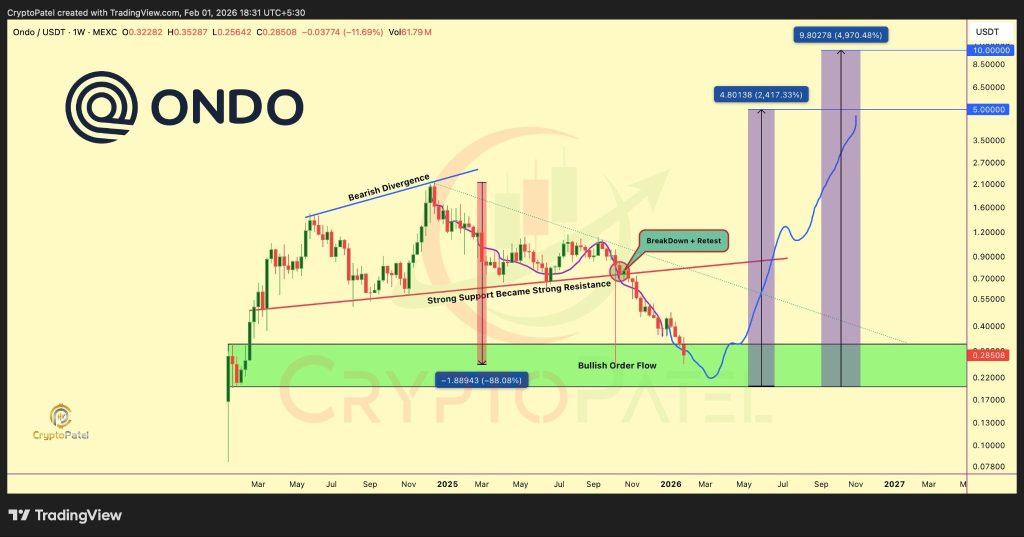
ONDO Price Crashes 88% From All-Time Highs, But Analyst Says ‘Last Hope’ Zone Is Here

ONDO Price Crashes 88% From All-Time Highs, But Analyst Says ‘Last Hope’ Zone Is Here

The ONDO price has drifted into a part of the chart that usually gets traders paying attention. After months of downside, the price is now sitting inside a zone
Share
Captainaltcoin2026/02/03 02:30
