TRM Labs says North Korean IT workers have laundered millions in USDC and USDT while secretly working for blockchain startups. North Korea continues to rely on crypto to quietly fund its weapons programs and the U.S. government is stepping up…TRM Labs says North Korean IT workers have laundered millions in USDC and USDT while secretly working for blockchain startups. North Korea continues to rely on crypto to quietly fund its weapons programs and the U.S. government is stepping up…

Here’s how North Korean hackers are still getting paid in crypto despite sanctions

4 min read

TRM Labs says North Korean IT workers have laundered millions in USDC and USDT while secretly working for blockchain startups.

North Korea continues to rely on crypto to quietly fund its weapons programs and the U.S. government is stepping up efforts to shut it down. On July 8, the U.S. Treasury’s Office of Foreign Assets Control sanctioned a North Korean hacker, Song Kum Hyok, who they say helped organize a widespread scheme involving fake remote workers at unsuspecting tech and crypto companies.

According to a recent report from blockchain forensic firm TRM Labs, Song was linked to Andariel, a cybercrime unit that’s part of North Korea’s military intelligence. They explained that he played a key role in placing IT workers — most of whom were actually North Korean operatives — into jobs at U.S. companies by using stolen American identities and fake documents.

Many of these jobs were in web3, crypto infrastructure, or blockchain-related software development.

TRM Labs said these workers operated from countries like China and Russia while pretending to be U.S.-based freelancers. They got paid in stablecoins such as USD Coin (USDC) and Tether (USDT). From there, the money appeared to have flowed through layers of wallets, mixers, and conversion services before ending up in the hands of the North Korean regime.

Analysts at TRM Labs pointed out that this is just the latest sign that North Korea’s Reconnaissance General Bureau — the same agency behind Lazarus and Bluenoroff — is still using cyber tactics to support military goals. Treasury officials, they noted, have been warning that crypto theft and identity fraud remain central to North Korea’s strategy for avoiding economic pressure.

The analysts explained that the scheme uncovered by OFAC relies heavily on fake personas. Song was allegedly responsible for building those fake identities, using stolen data from real U.S. citizens. Once hired, North Korean operatives may have worked for months or even years in U.S. companies under false names.

They also noted that OFAC sanctioned four companies and one other person connected to a Russia-based network that allegedly helped manage these fake IT jobs. These businesses reportedly signed long-term contracts with DPRK-linked firms and were aware they were dealing with North Korean workers.

Many of the workers targeted jobs in the crypto sector specifically, where payments were easier to anonymize. Once the crypto was received, TRM Labs analysts said, it was spread across several wallets and eventually converted into fiat using OTC brokers, some of whom have been previously sanctioned.

Cyber alliance

The latest OFAC’s action followed a series of coordinated moves by U.S. agencies, including the Department of Justice and the FBI. On June 5, 2025, the DOJ also filed a civil forfeiture complaint seeking to seize over $7.7 million in crypto, NFTs, and other digital assets believed to be linked to the same North Korean network.

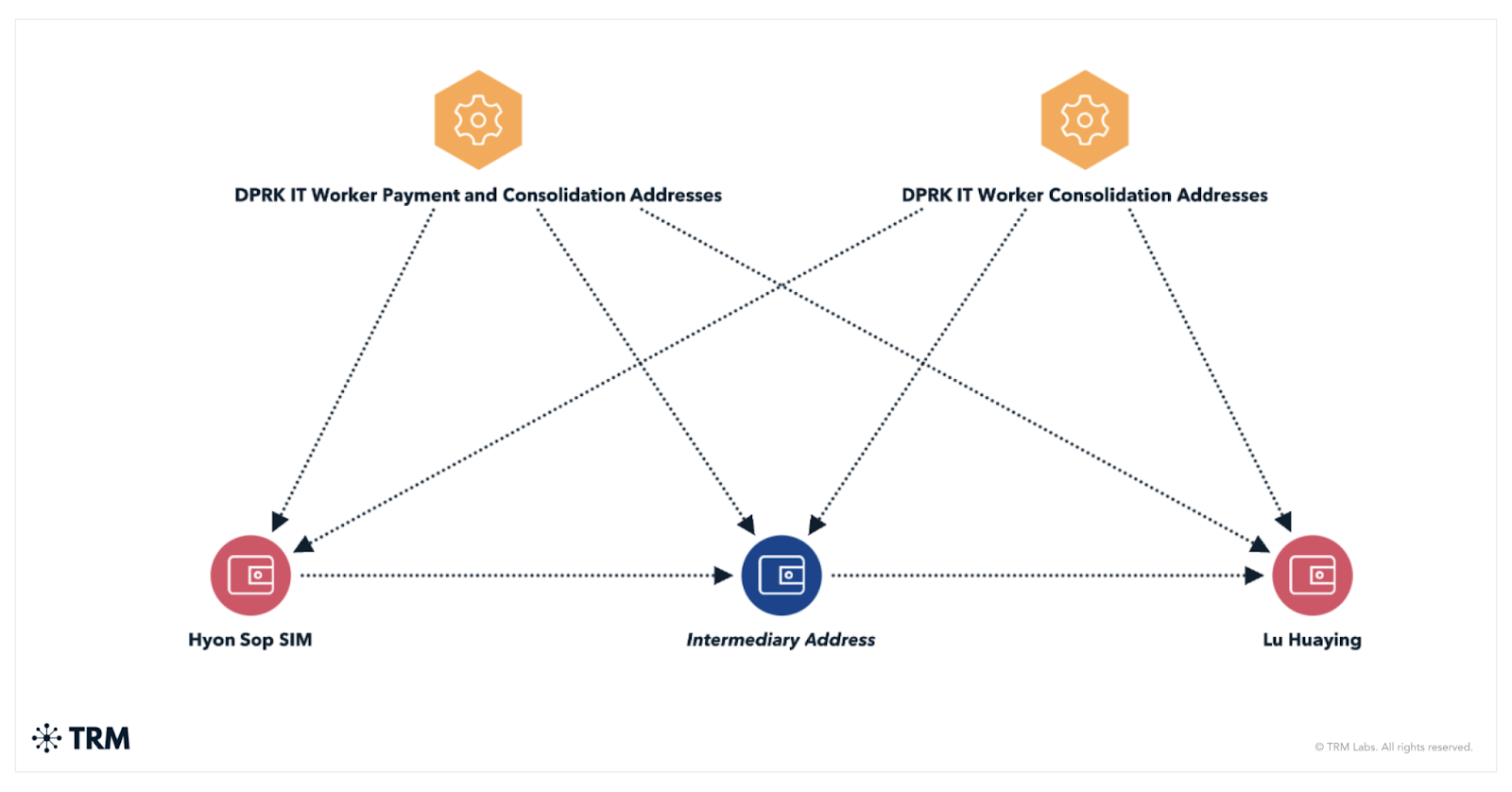
TRM Labs says the workers used identities like “Joshua Palmer” and “Alex Hong” to get hired at crypto startups and other tech firms. They were paid in stablecoins, with proceeds routed through centralized exchanges, self-hosted wallets, and then on to higher-level regime figures like Kim Sang Man and Sim Hyon Sop, both already under U.S. sanctions.

The DOJ’s investigation, according to analysts, revealed that parts of the operation relied on infrastructure based in Russia and the UAE. Investigators found the use of local IP addresses and forged documentation, which helped the North Korean workers hide their true identities. This, they said, underscored just how international the scheme had become.
Here's how North Korean hackers are still getting paid in crypto despite sanctions - 1

Blockchain data reviewed by TRM showed that once funds reached mid-level wallets, the money was split into smaller portions, routed through privacy-enhancing tools, and eventually exchanged for fiat via OTC desks. One of those OTC brokers had already been sanctioned by OFAC in late 2024.

As for law enforcement efforts, the FBI and other agencies successfully seized a portion of the laundered digital assets, including USDC, ETH, and some high-value NFTs. The analysts described these seizures as part of a broader laundering strategy meant to break up the money trail and make detection far more difficult.

TRM Labs says the U.S. government’s latest action sends a message that crypto remains a high-risk channel for sanctions evasion, especially when it comes to North Korean operations. The blockchain intel firm warned that companies hiring remote developers — especially in the blockchain space — need to take extra care in verifying who they’re really dealing with.

Market Opportunity
USDCoin Logo
USDCoin Price(USDC)
$1.0019
$1.0019$1.0019
+0.06%
USD
USDCoin (USDC) Live Price Chart
Disclaimer: The articles reposted on this site are sourced from public platforms and are provided for informational purposes only. They do not necessarily reflect the views of MEXC. All rights remain with the original authors. If you believe any content infringes on third-party rights, please contact service@support.mexc.com for removal. MEXC makes no guarantees regarding the accuracy, completeness, or timeliness of the content and is not responsible for any actions taken based on the information provided. The content does not constitute financial, legal, or other professional advice, nor should it be considered a recommendation or endorsement by MEXC.

You May Also Like

American Bitcoin’s $5B Nasdaq Debut Puts Trump-Backed Miner in Crypto Spotlight
American Bitcoin’s $5B Nasdaq Debut Puts Trump-Backed Miner in Crypto Spotlight

The post American Bitcoin’s $5B Nasdaq Debut Puts Trump-Backed Miner in Crypto Spotlight appeared on BitcoinEthereumNews.com. Key Takeaways: American Bitcoin (ABTC) surged nearly 85% on its Nasdaq debut, briefly reaching a $5B valuation. The Trump family, alongside Hut 8 Mining, controls 98% of the newly merged crypto-mining entity. Eric Trump called Bitcoin “modern-day gold,” predicting it could reach $1 million per coin. American Bitcoin, a fast-rising crypto mining firm with strong political and institutional backing, has officially entered Wall Street. After merging with Gryphon Digital Mining, the company made its Nasdaq debut under the ticker ABTC, instantly drawing global attention to both its stock performance and its bold vision for Bitcoin’s future. Read More: Trump-Backed Crypto Firm Eyes Asia for Bold Bitcoin Expansion Nasdaq Debut: An Explosive First Day ABTC’s first day of trading proved as dramatic as expected. Shares surged almost 85% at the open, touching a peak of $14 before settling at lower levels by the close. That initial spike valued the company around $5 billion, positioning it as one of 2025’s most-watched listings. At the last session, ABTC has been trading at $7.28 per share, which is a small positive 2.97% per day. Although the price has decelerated since opening highs, analysts note that the company has been off to a strong start and early investor activity is a hard-to-find feat in a newly-launched crypto mining business. According to market watchers, the listing comes at a time of new momentum in the digital asset markets. With Bitcoin trading above $110,000 this quarter, American Bitcoin’s entry comes at a time when both institutional investors and retail traders are showing heightened interest in exposure to Bitcoin-linked equities. Ownership Structure: Trump Family and Hut 8 at the Helm Its management and ownership set up has increased the visibility of the company. The Trump family and the Canadian mining giant Hut 8 Mining jointly own 98 percent…
Share
BitcoinEthereumNews2025/09/18 01:33
UBS CEO Targets Direct Crypto Access With “Fast Follower” Tokenization Strategy

UBS CEO Targets Direct Crypto Access With “Fast Follower” Tokenization Strategy

The tension in UBS’s latest strategy update is not between profit and innovation, but between speed and control. On February 4, 2026, as the bank reported a record
Share
Ethnews2026/02/05 04:56
BlackRock boosts AI and US equity exposure in $185 billion models

BlackRock boosts AI and US equity exposure in $185 billion models

The post BlackRock boosts AI and US equity exposure in $185 billion models appeared on BitcoinEthereumNews.com. BlackRock is steering $185 billion worth of model portfolios deeper into US stocks and artificial intelligence. The decision came this week as the asset manager adjusted its entire model suite, increasing its equity allocation and dumping exposure to international developed markets. The firm now sits 2% overweight on stocks, after money moved between several of its biggest exchange-traded funds. This wasn’t a slow shuffle. Billions flowed across multiple ETFs on Tuesday as BlackRock executed the realignment. The iShares S&P 100 ETF (OEF) alone brought in $3.4 billion, the largest single-day haul in its history. The iShares Core S&P 500 ETF (IVV) collected $2.3 billion, while the iShares US Equity Factor Rotation Active ETF (DYNF) added nearly $2 billion. The rebalancing triggered swift inflows and outflows that realigned investor exposure on the back of performance data and macroeconomic outlooks. BlackRock raises equities on strong US earnings The model updates come as BlackRock backs the rally in American stocks, fueled by strong earnings and optimism around rate cuts. In an investment letter obtained by Bloomberg, the firm said US companies have delivered 11% earnings growth since the third quarter of 2024. Meanwhile, earnings across other developed markets barely touched 2%. That gap helped push the decision to drop international holdings in favor of American ones. Michael Gates, lead portfolio manager for BlackRock’s Target Allocation ETF model portfolio suite, said the US market is the only one showing consistency in sales growth, profit delivery, and revisions in analyst forecasts. “The US equity market continues to stand alone in terms of earnings delivery, sales growth and sustainable trends in analyst estimates and revisions,” Michael wrote. He added that non-US developed markets lagged far behind, especially when it came to sales. This week’s changes reflect that position. The move was made ahead of the Federal…
Share
BitcoinEthereumNews2025/09/18 01:44