

Shiba Inu price: SHIB stuck in neutral while the market catches its breath

Market conditions are signaling a pause across crypto, with Shiba Inu price reflecting a cautious stance as capital clusters around major assets and away from speculative risk.
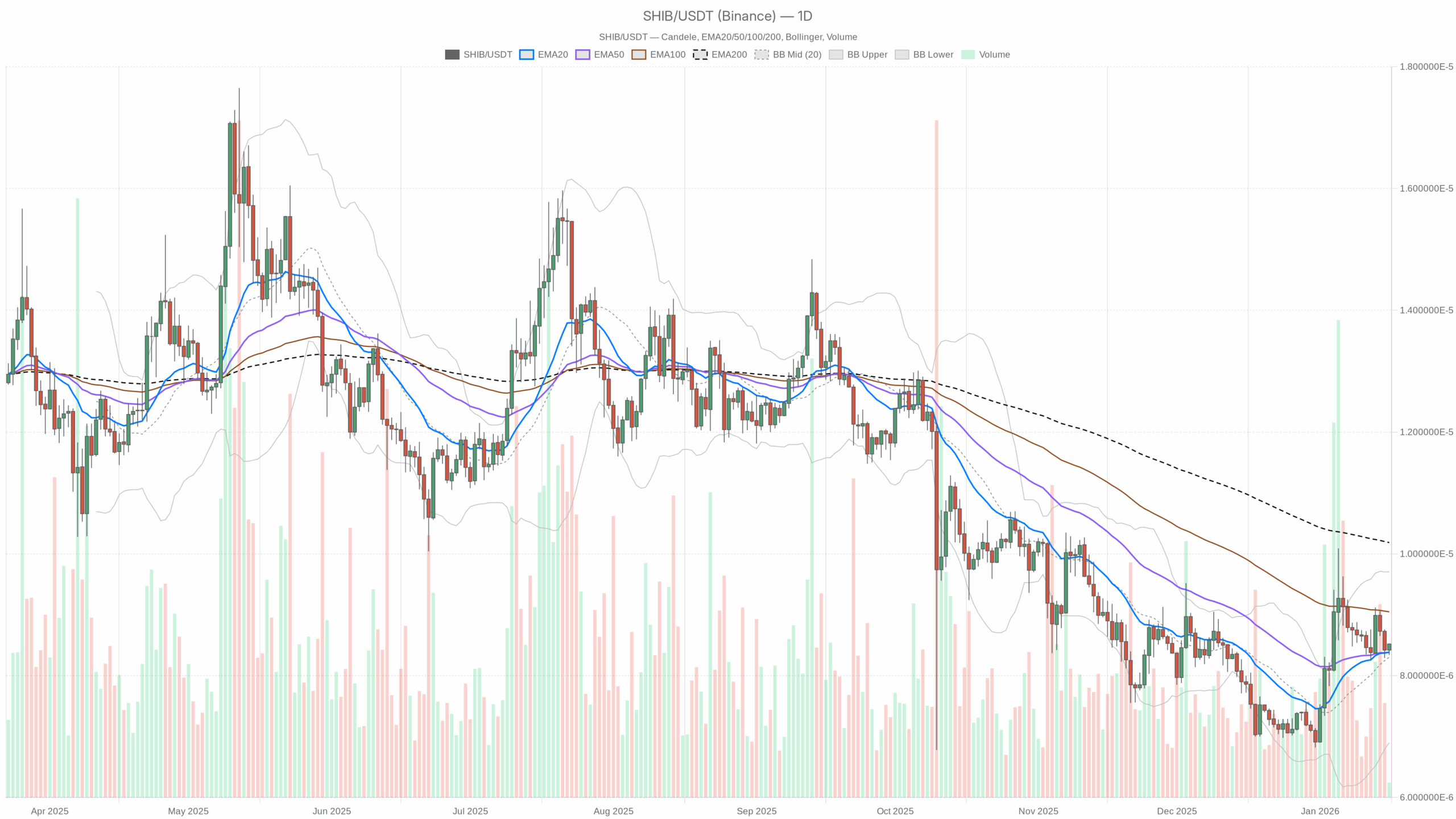 SHIB/USDT — daily chart with candlesticks, EMA20/EMA50 and volume.
Daily timeframe (D1): the macro bias for Shiba Inu price
On the daily chart, the system flags SHIBUSDT in a neutral regime. That is consistent with the indicators we can see.
RSI (D1)
RSI (14): 53.33
Shiba Inu’s daily RSI is sitting just above the midline. That is neither overbought nor oversold. It is the kind of reading you get when price is consolidating after a move rather than starting a new trend. In practice, it means dip buyers and profit takers are roughly balanced, and the market is waiting for a fresh catalyst.
MACD (D1)
MACD line ≈ signal, histogram ≈ 0
The MACD is essentially flat on the daily. That tells you trend momentum has faded. Bulls are not pressing an advantage, but bears have not seized control either. It is classic late-stage range behavior: moves can still be sharp intraday, but trend-following signals are not aligned for a sustained run yet.
EMAs (D1)
EMA20 / EMA50 / EMA200: regime tagged as neutral
The model’s neutral regime on D1 implies Shiba Inu price is trading close to its key moving averages, with no clear slope or separation between the 20, 50, and 200-day EMAs. In other words, the market has not decided whether the last bigger move was a pause in a larger uptrend or just noise inside a broader sideways structure. When EMAs bunch up like this, the next decisive break above or below that cluster usually sets the tone for weeks.
Bollinger Bands (D1)
Bollinger Bands: compressed / mid-range behavior
With the system showing a neutral volatility regime and no strong directional bias, daily Bollinger Bands are effectively acting as a containment zone rather than a trending channel. Shiba Inu price is likely oscillating around the middle band, with neither band being tested aggressively. That kind of structure often precedes an expansion in volatility. The key is to watch which side is breached first.
ATR (D1)
ATR (14): low / normalized
The automated feed treats daily ATR as part of a neutral regime. Practically, that means recent daily swings in Shiba Inu are not extreme relative to its own history. Position sizing in this environment can easily become complacent. Traders start assuming the recent tight ranges will hold, which can make any breakout move more violent when it finally arrives.
Daily pivot levels (D1)
Pivot structure: neutral bias
The system’s neutral tag around daily pivots suggests Shiba Inu price is chopping near its central pivot rather than leaning into a clean move toward R1 or S1. That is typical for a range day profile. Intraday reversals near the pivot are common, and breakout traders get repeatedly faded unless there is a clear catalyst in the broader market.
Daily takeaway: the higher timeframe bias for Shiba Inu price is neutral with no confirmed trend. Bulls do not have control, but bears also lack confirmation. That sets the stage for the lower timeframes to matter more than usual for timing.
1-hour timeframe (H1): local structure backing the neutral view
The 1-hour Shiba Inu chart is broadly echoing the daily picture, which increases the credibility of the neutral bias.
RSI (H1)
RSI (14): 52.67
On the hourly, RSI hovering just above 50 says the intraday battle is balanced. There is a slight lean to the upside, but nothing that qualifies as strong momentum. Intraday pops are more likely to be sold into unless they coincide with a macro push in BTC or a meme rotation wave.
MACD (H1)
MACD line ≈ signal, histogram ≈ 0
MACD on H1 is also flat, which lines up with a market that is chopping rather than trending. When both D1 and H1 MACD go flat, you usually get a liquidity-hunting environment. Price spikes above local highs and below local lows to trigger stops, but fails to build follow-through.
EMAs (H1)
EMA20 / EMA50 / EMA200: clustered
The system’s neutral regime on H1 implies price is gravitating around the short and medium EMAs. That is the definition of a mean-reversion intraday structure: moves away from the EMAs have a higher probability of snapping back rather than extending. For Shiba Inu scalpers, that favors fading extremes over chasing breakouts, at least until EMAs start to fan out again.
Bollinger Bands & ATR (H1)
Bollinger Bands: mid-band magnet
ATR: subdued intraday volatility
On the hourly, neutral volatility plus a mid-band bias means Shiba Inu price is oscillating inside a relatively tight envelope. This is where short-duration volatility strategies thrive, but directional traders get chopped up. A clean hourly close outside the bands, backed by rising ATR, would be the first sign that the market is picking a direction.
Hourly pivots (H1)
Pivot regime: range behavior
H1 pivot action is consistent with range trading. Price repeatedly interacts with the pivot point, with R1 and S1 acting more as outer magnets than as launchpads for trends. This often continues until external news, or a big move in BTC, provides the shove needed to break that balance.
15-minute timeframe (M15): execution context for Shiba Inu price
The 15-minute chart is where Shiba Inu finally shows a bit of tension against the higher timeframes.
RSI (M15)
RSI (14): 67.18
On M15, RSI is leaning into overbought territory. That does not define a trend by itself, but it does hint at short-term buyers getting ahead of themselves compared to the flat daily backdrop. In plain terms, the very short-term move is a bit hot, while the bigger picture remains undecided. That is a classic setup for either a shallow pullback or a squeeze higher if shorts step in too early.
MACD, EMAs, Bands & pivots (M15)
MACD: flat
EMAs: locally supportive
Bands & pivots: intraday levels
Despite the higher RSI, the 15-minute MACD is not showing strong momentum, which means this uptick may be more of a grind than a breakout. EMAs on M15 are likely acting as a rising intraday support, but with the broader regime neutral, that support is fragile. It holds until it does not, and reversals can be sharp. Bollinger Bands on this timeframe are probably being tested on the upper side, making it a poor spot to initiate fresh longs unless higher timeframes join in.
Multi-timeframe tension: daily and hourly are neutral, while 15-minute is mildly stretched to the upside. That combination often resolves with a short-term cool-off rather than an immediate trend change.
Market context: why Shiba Inu is drifting
The broader market backdrop explains a lot of this indecision. Bitcoin dominance above 57% shows capital is clustered in BTC, while total market cap is slightly down with volumes dropping over 20% on the day. That is not the environment where meme coins usually lead.
Global sentiment at neutral (49) confirms this is not a panic phase; it is a patience test. Macro headlines are centered around FX, such as yen and dollar, and regulatory chatter around stablecoin bills. None of these are specifically catalyzing meme flows. In this climate, Shiba Inu is trading as a beta play on broader risk rather than running its own story.
Bullish scenario for Shiba Inu price
For a bullish path to develop from here, Shiba Inu needs alignment across timeframes and a nudge from the broader market.
• The first step would be turning today’s M15 overbought push into a genuine trend. That means 15-minute and 1-hour MACD starting to expand positively, with price holding above the hourly EMA20 and EMA50 cluster instead of snapping back.
• On the daily, Shiba Inu price would need to build a series of higher lows around the current EMA cluster, with RSI grinding from the low 50s toward the 60–65 area. That would signal a shift from random chop to constructive accumulation.
• Volatility needs to expand in the right direction. Daily Bollinger Bands should open up with price hugging the upper band, and ATR ticking higher while the market trades higher, not just whipping both ways.
If that alignment happens, meme-coin rotation could kick in, especially if BTC stabilizes and traders go hunting for higher beta. In that case, rallies would start to stick rather than fully mean-revert, and dips into hourly EMAs would be bought aggressively.
What invalidates the bullish case?
The bullish scenario fails if SHIB can not hold above its hourly moving average cluster and the daily RSI rolls back toward 45 with MACD turning more decisively negative. In price behavior terms, that would look like repeated failed breakouts above local resistance followed by deeper and faster selloffs on each rejection.
Bearish scenario for Shiba Inu price
On the bearish side, the risk is that this neutral regime is simply a pause before a rotation out of meme risk.
• If BTC extends downside while dominance remains high, capital tends to flee peripheral assets first, SHIB included. In that environment, the current neutral readings can quickly flip into a downside trend once key supports break.
• Technically, that would show up as daily RSI slipping under 50 and grinding toward the low 40s, with MACD crossing more clearly bearish and EMAs starting to slope down with price stuck underneath.
• On lower timeframes, you would see hourly and 15-minute attempts to rally being capped at the EMA20 and EMA50, with Bollinger upper bands acting as firm resistance rather than expanding into an up-move.
That kind of structure usually leads to a stair-step decline. Shallow bounces, heavy selling on every test of resistance, and ATR starting to tick higher on red days as volatility expands to the downside.
What invalidates the bearish case?
Bears lose the edge if Shiba Inu starts closing consistently back above intraday resistance, such as hourly EMAs and prior swing highs, and the daily RSI refuses to stay below 50. If each dip quickly recovers and MACD flattens again instead of accelerating lower, then the move was likely just a shakeout within an extended range.
Neutral / rangebound scenario (current base case)
Given the data, the base case for Shiba Inu price is still neutral.
• Daily RSI around 53 and flat MACD signal a market without clear directional conviction.
• Hourly indicators mirror that balance, reinforcing the idea of range behavior and mean reversion.
• Only the 15-minute chart shows stretched conditions, which are typically short-lived.
Under this scenario, Shiba Inu continues to oscillate within a broad horizontal band, with rallies fading near resistance and dips getting bought near support, but without a decisive trend. It is an environment more suited to short-term traders who can adapt intraday than to position traders looking for clean swings.
Positioning, risk, and what matters next
With Shiba Inu sitting in a neutral pocket on both daily and hourly charts, the key for traders is accepting that signal quality is low right now. Trend-followers will find it hard to justify heavy exposure until D1 momentum picks a side. Mean-reversion traders may lean into fading extremes on the lower timeframes, but they are playing a short game that depends on tight risk controls.
The main variables to watch:
• Bitcoin and total market cap: a decisive move in either direction will likely drag SHIB with it, given current dominance levels.
• Daily volatility: a shift from compressed Bollinger Bands and subdued ATR into an expansion phase will mark the next phase for Shiba Inu price, whether that is a breakout or breakdown.
• Structure of pullbacks and rallies: are dips shallow and quickly reclaimed, or are bounces weak and sold aggressively? That behavior will reveal which side is actually in control beneath the neutral indicators.
What is clear is that uncertainty and headline risk remain high across the macro landscape, and volumes are lighter than they were during the last impulsive moves. In that kind of tape, over-leveraging into a coin that is technically neutral is less a strategy and more a gamble. Treat this phase as a time to observe how Shiba Inu behaves at its key intraday and daily levels. The next clean trend will likely come out of this current indecision.
If you want to monitor markets with professional charting tools and real-time data, you can open an account on Investing using our partner link:
Open your Investing.com account
This section contains a sponsored affiliate link. We may earn a commission at no additional cost to you.
Disclaimer: This article is a market analysis and reflects a technical view of current conditions for Shiba Inu price based on the data available at the time of writing. It is not investment advice, and it should not be used as the sole basis for any financial decision. Crypto assets are highly volatile, and any trading or investing activity involves significant risk, including the possible loss of capital. Always conduct your own research and consider your risk tolerance before entering the market.
You May Also Like

Trading time: Tonight, the US GDP and the upcoming non-farm data will become the market focus. Institutions are bullish on BTC to $120,000 in the second quarter.

Ethereum Fusaka Upgrade Set for December 3 Mainnet Launch, Blob Capacity to Double
