Tech companies requiring access to GPU workloads have a new option at their disposal following Salad.com’s decision to partner with Web3 specialist Golem NetworkTech companies requiring access to GPU workloads have a new option at their disposal following Salad.com’s decision to partner with Web3 specialist Golem Network

Salad.com Teams Up With Golem Network to Deliver GPU Processing on Decentralized Infra

4 min read

Tech companies requiring access to GPU workloads have a new option at their disposal following Salad.com’s decision to partner with Web3 specialist Golem Network. The collaboration will bring Web2 workloads into the Web3 arena, taking advantage of Salad’s existing customer base and Golem’s distributed compute model.

Web3 Compute With a Side of Salad

Like all partnerships – particularly those that bridge the Web2-Web3 divide – the first task to be undertaken by Salad and Golem is to establish the technical capabilities of the arrangement. Once the teams’ respective engineers are confident that the integration is operating smoothly and capable of matching demand, it will then be scaled up and fully rolled out.

Should it prove as successful as hoped, the arrangement should benefit all parties. For Salad, it provides additional bandwidth, enabling it to meet the ever-growing demands for GPU compute from its enterprise clients. The design of Golem Network’s infrastructure means that the computational resources available are flexible and should ensure that Salad clients don’t hit a GPU “ceiling” during peak times.

For Golem, meanwhile, it’s a coup to have partnered with a major B2E player in the form of Salad.com. The partnership will provide a live and very public demonstration of what Golem’s Web3 infrastructure is capable of delivering. In the process, it further burnishes the credentials of the DePIN sector at large, which has quietly grown into the backbone for global resource allocation and remuneration, aided by Web3 technologies such as blockchain and tokenization.

Centralized Cloud Meets Decentralized Devices

Like most GPU providers, Salad currently utilized centralized cloud services to supply the infrastructure its customers rely on for their computational needs. The decision to partner with Golem, therefore, represents a radical shift in Salad’s business model, even if the user experience should remain unchanged: Salad clients will still tap into GPU resources in the same manner as usual, but behind the scenes, the workflow will be very different.

As an exploratory partnership, Salad isn’t planning to offload all its GPU demands to Golem at this point in time, it should be noted. Nevertheless, the move provides further evidence of the way the industry is moving as rising demand for AI workloads prompts Web2 businesses to look to distributed models that can take the strain.

Two Worlds That Work as One

Salad’s decision to partner with an established Web3 infra provider in Golem Network may appear to have come out of the blue, but the latter has actually known to the former for some time. Salad CEO Bob Miles professes to have first read the Golem whitepaper in 2017, and now that the network has come of age, is eager to test its capabilities. And there will be plenty to test, from decentralized marketplace setup to tokenization, though the Golem SDK should at least make the integration itself relatively straightforward.

Despite Golem having been on Salad’s radar for a while, Salad.com began seriously evaluating the capabilities of numerous DePIN protocols in 2025 before settling on Golem. According to Salad CTO Kyle Dodson, “The architecture provided by Golem, connecting compute requestors and compute providers via a decentralized protocol, has significant overlap with how Salad’s platform operates today.” It will still necessitate a change in how Salad’s GPU provision works, albeit one that taps into the many synergies between the two partners.

Both entities specialize in supplying GPU workloads for use cases such as AI inference and 3D rendering. It’s business as usual then, but business now as partners spanning Web2 and Web3 respectively.

Comments
Market Opportunity
NodeAI Logo
NodeAI Price(GPU)
$0.03525
$0.03525$0.03525
+1.00%
USD
NodeAI (GPU) Live Price Chart
Disclaimer: The articles reposted on this site are sourced from public platforms and are provided for informational purposes only. They do not necessarily reflect the views of MEXC. All rights remain with the original authors. If you believe any content infringes on third-party rights, please contact service@support.mexc.com for removal. MEXC makes no guarantees regarding the accuracy, completeness, or timeliness of the content and is not responsible for any actions taken based on the information provided. The content does not constitute financial, legal, or other professional advice, nor should it be considered a recommendation or endorsement by MEXC.

You May Also Like

Three dormant wallets, suspected to belong to the same entity, purchased 5,970 ETH eight hours ago.

Three dormant wallets, suspected to belong to the same entity, purchased 5,970 ETH eight hours ago.

PANews reported on February 4 that, according to Lookonchain monitoring, three wallets that had been dormant for four years (likely controlled by the same entity
Share
PANews2026/02/04 11:36
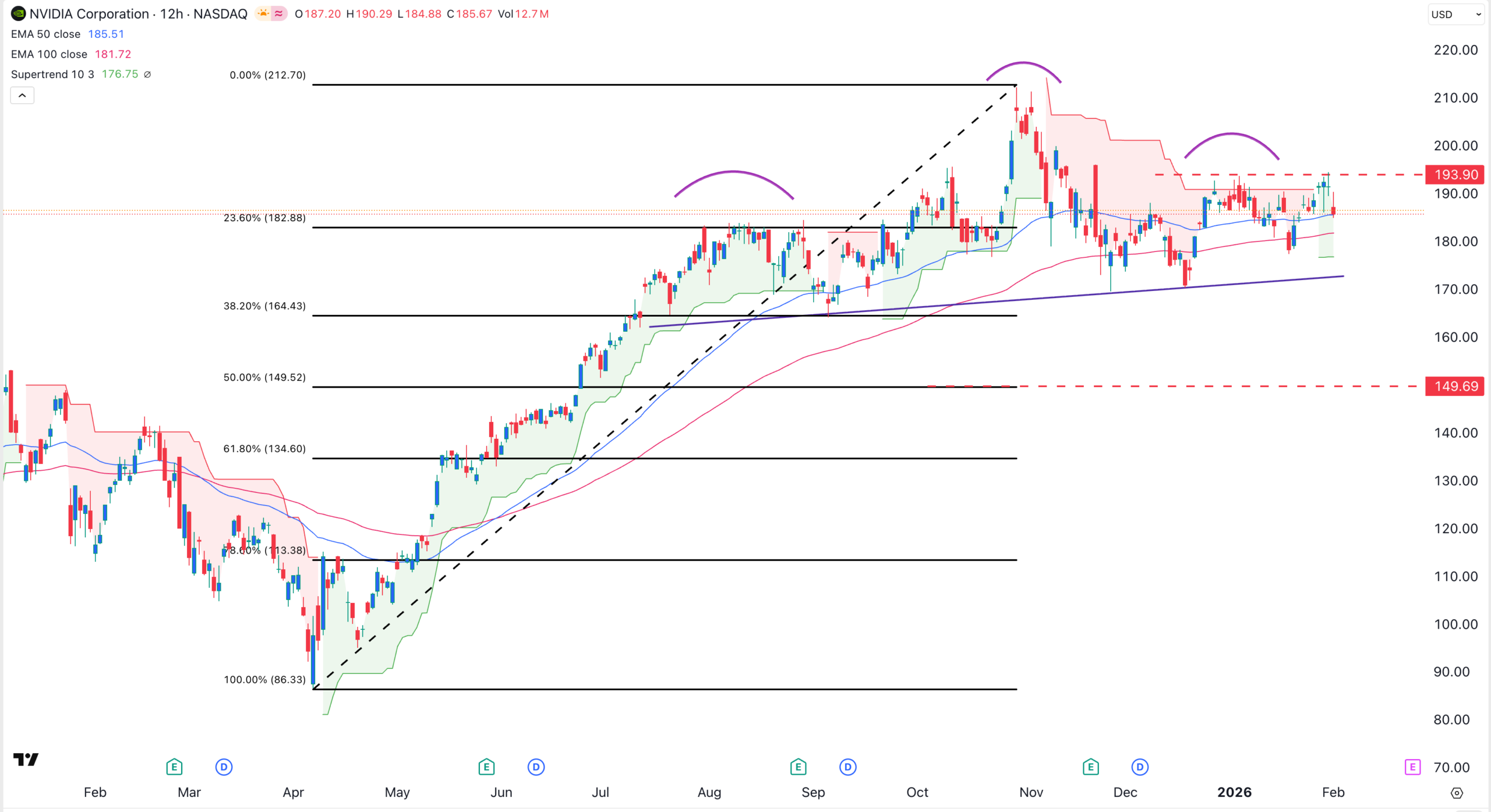
NVIDIA Stock Price Analysis as OpenAI Issues Concerns About its Chips

NVIDIA Stock Price Analysis as OpenAI Issues Concerns About its Chips

Key Insights NVIDIA stock started the week in the red. It crashed by over 2%. Meanwhile, the S&P 500, Dow Jones, and Nasdaq 100 moved close to their all-time highs
Share
Themarketperiodical2026/02/04 11:27
Ondo Finance Launches USDY Yieldcoin on Stellar, Bringing Tokenized U.S. Treasuries to Users

Ondo Finance Launches USDY Yieldcoin on Stellar, Bringing Tokenized U.S. Treasuries to Users

Ondo Finance, a U.S.-based digital asset firm specializing in bringing traditional financial products on-chain through tokenization, is expanding its yieldcoin USDY to the Stellar network. This lates update marks a step forward in merging tokenized real-world assets with a global payments infrastructure, unlocking new opportunities for users worldwide. The announcement was made at the Stellar Meridian event in Copacabana, Rio de Janeiro, on September 17. USDY Joins the Stellar Ecosystem Ondo Finance, a recognized leader in tokenized real-world assets, announced the deployment of United States Dollar Yield (USDY) on Stellar, the payments-focused blockchain known for speed and low transaction costs. USDY is the most widely available “yieldcoin,” offering investors access to onchain assets backed by U.S. Treasuries. This launch allows Stellar’s global user base to tap into permissionless, yield-bearing assets tied to one of the safest financial instruments in the world. It also aligns with Stellar’s mission of driving fast, affordable cross-border payments. Combining Yield with Payments Infrastructure “Stablecoins unlocked global access to the U.S. dollar. With USDY, we’re taking the next step by bringing U.S. Treasuries onchain in a form that combines stability, liquidity, and yield,” said Ian De Bode, Chief Strategy Officer at Ondo Finance. “Fast, affordable cross-border payments are at the center of what Stellar was designed to do. The global reach of the Stellar ecosystem combined with a yield-bearing asset like USDY levels up what is possible onchain, allowing wallets and businesses to offer yield opportunities to their users,” said Denelle Dixon, CEO of the Stellar Development Foundation. Ondo claims by pairing USDY with Stellar’s infrastructure, new possibilities open up in treasury management, collateralization, and everyday financial applications. Unlocking Institutional and Retail Use Cases USDY currently manages over $650 million in total value locked (TVL) across nine blockchains and offers a 5.3% APY. By launching on Stellar, Ondo Finance extends these benefits to global retail and institutional users. The firm explains balances on Stellar can now become productive, supporting use cases such as onchain savings, institutional treasury strategies, cost-efficient collateral for DeFi protocols, and remittance flows that carry yield rather than remaining static. A Milestone for Tokenized Treasuries With the integration of USDY, Stellar users gain more than just access to stable-value assets—they gain access to institutional-grade yield. For investors outside the U.S., the launch represents a new way to combine the safety of Treasuries with the accessibility of blockchain technology. As tokenization accelerates globally, Ondo Finance’s decision to deploy USDY on Stellar reinforces the narrative that blockchain is not just about speculation, but about reimagining the global financial system through secure, yield-bearing digital assets
Share
CryptoNews2025/09/18 00:46