The post Senate CLARITY Act Eyes January Markup Despite Democratic Regulatory Concerns appeared on BitcoinEthereumNews.com. The CLARITY Act, a landmark crypto marketThe post Senate CLARITY Act Eyes January Markup Despite Democratic Regulatory Concerns appeared on BitcoinEthereumNews.com. The CLARITY Act, a landmark crypto market

Senate CLARITY Act Eyes January Markup Despite Democratic Regulatory Concerns

  • January Markup Confirmation: Senate Banking and Agriculture Chairs Tim Scott and John Boozman schedule review of the CLARITY Act despite Democratic reservations on independence.

  • Building on House approval in July 2025 and the recent GENIUS Act for stablecoins, the bill establishes a comprehensive framework for crypto oversight.

  • According to White House crypto advisor David Sacks, the legislation is closer to passage, with over 70% bipartisan support in initial votes and potential for full Senate debate by mid-2026.

Discover how the CLARITY Act shapes crypto’s future: Senate markup in January 2025 clarifies SEC-CFTC roles, boosting innovation. Stay informed on digital asset regulations—read more now!

What is the CLARITY Act and How Does It Impact Crypto Markets?

The CLARITY Act, or Digital Asset Market Clarity Act of 2025, is comprehensive federal legislation designed to provide regulatory clarity for digital assets in the United States. It delineates responsibilities between the Securities and Exchange Commission (SEC) and the Commodity Futures Trading Commission (CFTC), treating most cryptocurrencies as commodities rather than securities. This framework aims to reduce enforcement uncertainties that have plagued the industry, enabling safer market participation and innovation while protecting investors from fraud.

How Will the Senate Markup Affect Regulatory Independence for Crypto?

The upcoming Senate markup in January 2025, led by Chairs Tim Scott and John Boozman, represents a critical step toward enacting the CLARITY Act after its House passage in July 2025 with strong bipartisan backing. This session will scrutinize provisions that assign oversight of spot crypto markets to the CFTC, potentially shifting billions in regulatory authority from the SEC’s stricter securities regime. According to statements from White House AI and crypto advisor David Sacks, the bill’s progress aligns with President Trump’s priorities for a pro-innovation environment.

Democratic concerns, voiced by Senator Cory Booker, highlight risks to agency independence, especially amid Supreme Court signals that could empower presidential firings of commissioners. Booker emphasized at the Blockchain Association’s annual policy summit that such changes might enable short-term appointments favoring political allies, eroding bipartisan stability. Data from the Congressional Budget Office estimates the bill could generate up to $2.5 billion in annual compliance revenues for regulators, but critics warn it favors established firms over startups.

Expert Kadan Stadelmann, Chief Technology Officer at Komodo Platform, noted that while the Act promotes clarity, its requirements for data collection and identity verification could enhance surveillance and centralization. “The CLARITY Act supports innovation on the surface but may impose burdens that stifle smaller players,” Stadelmann said, citing examples where similar rules in the European Union’s MiCA framework increased operational costs by 30-50% for emerging projects.

Frequently Asked Questions

What Are the Key Provisions of the CLARITY Act for Crypto Regulation?

The CLARITY Act defines digital assets as commodities under CFTC jurisdiction unless they qualify as investment contracts under SEC rules, providing a clear classification system. It mandates disclosure requirements for crypto issuers and establishes anti-manipulation safeguards, aiming to prevent events like the 2022 market crashes. This 40-word overview ensures balanced oversight, with input from over 200 industry stakeholders during drafting.

Why Is Democratic Support Crucial for the CLARITY Act’s Passage?

Democratic backing is essential for the CLARITY Act to achieve the 60-vote Senate threshold, given the chamber’s composition. Leaders like Senator Booker seek assurances on commissioner appointments to maintain regulatory neutrality, ensuring decisions prioritize public interest over political influence. This natural approach fosters trust, making the bill viable for voice searches on crypto policy dynamics.

Key Takeaways

  • Markup Milestone: The January 2025 Senate review signals accelerated progress for the CLARITY Act, building on House success and stablecoin laws.
  • Bipartisan Momentum: Support from Chairs Scott and Boozman, plus House leaders French Hill and GT Thompson, underscores growing consensus despite tensions.
  • Balancing Act: Address independence concerns through nominations to SEC and CFTC, promoting fair crypto innovation without excessive centralization.

Conclusion

The CLARITY Act’s path to January 2025 Senate markup marks a pivotal moment for crypto market structure, offering long-sought regulatory clarity between the SEC and CFTC while navigating Democratic worries on independence. As digital assets integrate deeper into global finance, with trading volumes exceeding $2 trillion monthly per Chainalysis reports, this legislation could unlock institutional adoption and protect consumers. Policymakers and industry leaders must collaborate to refine safeguards, ensuring a robust framework that drives sustainable growth—watch for updates as the markup unfolds.

Source: https://en.coinotag.com/senate-clarity-act-eyes-january-markup-despite-democratic-regulatory-concerns
Market Opportunity
The AI Prophecy Logo
The AI Prophecy Price(ACT)
$0.03028
$0.03028$0.03028
+1.13%
USD
The AI Prophecy (ACT) Live Price Chart
Disclaimer: The articles reposted on this site are sourced from public platforms and are provided for informational purposes only. They do not necessarily reflect the views of MEXC. All rights remain with the original authors. If you believe any content infringes on third-party rights, please contact service@support.mexc.com for removal. MEXC makes no guarantees regarding the accuracy, completeness, or timeliness of the content and is not responsible for any actions taken based on the information provided. The content does not constitute financial, legal, or other professional advice, nor should it be considered a recommendation or endorsement by MEXC.

You May Also Like

Building a DEXScreener Clone: A Step-by-Step Guide

Building a DEXScreener Clone: A Step-by-Step Guide

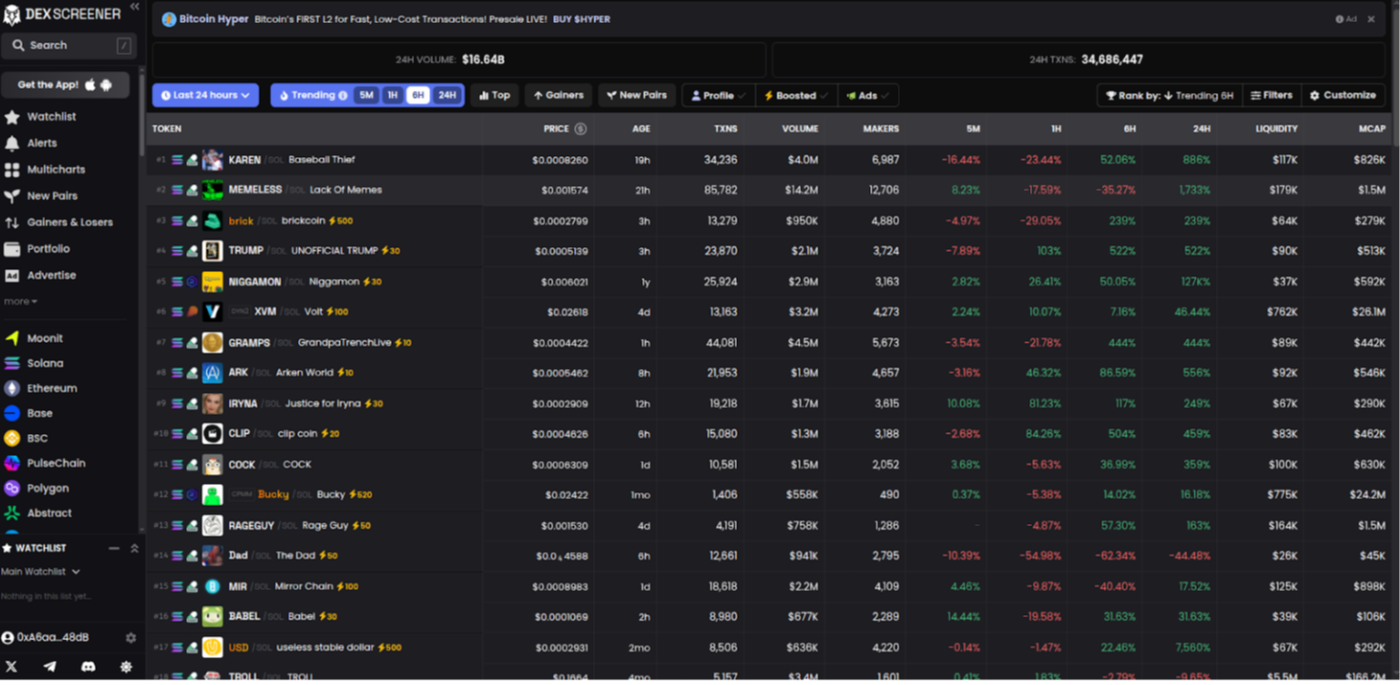
DEX Screener is used by crypto traders who need access to on-chain data like trading volumes, liquidity, and token prices. This information allows them to analyze trends, monitor new listings, and make informed investment decisions. In this tutorial, I will build a DEXScreener clone from scratch, covering everything from the initial design to a functional app. We will use Streamlit, a Python framework for building full-stack apps.
Share
Hackernoon2025/09/18 15:05
Which DOGE? Musk's Cryptic Post Explodes Confusion

Which DOGE? Musk's Cryptic Post Explodes Confusion

A viral chart documenting a sharp decline in U.S. federal employment during President Trump's second term has sparked unexpected confusion in cryptocurrency markets
Share
Coinstats2025/12/20 01:13
Google's AP2 protocol has been released. Does encrypted AI still have a chance?

Google's AP2 protocol has been released. Does encrypted AI still have a chance?

Following the MCP and A2A protocols, the AI Agent market has seen another blockbuster arrival: the Agent Payments Protocol (AP2), developed by Google. This will clearly further enhance AI Agents' autonomous multi-tasking capabilities, but the unfortunate reality is that it has little to do with web3AI. Let's take a closer look: What problem does AP2 solve? Simply put, the MCP protocol is like a universal hook, enabling AI agents to connect to various external tools and data sources; A2A is a team collaboration communication protocol that allows multiple AI agents to cooperate with each other to complete complex tasks; AP2 completes the last piece of the puzzle - payment capability. In other words, MCP opens up connectivity, A2A promotes collaboration efficiency, and AP2 achieves value exchange. The arrival of AP2 truly injects "soul" into the autonomous collaboration and task execution of Multi-Agents. Imagine AI Agents connecting Qunar, Meituan, and Didi to complete the booking of flights, hotels, and car rentals, but then getting stuck at the point of "self-payment." What's the point of all that multitasking? So, remember this: AP2 is an extension of MCP+A2A, solving the last mile problem of AI Agent automated execution. What are the technical highlights of AP2? The core innovation of AP2 is the Mandates mechanism, which is divided into real-time authorization mode and delegated authorization mode. Real-time authorization is easy to understand. The AI Agent finds the product and shows it to you. The operation can only be performed after the user signs. Delegated authorization requires the user to set rules in advance, such as only buying the iPhone 17 when the price drops to 5,000. The AI Agent monitors the trigger conditions and executes automatically. The implementation logic is cryptographically signed using Verifiable Credentials (VCs). Users can set complex commission conditions, including price ranges, time limits, and payment method priorities, forming a tamper-proof digital contract. Once signed, the AI Agent executes according to the conditions, with VCs ensuring auditability and security at every step. Of particular note is the "A2A x402" extension, a technical component developed by Google specifically for crypto payments, developed in collaboration with Coinbase and the Ethereum Foundation. This extension enables AI Agents to seamlessly process stablecoins, ETH, and other blockchain assets, supporting native payment scenarios within the Web3 ecosystem. What kind of imagination space can AP2 bring? After analyzing the technical principles, do you think that's it? Yes, in fact, the AP2 is boring when it is disassembled alone. Its real charm lies in connecting and opening up the "MCP+A2A+AP2" technology stack, completely opening up the complete link of AI Agent's autonomous analysis+execution+payment. From now on, AI Agents can open up many application scenarios. For example, AI Agents for stock investment and financial management can help us monitor the market 24/7 and conduct independent transactions. Enterprise procurement AI Agents can automatically replenish and renew without human intervention. AP2's complementary payment capabilities will further expand the penetration of the Agent-to-Agent economy into more scenarios. Google obviously understands that after the technical framework is established, the ecological implementation must be relied upon, so it has brought in more than 60 partners to develop it, almost covering the entire payment and business ecosystem. Interestingly, it also involves major Crypto players such as Ethereum, Coinbase, MetaMask, and Sui. Combined with the current trend of currency and stock integration, the imagination space has been doubled. Is web3 AI really dead? Not entirely. Google's AP2 looks complete, but it only achieves technical compatibility with Crypto payments. It can only be regarded as an extension of the traditional authorization framework and belongs to the category of automated execution. There is a "paradigm" difference between it and the autonomous asset management pursued by pure Crypto native solutions. The Crypto-native solutions under exploration are taking the "decentralized custody + on-chain verification" route, including AI Agent autonomous asset management, AI Agent autonomous transactions (DeFAI), AI Agent digital identity and on-chain reputation system (ERC-8004...), AI Agent on-chain governance DAO framework, AI Agent NPC and digital avatars, and many other interesting and fun directions. Ultimately, once users get used to AI Agent payments in traditional fields, their acceptance of AI Agents autonomously owning digital assets will also increase. And for those scenarios that AP2 cannot reach, such as anonymous transactions, censorship-resistant payments, and decentralized asset management, there will always be a time for crypto-native solutions to show their strength? The two are more likely to be complementary rather than competitive, but to be honest, the key technological advancements behind AI Agents currently all come from web2AI, and web3AI still needs to keep up the good work!
Share
PANews2025/09/18 07:00