Global Macro Investor (GMI) head of macro research Julien Bittel posted a bitcoin “oversold RSI” roadmap on X, arguing the market has tracked it closely and tyingGlobal Macro Investor (GMI) head of macro research Julien Bittel posted a bitcoin “oversold RSI” roadmap on X, arguing the market has tracked it closely and tying

Bitcoin Washout Points To $180,000 In 90 Days, GMI Says

2025/12/18 21:30

Global Macro Investor (GMI) head of macro research Julien Bittel posted a bitcoin “oversold RSI” roadmap on X, arguing the market has tracked it closely and tying the setup to a broader view that the cycle could run into 2026—an outlook he says would render the traditional “four-year cycle” framework obsolete.

“A lot of people have been asking for an update on this chart, so I’ll just leave this here for anyone who needs to see it,” Bittel wrote, sharing a chart of bitcoin’s average price path after RSI falls below 30, with the RSI breach marked as t=0. “This shows the average BTC trajectory following an oversold RSI reading, with RSI falling below 30 at t=0.”

Can Bitcoin Skyrocket To $180,000 In Just 90 Days?

Bittel said the overlay has matched the current tape. “So far, it’s been pretty bang on,” he wrote. The “average market path” line rises sharply over the weeks that follow. The chart shows a steep rally within 90 days after t=0, with the BTC price potentially surging near the $180,000 area.

Still, Bittel emphasized the chart is not meant to be a precision forecast. “No, it won’t be perfect,” he wrote, adding that “assuming the bull market isn’t already over, it’s a useful chart to keep in mind.” He also warned that the rebound process can be uneven: “bases can take time to form and usually come with plenty of chop before the bigger up-move kicks in.”
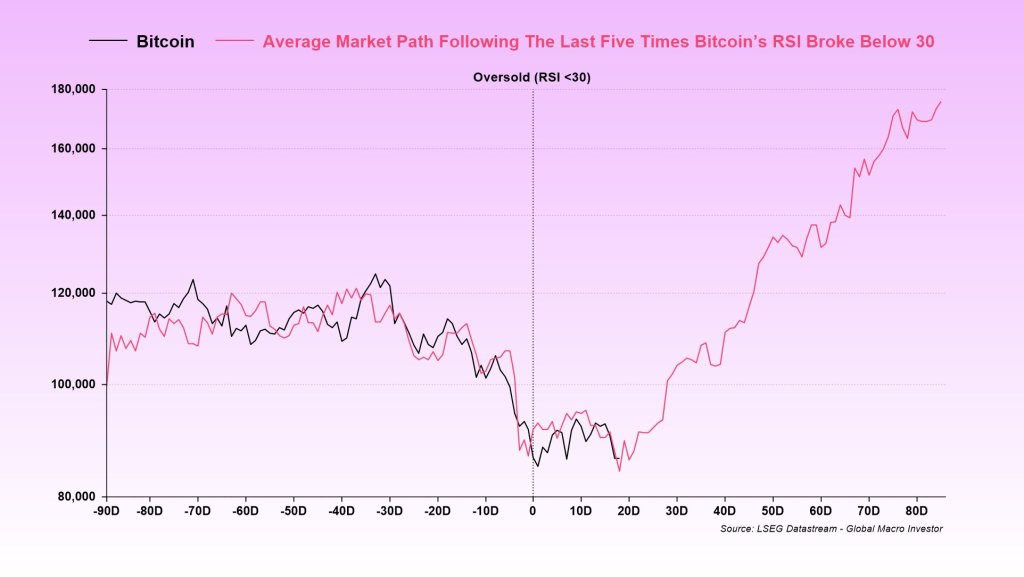
verage Market Path Following The Last Five Times Bitcoin’s RSI Broke Below 30

He reiterated the conditional nature of the framework in blunt terms. “If you think the bull market is over and we are now facing twelve months of pain, this chart is not for you. Move along…”

The bigger point, Bittel said, is that the familiar cycle narrative should not be taken for granted. “Unless you believe the 4-year cycle is still in play, which we don’t, this chart should hold up contextually over time,” he wrote. “As we’ve outlined many times, based on our work on the business cycle, the current path of financial conditions, and our expectations for overall liquidity, the balance of probabilities is that this cycle extends well into 2026.” In that scenario, he added, “the 4-year cycle is dead.”

Bittel also challenged the common assumption that bitcoin’s rhythm is fundamentally “about the halving.” “Remember, the 4-year cycle was never about the halving, despite widespread belief that it is, but instead has always been driven by the public debt refinancing cycle,” he wrote, adding that post-COVID that dynamic “was pushed out by one year.” He now argues the cycle is “officially broken” because “the weighted average maturity of the debt term structure has increased.”

He framed the macro backdrop in terms of debt-service pressure and liquidity response. “The bigger picture is that there is still a vast amount of interest expense that needs to be monetized, which has far exceeded GDP growth,” Bittel wrote.

Reactions across crypto X ranged from enthusiastic to skeptical. The ₿itcoin Therapist replied: “$180,000 BTC in 90 days.”

LondonCryptoClub (@LDNCryptoClub) said the chart “lines up with our thinking,” tying the narrative to what it called the Fed’s “not QE QE” dynamics and “liquidity games” between the Treasury and the central bank. The account still anticipated turbulence into year-end—“noise and chop into year end (which is negative liquidity)”—before “these fundamental drivers start to see BTC reconnect with the bull trend,” adding that “sentiment appears sufficiently bad for a BTC move higher to be the most hated trade to start 2026!”

Others struck a more sardonic tone. “precision-grade hopium here,” wrote doug funnie (@cryptoklotz), while still sketching a conditional path forward: Still think as long as BTC survives (ie doesn’t close in the $70k’s and starts grinding down or accepting there), there’s a plausible path to new highs on the earlier side in 2026. Just need to survive the ‘transition zone’ of 4 year deterministic selloors exhausting, and then ending up in an awkward spot as the music keeps playing.”

Capriole Investments founder Charles Edwards was more critical of the statistical grounding, urging a broader test set: “Now re run this with 100 occurrences, not 5 during up only.”

For traders, Bittel’s post effectively combines a tactical signal with a regime call: the RSI sub-30 template may map the rebound path, but only “assuming the bull market isn’t already over,” and only in a world where, as he put it, “the balance of probabilities” favors a cycle that “extends well into 2026.”

At press time, BTC traded at $87,330.
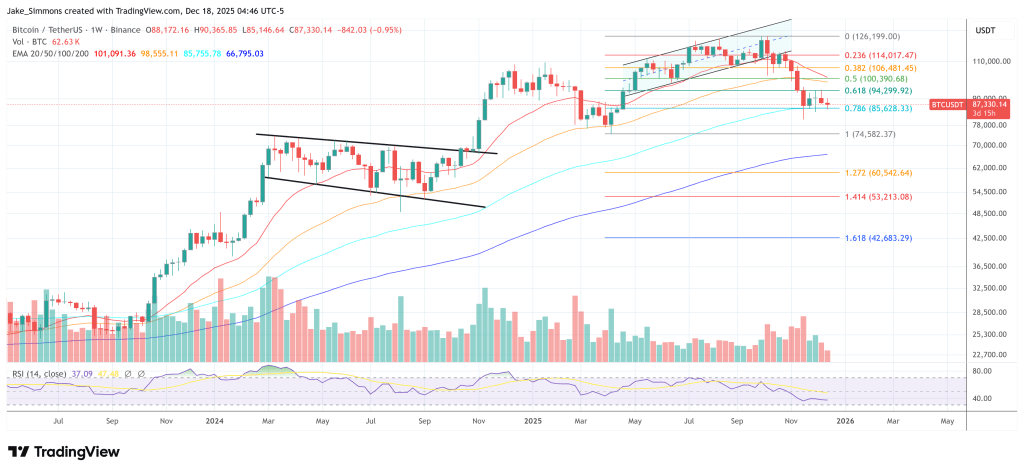
Bitcoin price
Market Opportunity
Render Logo
Render Price(RENDER)
$1.299
$1.299$1.299
-0.45%
USD
Render (RENDER) Live Price Chart
Disclaimer: The articles reposted on this site are sourced from public platforms and are provided for informational purposes only. They do not necessarily reflect the views of MEXC. All rights remain with the original authors. If you believe any content infringes on third-party rights, please contact service@support.mexc.com for removal. MEXC makes no guarantees regarding the accuracy, completeness, or timeliness of the content and is not responsible for any actions taken based on the information provided. The content does not constitute financial, legal, or other professional advice, nor should it be considered a recommendation or endorsement by MEXC.

You May Also Like

MoneyGram launches stablecoin-powered app in Colombia

MoneyGram launches stablecoin-powered app in Colombia

The post MoneyGram launches stablecoin-powered app in Colombia appeared on BitcoinEthereumNews.com. MoneyGram has launched a new mobile application in Colombia that uses USD-pegged stablecoins to modernize cross-border remittances. According to an announcement on Wednesday, the app allows customers to receive money instantly into a US dollar balance backed by Circle’s USDC stablecoin, which can be stored, spent, or cashed out through MoneyGram’s global retail network. The rollout is designed to address the volatility of local currencies, particularly the Colombian peso. Built on the Stellar blockchain and supported by wallet infrastructure provider Crossmint, the app marks MoneyGram’s most significant move yet to integrate stablecoins into consumer-facing services. Colombia was selected as the first market due to its heavy reliance on inbound remittances—families in the country receive more than 22 times the amount they send abroad, according to Statista. The announcement said future expansions will target other remittance-heavy markets. MoneyGram, which has nearly 500,000 retail locations globally, has experimented with blockchain rails since partnering with the Stellar Development Foundation in 2021. It has since built cash on and off ramps for stablecoins, developed APIs for crypto integration, and incorporated stablecoins into its internal settlement processes. “This launch is the first step toward a world where every person, everywhere, has access to dollar stablecoins,” CEO Anthony Soohoo stated. The company emphasized compliance, citing decades of regulatory experience, though stablecoin oversight remains fluid. The US Congress passed the GENIUS Act earlier this year, establishing a framework for stablecoin regulation, which MoneyGram has pointed to as providing clearer guardrails. This is a developing story. This article was generated with the assistance of AI and reviewed by editor Jeffrey Albus before publication. Get the news in your inbox. Explore Blockworks newsletters: Source: https://blockworks.co/news/moneygram-stablecoin-app-colombia
Share
BitcoinEthereumNews2025/09/18 07:04
ServicePower Closes Transformative Year with AI-Driven Growth and Market Expansion

ServicePower Closes Transformative Year with AI-Driven Growth and Market Expansion

Double-digit growth, 50% team expansion, and accelerated innovation define 2025 momentum MCLEAN, Va., Dec. 18, 2025 /PRNewswire/ — ServicePower, a leading provider
Share
AI Journal2025/12/18 23:32
XRP Fractal Signals $6–$7 Surge by November Amid DLT Disruption

XRP Fractal Signals $6–$7 Surge by November Amid DLT Disruption

The post XRP Fractal Signals $6–$7 Surge by November Amid DLT Disruption appeared on BitcoinEthereumNews.com. XRP Fractal Analysis Hints at $6–$7 Breakout by Mid-November According to renowned market analyst EGRAG CRYPTO, XRP may be on the verge of a significant price movement. In his latest analysis, he points to a fractal formation pattern that suggests XRP could reach the $6–$7 range by mid-November.  Source: EGRAG CRYPTO This projection has quickly caught the attention of traders and long-term investors, as XRP’s current price remains well below this target. Fractals, often used in technical analysis, are recurring chart patterns that can help predict future price action by identifying historical similarities in market behavior.  Therefore, EGRAG CRYPTO argues that XRP is currently mirroring a previous structure that led to a notable rally. If this fractal setup plays out as expected, it could mark one of the most significant price surges for the digital asset in recent years. If XRP reaches $6–$7 by mid-November, it would mark a major win for investors and a symbolic breakthrough for a token that has endured regulatory battles and market volatility, validating its resilience and cementing its relevance in the evolving digital finance ecosystem. Meanwhile, a recent cup-and-handle pattern signalled that XRP had the potential of soaring to $15 by year-end with the altcoin presently trading at $3.04 per CoinGecko data.  DLT-Based Solutions: How Ripple and Stellar are Redefining Cross-Border Banking According to crypto observer SMQKE, distributed ledger technology (DLT)-based solutions are increasingly challenging the traditional correspondent banking model.  For decades, cross-border payments have relied on a chain of intermediaries, often resulting in slow settlements, high costs, and limited transparency. But with the rise of blockchain networks such as Ripple and Stellar, the industry is experiencing a seismic shift. The correspondent banking model depends on trust and pre-funded accounts, locking up liquidity and exposing banks to counterparty risk.  Transactions often take days to…
Share
BitcoinEthereumNews2025/09/19 16:12