In 2008, the World Bank published a piece titled “PayPal (not) in Africa“. The intention was to call…In 2008, the World Bank published a piece titled “PayPal (not) in Africa“. The intention was to call…

PayPal accepts defeat: now the fintech giant finally wants to play in Africa

In 2008, the World Bank published a piece titled “PayPal (not) in Africa“. The intention was to call out the fintech platform for sidelining the continent, where millions of entrepreneurs, freelancers, and small business owners desperately needed access to global payment infrastructure.

The piece highlighted a glaring absence: while anyone could set up a PayPal account in Africa, there was no way to transfer money out. No withdrawal. No receiving funds from overseas clients. Just a one-way street that left countless African professionals locked out of the global digital economy.

Sixteen years later, the frustration endures. Yet something has shifted. The company is finally talking about Africa, not as a conqueror, but as a partner that has finally accepted its limits.

The payments giant recently announced plans to launch its PayPal World platform across Africa in 2026.

Otto Williams, PayPal’s Senior Vice President, Regional Head for the Middle East and Africa, confirmed at Abu Dhabi Finance Week that the company is actively pursuing partnerships with African fintech players. This signals a dramatic reversal of decades of reluctance.

But this raises the question: why now? And perhaps more importantly, what took so long?

Why the PayPal model struggled in Africa

To understand PayPal’s long absence, you need to understand its core imperative: trust. In the early 2000s, Africa represented a high-risk proposition. The company cited disproportionately high rates of chargebacks and fraudulent transactions.

In 2004, the fintech restricted users in Ghana, Nigeria, and several other countries from receiving funds, claiming stolen credit cards from the West were being used to syphon money. Without robust national ID systems at the time, PayPal viewed the continent as an existential threat to its network integrity.

Also, its traditional model was built for Western banking, where it required users to link credit cards or bank accounts, which were not readily available to most Africans.

Compliance with anti-money laundering laws was expensive in regions where regulatory infrastructure was weak. For years, the math simply didn’t add up as the cost of building compliance outweighed the potential revenue.
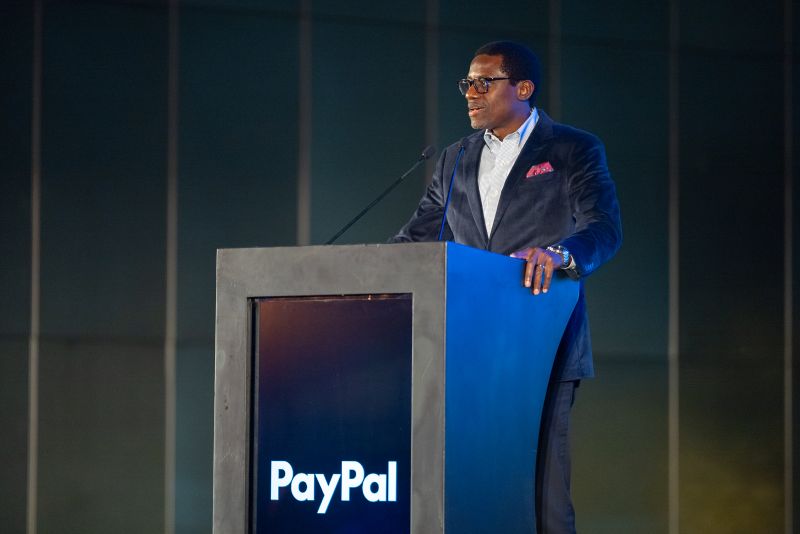
Otto Williams, PayPal’s Senior Vice President, Regional Head for the Middle East and AfricaOtto Williams, PayPal’s Senior Vice President, Regional Head for the Middle East and Africa

Scepticism about this new 2026 promise is high, and for good reason. The company has tried to enter Africa before with “half-measures” that often felt like PR wins rather than actual solutions.

In 2014, a partnership with First Bank of Nigeria was restricted to bank customers and was “send-only.” First Bank had said in one document: In 2021, a partnership with Flutterwave helped businesses but did little for the average person. These attempts failed because they tried to force Africans into a restricted Western banking box.

Meanwhile, since PayPal’s exit, Africa built its own world. Kenya’s M-Pesa revolutionised finance, processing KSh 39.39 trillion (around $300 billion) in Kenya alone. Today, Africa accounts for 70% of global mobile money transaction value.

Homegrown giants like Flutterwave and Paystack filled the void, solving the “last-mile” problems PayPal once deemed impossible.

The new strategy for PayPal World

The 2026 strategy for PayPal World is a quiet admission that the company cannot win the “wallet war” in Africa. Instead of trying to get you to open a PayPal account, the company is now trying to be the “bridge” for the wallet you already use.

Three fundamental shifts made this viable. First, regulatory maturity has improved with systems like Nigeria’s Bank Verification Number (BVN). Second, PayPal no longer has to build from scratch, they can partner with established giants like Safaricom and MTN.

Finally, there is economic pressure. As Western markets slow down, Africa’s young, urban population represents the last major frontier for growth.

For the average user, this is a major shift. In the past, you had to move into PayPal’s “house” and follow its strict rules. If they didn’t like your activity, they locked you out. With PayPal World, they are simply building a door between your house (like M-Pesa or MTN MoMo) and the rest of the world.

Market Opportunity
Nowchain Logo
Nowchain Price(NOW)
$0.00237
$0.00237$0.00237
-2.06%
USD
Nowchain (NOW) Live Price Chart
Disclaimer: The articles reposted on this site are sourced from public platforms and are provided for informational purposes only. They do not necessarily reflect the views of MEXC. All rights remain with the original authors. If you believe any content infringes on third-party rights, please contact service@support.mexc.com for removal. MEXC makes no guarantees regarding the accuracy, completeness, or timeliness of the content and is not responsible for any actions taken based on the information provided. The content does not constitute financial, legal, or other professional advice, nor should it be considered a recommendation or endorsement by MEXC.

You May Also Like

American Bitcoin’s $5B Nasdaq Debut Puts Trump-Backed Miner in Crypto Spotlight

American Bitcoin’s $5B Nasdaq Debut Puts Trump-Backed Miner in Crypto Spotlight

The post American Bitcoin’s $5B Nasdaq Debut Puts Trump-Backed Miner in Crypto Spotlight appeared on BitcoinEthereumNews.com. Key Takeaways: American Bitcoin (ABTC) surged nearly 85% on its Nasdaq debut, briefly reaching a $5B valuation. The Trump family, alongside Hut 8 Mining, controls 98% of the newly merged crypto-mining entity. Eric Trump called Bitcoin “modern-day gold,” predicting it could reach $1 million per coin. American Bitcoin, a fast-rising crypto mining firm with strong political and institutional backing, has officially entered Wall Street. After merging with Gryphon Digital Mining, the company made its Nasdaq debut under the ticker ABTC, instantly drawing global attention to both its stock performance and its bold vision for Bitcoin’s future. Read More: Trump-Backed Crypto Firm Eyes Asia for Bold Bitcoin Expansion Nasdaq Debut: An Explosive First Day ABTC’s first day of trading proved as dramatic as expected. Shares surged almost 85% at the open, touching a peak of $14 before settling at lower levels by the close. That initial spike valued the company around $5 billion, positioning it as one of 2025’s most-watched listings. At the last session, ABTC has been trading at $7.28 per share, which is a small positive 2.97% per day. Although the price has decelerated since opening highs, analysts note that the company has been off to a strong start and early investor activity is a hard-to-find feat in a newly-launched crypto mining business. According to market watchers, the listing comes at a time of new momentum in the digital asset markets. With Bitcoin trading above $110,000 this quarter, American Bitcoin’s entry comes at a time when both institutional investors and retail traders are showing heightened interest in exposure to Bitcoin-linked equities. Ownership Structure: Trump Family and Hut 8 at the Helm Its management and ownership set up has increased the visibility of the company. The Trump family and the Canadian mining giant Hut 8 Mining jointly own 98 percent…
Share
BitcoinEthereumNews2025/09/18 01:33
Trump Reviews Candidates to Succeed Fed Chair Powell

Trump Reviews Candidates to Succeed Fed Chair Powell

The post Trump Reviews Candidates to Succeed Fed Chair Powell appeared on BitcoinEthereumNews.com. Key Points: Trump evaluates Fed Chair candidates, considering
Share
BitcoinEthereumNews2025/12/19 08:34
CME Group to launch options on XRP and SOL futures

CME Group to launch options on XRP and SOL futures

The post CME Group to launch options on XRP and SOL futures appeared on BitcoinEthereumNews.com. CME Group will offer options based on the derivative markets on Solana (SOL) and XRP. The new markets will open on October 13, after regulatory approval.  CME Group will expand its crypto products with options on the futures markets of Solana (SOL) and XRP. The futures market will start on October 13, after regulatory review and approval.  The options will allow the trading of MicroSol, XRP, and MicroXRP futures, with expiry dates available every business day, monthly, and quarterly. The new products will be added to the existing BTC and ETH options markets. ‘The launch of these options contracts builds on the significant growth and increasing liquidity we have seen across our suite of Solana and XRP futures,’ said Giovanni Vicioso, CME Group Global Head of Cryptocurrency Products. The options contracts will have two main sizes, tracking the futures contracts. The new market will be suitable for sophisticated institutional traders, as well as active individual traders. The addition of options markets singles out XRP and SOL as liquid enough to offer the potential to bet on a market direction.  The options on futures arrive a few months after the launch of SOL futures. Both SOL and XRP had peak volumes in August, though XRP activity has slowed down in September. XRP and SOL options to tap both institutions and active traders Crypto options are one of the indicators of market attitudes, with XRP and SOL receiving a new way to gauge sentiment. The contracts will be supported by the Cumberland team.  ‘As one of the biggest liquidity providers in the ecosystem, the Cumberland team is excited to support CME Group’s continued expansion of crypto offerings,’ said Roman Makarov, Head of Cumberland Options Trading at DRW. ‘The launch of options on Solana and XRP futures is the latest example of the…
Share
BitcoinEthereumNews2025/09/18 00:56
