Despite the near-term weakness, Bitcoin’s price action continues to suggest a consolidation phase rather than a structural breakdown, shaping the current BitcoinDespite the near-term weakness, Bitcoin’s price action continues to suggest a consolidation phase rather than a structural breakdown, shaping the current Bitcoin

Best Crypto to Buy Now: Bitcoin Price Prediction

5 min read
Best Crypto to Buy Now: Bitcoin Price Prediction

Despite the near-term weakness, Bitcoin’s price action continues to suggest a consolidation phase rather than a structural breakdown, shaping the current Bitcoin price prediction around a period of base-building before a larger directional move.

Previous cycles show that similar pullbacks driven by macro uncertainty have often resolved higher once liquidity conditions stabilize and risk appetite returns. If inflation data continues to cool and financial conditions ease, Bitcoin could recover toward prior resistance zones later this year.

In that context, the best crypto to buy now is increasingly defined by networks showing measurable demand, rising transaction activity, and clear economic incentives, rather than speculative momentum alone.

Bitcoin Faces Pressure: Japan’s Rate Hike Sends Ripples Through Crypto

Bitcoin faced downward pressure from multiple factors, with no single catalyst driving the move, and prices may remain under stress in the near term. The largest macro influence came from Japan, where markets anticipated a Bank of Japan rate hike to historic levels later this week.

Even a modest hike matters because Japan has long driven global risk markets through the yen carry trade. For years, investors borrowed cheap yen to buy higher-risk assets like equities and crypto. As Japanese rates rise, that trade unwinds. Investors sell risk assets to cover yen liabilities.

Bitcoin has reacted sharply to past BOJ hikes, falling 20% to 30% in the weeks after the last three decisions. Traders priced in that historical pattern ahead of the move, pushing Bitcoin lower in advance.

Traders reduced risk ahead of key U.S. macro data, including inflation and labor reports, while the Federal Reserve signaled cautious pacing after its recent rate cut. This uncertainty impacts Bitcoin, which now reacts more to liquidity and macro conditions than as an independent hedge.

With inflation above target and jobs data expected to soften, markets hesitated on the Fed’s next move. That caution slowed speculation, and Bitcoin lost momentum near key technical levels.

Strategy Inc. Doubles Down on Bitcoin While Prices Drop

Bitcoin dropped as much as 7.21% to around $85,300 over the past seven days. It briefly recovered earlier this week, on Wednesday, December 10, reaching around $94,000 before retreating to its current level. The crypto asset remains down roughly 30% from its all-time high above $126,000.

Bitcoin’s decline has mirrored other risk assets in recent weeks, reflecting what analysts describe as a market under pressure from weak liquidity and reduced risk appetite, even after last week’s Federal Reserve rate cut.

Despite this, Michael Saylor’s Strategy Inc. continued its Bitcoin purchases. The digital asset treasury firm reported on Monday that it acquired nearly $1 billion in Bitcoin for the second week in a row.

Most of these recent purchases were funded through at-the-market sales of its Class A common stock, which critics argue may dilute existing shareholder equity and diminish the premium previously supported by its roughly $50 billion Bitcoin holdings.

Bitcoin Price Prediction

Bitcoin is approaching a historically strong support zone around the mid-$80,000 range, where a short-term bounce is possible, though a slightly deeper dip may be needed to trap short positions before a meaningful reversal occurs.

The market remains relatively stable despite occasional bearish pressure, providing opportunities for buyers near key support levels. Technical indicators point to potential moves toward $90,000 to $91,000, filling gaps and single prints from previous sessions.
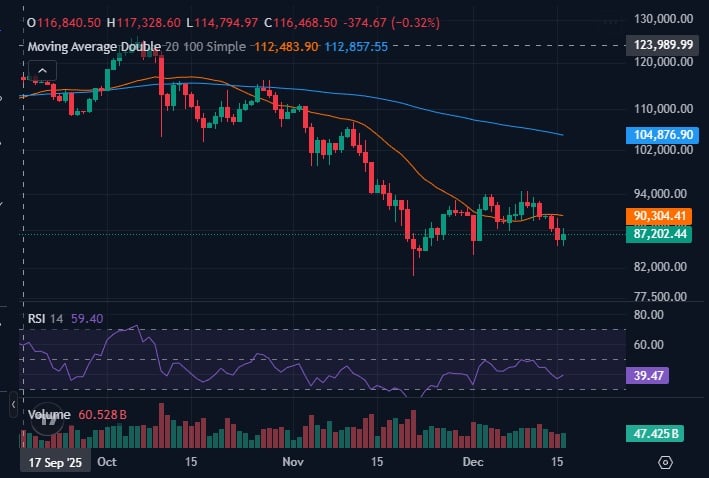
On higher time frames, Bitcoin is expected to continue consolidating until a decisive breakout occurs, potentially around the holiday period when liquidity may be lower.

Top Crypto to Buy Now: Promising Early-Stage Meme Coin Presales

While most altcoins remain highly correlated with Bitcoin, early-stage presale tokens are showing strong independent potential based on their funding momentum and market interest.

Below are two meme coin presales that have raised millions in funding and are recognized by many as the best crypto to buy now.

Bitcoin Hyper (HYPER)

Bitcoin Hyper, a new layer 2 upgrade for Bitcoin, is gaining significant attention as it raises nearly $30 million during a period of widespread market fear. The project is designed to enhance Bitcoin’s usability by enabling near-instant transactions on its layer 2 network.

This approach addresses Bitcoin’s long-standing limitation of slow transaction speeds, allowing applications and payments to operate efficiently without congesting the base layer.

Source – ClayBro YouTube Channel

Analysts highlight that Bitcoin Hyper provides a practical solution for Bitcoin to move, circulate, and scale within a high-speed environment, effectively giving the network room to function as a living economic ecosystem.

Current prices remain accessible for early-stage investors, and the layer 2 network could significantly increase Bitcoin’s real-world utility. Market interest continues to grow as adoption and community engagement expand.

Visit Bitcoin Hyper

Pepenode (PEPENODE)

Pepenode has emerged asone of the best crypto to buy now, gaining attention for its innovative presale and in-game utility mechanics. The project combines mine-to-earn GameFi features with meme coin elements, allowing users to build virtual server rooms, purchase nodes, and engage in competitive mining for bonuses.

Its presale has already raised nearly $2.5 million, reflecting strong investor interest, with staking offering annualized returns of around 550%. Despite a broader market dominated by fear and muted altcoin performance, Pepenode stands out for its potential during speculative market upswings.

The combination of funding momentum, gaming utility, and staking incentives positions it as a prominent early-stage altcoin to watch. Market sentiment may drive further growth as fear transitions to greed.

Visit Pepenode

This article has been provided by one of our commercial partners and does not reflect Cryptonomist’s opinion. Please be aware our commercial partners may use affiliate programs to generate revenues through the links on this article.

Market Opportunity
Best Wallet Logo
Best Wallet Price(BEST)
$0.001435
$0.001435$0.001435
-1.91%
USD
Best Wallet (BEST) Live Price Chart
Disclaimer: The articles reposted on this site are sourced from public platforms and are provided for informational purposes only. They do not necessarily reflect the views of MEXC. All rights remain with the original authors. If you believe any content infringes on third-party rights, please contact service@support.mexc.com for removal. MEXC makes no guarantees regarding the accuracy, completeness, or timeliness of the content and is not responsible for any actions taken based on the information provided. The content does not constitute financial, legal, or other professional advice, nor should it be considered a recommendation or endorsement by MEXC.

You May Also Like

Trading time: Tonight, the US GDP and the upcoming non-farm data will become the market focus. Institutions are bullish on BTC to $120,000 in the second quarter.

Trading time: Tonight, the US GDP and the upcoming non-farm data will become the market focus. Institutions are bullish on BTC to $120,000 in the second quarter.

Daily market key data review and trend analysis, produced by PANews.
Share
PANews2025/04/30 13:50
Ethereum Fusaka Upgrade Set for December 3 Mainnet Launch, Blob Capacity to Double

Ethereum Fusaka Upgrade Set for December 3 Mainnet Launch, Blob Capacity to Double

Ethereum developers confirmed the Fusaka upgrade will activate on mainnet on December 3, 2025, following a systematic testnet rollout beginning on October 1 on Holesky. The major hard fork will implement around 11-12 Ethereum Improvement Proposals targeting scalability, node efficiency, and data availability improvements without adding new user-facing features. According to Christine Kim, the upgrade introduces a phased blob capacity expansion through Blob Parameter Only forks occurring two weeks after Fusaka activation. Initially maintaining current blob limits of 6/9 target/max, the first BPO fork will increase capacity to 10/15 blobs one week later. A second BPO fork will further expand limits to 14/21 blobs, more than doubling total capacity within two weeks. Strategic Infrastructure Overhaul Fusaka prioritizes backend protocol improvements over user-facing features, focusing on making Ethereum faster and less resource-intensive. The upgrade includes PeerDAS implementation through EIP-7594, allowing validator nodes to verify data by sampling small pieces rather than downloading entire blobs. This reduces bandwidth and storage requirements while enhancing Layer 2 rollup scalability. The upgrade builds on recent gas limit increases from 30 million to 45 million gas, with ongoing discussions for further expansion. EIP-7935 proposes increasing limits to 150 million gas, potentially enabling significantly higher transaction throughput. These improvements complement broader scalability efforts, including EIP-9698, which suggests a 100x gas limit increase over two years to reach 2,000 transactions per second. Fusaka removes the previously planned EVM Object Format redesign to reduce complexity while maintaining focus on essential infrastructure improvements. The upgrade introduces bounded base fees for blob transactions via EIP-7918, creating more predictable transaction costs for data-heavy applications. Enhanced spam resistance and security improvements strengthen network resilience against scalability bottlenecks and attacks. Technical Implementation and Testing Timeline The Fusaka rollout follows a conservative four-phase approach across Ethereum testnets before mainnet deployment. Holesky upgrade occurs October 1, followed by Sepolia on October 14 and Hoodi on October 28. Each testnet will undergo the complete BPO fork sequence to validate the blob capacity expansion mechanism. BPO forks activate automatically based on predetermined epochs rather than requiring separate hard fork processes. On mainnet, the first BPO fork launches December 17, increasing blob capacity to 10/15 target/max. The second BPO fork activates January 7, 2026, reaching the final capacity of 14/21 blobs. This automated approach enables flexible blob scaling without requiring full network upgrades. Notably, node operators face release deadlines ranging from September 25 for Holesky to November 3 for mainnet preparation. The staggered timeline, according to the developers, allows comprehensive testing while giving infrastructure providers sufficient preparation time. Speculatively, the developers use this backward-compatible approach to ensure smooth transitions with minimal disruption to existing applications. PeerDAS implementation reduces node resource demands, potentially increasing network decentralization by lowering barriers for smaller operators. The technology enables more efficient data availability sampling, crucial for supporting growing Layer 2 rollup adoption. Overall, these improvements, combined with increased gas limits, will enable Ethereum to handle higher transaction volumes while maintaining security guarantees. Addressing Network Scalability Pressures The Fusaka upgrade addresses mounting pressure for Ethereum base layer improvements amid criticism of Layer 2 fragmentation strategies. Critics argue that reliance on rollups has created isolated chains with limited interoperability, complicating user experiences. The upgrade’s focus on infrastructure improvements aims to enhance base layer capacity while supporting continued Layer 2 growth. The recent validator queue controversy particularly highlights ongoing network scalability challenges. According to a Cryptonews report covered yesterday, currently, over 2M ETH sits in exit queues facing 43-day delays, while entry queues process in just 7 days.Ethereum Validator Queue (Source: ValidatorQueue) However, Vitalik Buterin defended these delays as essential for network security, comparing validator commitments to military service requiring “friction in quitting.” The upgrade coincides with growing institutional interest in Ethereum infrastructure, with VanEck predicting that Layer 2 networks could reach $1 trillion market capitalization within six years. Fusaka’s emphasis on data availability and node efficiency supports Ethereum’s evolution toward seamless cross-chain interoperability. The upgrade complements initiatives like the Open Intents Framework, where Coinbase Payments recently joined as a core contributor. The initiative, if successful, will address the $21B surge in cross-chain crime. These coordinated efforts aim to unify the fragmented multichain experience while maintaining Ethereum’s security and decentralization principles
Share
CryptoNews2025/09/19 16:37
VectorUSA Achieves Fortinet’s Engage Preferred Services Partner Designation

VectorUSA Achieves Fortinet’s Engage Preferred Services Partner Designation

TORRANCE, Calif., Feb. 3, 2026 /PRNewswire/ — VectorUSA, a trusted technology solutions provider, specializes in delivering integrated IT, security, and infrastructure
Share
AI Journal2026/02/05 00:02
