👨🏿🚀TechCabal Daily – The Wolf of safe streets
Howdy. 
On the Francophone Weekly by TechCabal, our latest newsletter for French-speaking Africa, we’ve been discussing capital efficiency in Africa’s tech ecosystem for a month now. We explored debt as a growth-friendly financial vehicle for operations-heavy startups, spotlighting Julaya, an Ivorian SME-focused fintech adopting this strategy. Later, we shifted the conversation to how Africa can use local exchanges as a capital-raising avenue for growth-stage startups, and even SMEs, to access sustainable capital.
This week, we’re publishing the second part of our series examining how local exchanges can attract SMEs to list, using the Bourse Régionale des Valeurs Mobilières (BRVM), the regional bourse serving eight French-speaking West African countries, as our case study. We speak with Houmou Ormon, director of the BRVM national representative office, about the bourse’s potential as a capital-raising option for startups and what they’ve learned from SMEs and founders. Sign up here to receive today’s newsletter straight to your inbox.
Catch up on previous editions of Francophone Weekly by TechCabal.
- Kenya says Safaricom executives must be citizens
- Community Wolf acquires Namola
- Capitec agrees to buy Walletdoc
- Starlink’s rebound in Kenya
- Cool Stuff

- World Wide Web 3
- Opportunities
Companies
Kenya says Safaricom must appoint citizens as leaders in fresh rules for Vodacom takeover
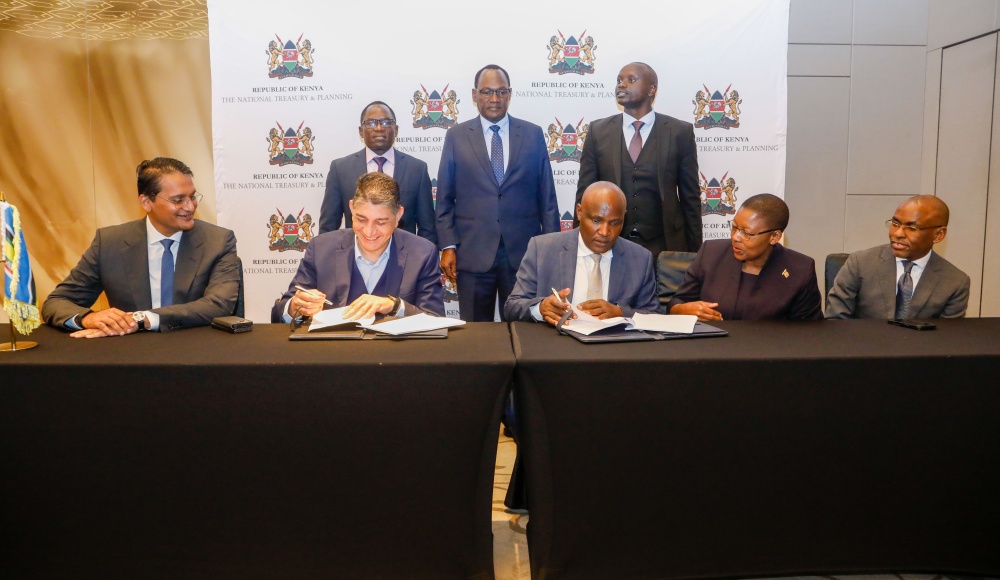 National treasury CS Hon. FCPA John Mbadi (seated, centre) during the National Treasury market updates and MoU signing ceremony at the Jw Marriot hotel in Nairobi on Monday/Image Source: TechCabal
Do you remember the whole Vodacom-Safaricom dance we delivered to your inbox on Friday? The one where we noted that Vodafone, owned by Vodacom, now has a 55% majority control stake in Safaricom due to the Kenyan government selling 15% of its stake. Remember, we noted Vodacom was still awaiting regulatory approvals from the Capital Markets Authority (CMA), the Competition Authority (CAK), the Central Bank of Kenya (CBK), and regional competition bodies before gaining full control. Vodacom has also said it is not trying to take full control of Safaricom, but well, whatever the long-term plan is, the Kenyan government has given conditions for the deal to progress, and they are… firm.
Top of the list: Safaricom’s CEO and board chair must be Kenyan citizens. Full stop. Regardless of a foreign majority ownership or not, the Kenyan government wants leadership to stay local.
That’s just the beginning: Vodacom cannot alter Safaricom’s name, trademarks, brand identity, or corporate symbols without government approval. It also can not introduce sweeping changes to suppliers or declare staff redundancies outside normal business cycles. Even expansion outside Kenya requires consultation with the state. In addition, all Safaricom and M-PESA Foundation trustees must be Kenyan, and its funds must be spent domestically.
What does this mean? The Kenyan government needed some extra cash, but not a loss of control. Safaricom is a national asset, and these conditions allow the government to preserve its identity, workforce, and regional priorities even after selling a significant stake.
Is this unusual in Africa? Surprisingly, no. Countries often tighten governance rules when foreign ownership rises. In Ethiopia, foreign investors are only allowed to own up to 49% of local banks. This is after decades of the country’s banking industry being off-limits for foreign players.
Can Kenya do this legally? If Vodacom agreed to the terms, and it looks like they did, then absolutely. So yes, Vodacom is getting 55%, but Kenya is holding the steering wheel with two hands.
Powering businesses across Africa to pay and get paid in local currencies.
With Fincra, businesses, startups, global enterprises and platforms can easily send and receive payments in multiple African currencies, empowering trade, and growth across the continent. Create your account in 3 minutes.
M&A
South African safety-tech startup Community Wolf acquires Namola
 Image Source: Startup Researcher
Community Wolf, a South African safety-tech startup, has acquired emergency-response app Namola for an undisclosed amount, and this consolidation actually matters for a country where safety failures are a daily reality.
The deal is less about consolidation and more about whether technology can finally knit together a system that has long been defined by fragmentation, uneven service quality, and slow, unreliable response times.
State of play: South Africa’s safety landscape has strong players, but none of them talk to each other. Police data is delayed, neighbourhood groups rely on WhatsApp chaos, private security firms guard specific pockets, and emergency numbers vary from province to province. Community Wolf thinks there’s an opportunity to build a single layer that pulls all of this together.
Its AI-driven WhatsApp reporting already gives communities real-time visibility that SAPS simply can’t. Namola brings something Wolf lacks: a nationwide, established response network with a decade of user trust.
Between the lines: That is why this acquisition is interesting. It is not about scale for the sake of scale; it is about combining immediacy with infrastructure. If it works, Community Wolf becomes the platform that sits above South Africa’s messy safety ecosystem and makes it usable. That is a compelling ambition in a market projected to reach almost $2 billion by 2030.
Is this a win for Africa? It’s at least a win for continuity. Namola gets revived instead of shelved. Community Wolf gains the legitimacy and distribution it could never build quickly on its own. The hard part now is execution. But if the integration holds, this could be one of the rare deals that genuinely shifts how everyday people experience safety in South Africa.
Enjoy smooth payments while you’re home this Detty December

Coming home for Detty December? Enjoy smooth payments every day with your Paga US account. Send money to any bank instantly. Don’t miss out, get started now.
M&A
Capitec agrees $23 million deal to acquire fintech Walletdoc
 Image Source: ZIkoko Memes/TechCabal
In more South African acquisition news, Capitec Bank, South Africa’s largest retail bank by customer base, has signed a deal to acquire Walletdoc, a South African fintech, for R400 million ($23 million). Capitec will put R300 million ($17 million) down in cash upfront, with the remaining balance paid over three years as an earn-out tied to Walletdoc hitting performance targets. This means that if Walletdoc grows as Capitec hopes, the founders will get their balance. If not, they don’t.
Why does this matter? Capitec wants to expand beyond retail banking and sink its teeth deeper into South Africa’s fast-growing payments ecosystem. Walletdoc’s stack, including online payments, digital wallets, and real-time payouts, fits neatly into Capitec’s ongoing push to compete directly with Payfast, Peach Payments, Yoco, and the broader merchant services market.
And Capitec is not alone. In August 2025, South Africa’s Nedbank acquired Durban fintech, iKhokha, for $93 million to boost SME services.
The acquisition comes after Capitec partnered with Stitch, one of South Africa’s largest payments fintech startups, to allow customers to automate recurring payments for services like Netflix, deliveries, and bills, using Variable Recurring Payments (VRP), a smarter form of direct debit.
This isn’t Capitec’s first expansion beyond retail banking. In 2019, it acquired Mercantile Bank to enter the SME/business-banking market, and in 2024, it increased its stake in European online-lending fintech Avafin from 40.66% to 97.69%. The Walletdoc deal is still pending regulatory processes before further details emerge.
Stay up to date with Paystack news!
Subscribe to Paystack for a curated dose of product updates, insights, event invites and more. Subscribe here →.
Internet
Starlink rebounds in Kenya, hits 19,460 active users for the first time
 Image source: Tenor
If you love a good comeback story, we’re not sure you’ll like this one if you’re anti-Elon Musk. But Starlink, the billionaire’s satellite internet company, is blowing hot again in Kenya.
After last year’s humiliating freeze on urban sign-ups—an embarrassing admission that Nairobi and Mombasa users were pushing the network to its limits—the satellite provider has bounced from its sub-17,000 decline in June back to 19,460 active users, its highest yet.
Starlink previously paused new registrations in November 2024, only resuming in June 2025, and has seen a strong renewed uptake from customers. Yet the market Starlink is returning to isn’t the one it left. That six-month pause gave competitors exactly what they needed: time.
Safaricom used it to quietly cement its dominance, expanding fibre and blanketing more towns with affordable 5G routers. It now commands 35.6% of the fixed-internet market, while Airtel followed with its own cut-price hardware.
For most users—especially the mass market that simply wants “fast enough” internet at the lowest possible cost—KES 3,000 ($23) routers beat a KES 27,000 ($208) Starlink Mini every day of the week.
Starlink’s edge is no longer selling novel technology, as customers now want whatever is good enough and cheap. Yet its real play is holding the high ground in places where “good enough” still isn’t available—rural pockets where fibre won’t go and 5G can’t hold a signal. That reliability premium might be the lifeline Starlink needs, especially as the market shifts toward low-cost hardware.
The Information reports that its parent company, SpaceX, is eyeing a 2026 IPO, keeping Starlink as part of that deal, and reversing earlier spin-off plans. If SpaceX becomes a publicly traded company, Starlink’s performance in frontier markets like Kenya will become part of the growth story SpaceX has to sell to investors, putting more pressure on the satellite unit to prove it can scale beyond being a niche premium option.
AI in a Nutshell gives you weekly AI knowledge and insights

Want to stay close to AI but hate long reads? AI in a Nutshell gives you weekly AI knowledge, news, tools, and insights – short, smart, and fun. Perfect for curious (but lazy) readers who still want to stay ahead. Subscribe here.
COOL STUFF
Nigerian YC-backed food delivery startup Chowdeck has now surpassed 2 million registered users on its platform, roughly a year after announcing it had crossed the 1 million user mark and over ₦30 billion ($21 million) in deliveries. This year alone, the company processed over ₦1.4 billion ($965,000) in Black Friday orders, a surge that sits comfortably on top of its 1 million monthly orders and rapid city expansion. It’s a wild trajectory for what started as a Lagos COVID-era side bet and is now one of West Africa’s most scaled consumer internet products.
Shout-out to Femi Aluko and the team.
CRYPTO TRACKER
The World Wide Web3
Source:

|
Coin Name |
Current Value |
Day |
Month |
|---|---|---|---|
| Bitcoin | $89,951 |
– 1.28% |
– 11.60% |
| Ether | $3,107 |
– 0.58% |
– 8.08% |
| Yooldo | $0.4066 |
+ 3.60% |
+ 92.15% |
| Solana | $132.76 |
– 1.51% |
– 15.81% |
* Data as of 06.11 AM WAT, December 9, 2025.
Opportunities
- The Growth Talent Accelerator Programme (GTAP) is alGROWithm’s flagship training experience designed to turn ambitious professionals, operators, and teams into world-class Growth Engineers. If you’re an individual looking to upskill and become indispensable in 2026, or a company looking to strengthen your team, optimise operations, and increase revenue, GTAP 2026 is the right place to start. Apply for the Lite stream as an individual or nominate your team for the Pro stream
- Every startup has a story worth hearing. My Startup in 60 Seconds by TechCabal offers founders a one-minute spotlight to share their vision, challenges, and achievements. Beyond visibility, it connects you to investors, customers, and Africa’s tech ecosystem. Apply to be featured or explore other TechCabal advertorial opportunities. This is a paid opportunity.
- Win $30 Weekly This Christmas! This December, cross-border payment company Accrue is giving away $30 weekly, and you could be one of the lucky winners! Getting started is simple: just download the Accrue app from the App Store or Google Play Store and jump right into the challenge, and maybe even snag a little holiday cash while you’re at it.
- Ask An Investor: Blockchain, not crypto, is driving Africa’s next wave of venture bets, says CV VC’s Jarryd Kennedy
- Follow The Money: The office giving freelancers a shot at fighting unfair taxes from 2026
- The new logistics hub that wants to cut Nigeria’s port clearance timelines by 70%
- Africa’s internet is about to change forever – thanks to a satellite arms race
Written by: Opeyemi Kareem and Emmanuel Nwosu
Edited by: Emmanuel Nwosu & Ganiu Oloruntade
Want more of TechCabal?
Sign up for our insightful newsletters on the business and economy of tech in Africa.
- The Next Wave: futuristic analysis of the business of tech in Africa.
- TC Scoops: breaking news from TechCabal
- Francophone Weekly by TechCabal: insider insights and analysis of Francophone’s tech ecosystem
P:S If you’re often missing TC Daily in your inbox, check your Promotions folder and move any edition of TC Daily from “Promotions” to your “Main” or “Primary” folder and TC Daily will always come to you.

You May Also Like

Wormhole Unveils W Token 2.0 with Enhanced Tokenomics
![[OPINION] US National Security Strategy 2025: An iconoclastic document](https://www.rappler.com/tachyon/2025/12/AMERICANS-ARE-BACK-DEC-12-2025.jpg?resize=75%2C75&crop_strategy=attention)
[OPINION] US National Security Strategy 2025: An iconoclastic document