USPD stablecoin protocol falls prey to an advanced CPIMP attack costing 1M. During deployment, Hacker took control and went underground, taking months before emptying the coffers. A critical exploit was confirmed by the USPD protocol. The attacker minted 98 million USPD tokens. About 232 stETH was liquidated out of liquidity pools. As per the USPD […] The post $1M Drained: Hacker’s “Ghost” Protocol Attack Exposed appeared first on Live Bitcoin News.USPD stablecoin protocol falls prey to an advanced CPIMP attack costing 1M. During deployment, Hacker took control and went underground, taking months before emptying the coffers. A critical exploit was confirmed by the USPD protocol. The attacker minted 98 million USPD tokens. About 232 stETH was liquidated out of liquidity pools. As per the USPD […] The post $1M Drained: Hacker’s “Ghost” Protocol Attack Exposed appeared first on Live Bitcoin News.

$1M Drained: Hacker’s “Ghost” Protocol Attack Exposed

2025/12/06 15:45

USPD stablecoin protocol falls prey to an advanced CPIMP attack costing 1M. During deployment, Hacker took control and went underground, taking months before emptying the coffers.

A critical exploit was confirmed by the USPD protocol. The attacker minted 98 million USPD tokens. About 232 stETH was liquidated out of liquidity pools.

As per the USPD on X, users need to stop purchasing the USPD. The group put out a security emergency warning 20 hours ago. Every approval is to be canceled immediately.
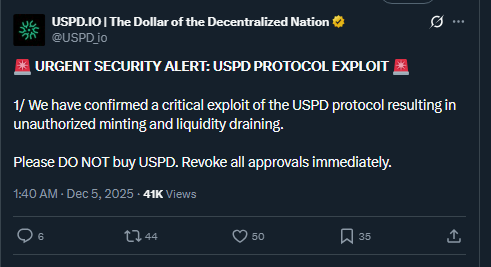
$1M Drained: Hacker's "Ghost" Protocol Attack Exposed

Source:   USPD on X

Hidden Attack Went Unnoticed Since September

It was not a code vulnerability breach. USPD was audited by Nethermind and Resonance regarding security. The logic of smart contracts was not compromised in the incident.

Rather, attackers used a CPIMP attack vector. This abbreviates Clandestine Proxy in the Middle of Proxy. The adventure took place on deployment on the 16th of September.

The Multicall3 transaction was used to initialize the proxy with the aid of the hacker. Before deployment scripts would complete, admin privileges were stolen. A shadow implementation sent calls to the valid audited code.

Etherscan Verification Tools Fooled Completely

The presence of the attacker was hidden by the manipulation of the event payload. Storage slot spoofing played around the Etherscan verification system. The site portrayed audited contracts as ongoing implementations.

This camouflage avoided every verification tool as tweeted by USPD_io on X. Security checks performed manually did not reveal any suspicious items. The hacker was lurking in full view for months.

Proxy upgrades were available yesterday by accessing a proxy via a hidden means. Unlicensed coins struck the world with tokens. Minting operations are followed by the draining of liquidity.

You might also like: Crypto Hack News: North Korean Hackers Exploit EtherHiding for Crypto Thefts

Law Enforcement and CEXs Now Tracking Stolen Funds

USPD representatives marked out the addresses of attackers with significant exchanges. Notifications were made on both centralized and decentralized platforms. Now, fund flow monitoring is operational on platforms.

There are two addresses under investigation. Infector wallet = 0x7C97313f349608f59A07C23b18Ce523A33219d83. Drainer address = 0x083379BDAC3E138cb0C7210e0282fbC466A3215A.

The team provided a whitehat resolution path. Attackers can refund 90 percent of stolen funds. When funds are recovered, law enforcement will be halted.

The USPD officials have assured a technical post-mortem shortly. Transparency in the community is still a priority. The recovery process goes on with major security organizations.

The protocol showed how new attack vectors are putting security to the test. This advanced attack was not thwarted by even the stringent audits. An industry-wide implication is now being looked at.

The post $1M Drained: Hacker’s “Ghost” Protocol Attack Exposed appeared first on Live Bitcoin News.

Disclaimer: The articles reposted on this site are sourced from public platforms and are provided for informational purposes only. They do not necessarily reflect the views of MEXC. All rights remain with the original authors. If you believe any content infringes on third-party rights, please contact service@support.mexc.com for removal. MEXC makes no guarantees regarding the accuracy, completeness, or timeliness of the content and is not responsible for any actions taken based on the information provided. The content does not constitute financial, legal, or other professional advice, nor should it be considered a recommendation or endorsement by MEXC.

You May Also Like

Aave DAO to Shut Down 50% of L2s While Doubling Down on GHO

Aave DAO to Shut Down 50% of L2s While Doubling Down on GHO

The post Aave DAO to Shut Down 50% of L2s While Doubling Down on GHO appeared on BitcoinEthereumNews.com. Aave DAO is gearing up for a significant overhaul by shutting down over 50% of underperforming L2 instances. It is also restructuring its governance framework and deploying over $100 million to boost GHO. This could be a pivotal moment that propels Aave back to the forefront of on-chain lending or sparks unprecedented controversy within the DeFi community. Sponsored Sponsored ACI Proposes Shutting Down 50% of L2s The “State of the Union” report by the Aave Chan Initiative (ACI) paints a candid picture. After a turbulent period in the DeFi market and internal challenges, Aave (AAVE) now leads in key metrics: TVL, revenue, market share, and borrowing volume. Aave’s annual revenue of $130 million surpasses the combined cash reserves of its competitors. Tokenomics improvements and the AAVE token buyback program have also contributed to the ecosystem’s growth. Aave global metrics. Source: Aave However, the ACI’s report also highlights several pain points. First, regarding the Layer-2 (L2) strategy. While Aave’s L2 strategy was once a key driver of success, it is no longer fit for purpose. Over half of Aave’s instances on L2s and alt-L1s are not economically viable. Based on year-to-date data, over 86.6% of Aave’s revenue comes from the mainnet, indicating that everything else is a side quest. On this basis, ACI proposes closing underperforming networks. The DAO should invest in key networks with significant differentiators. Second, ACI is pushing for a complete overhaul of the “friendly fork” framework, as most have been unimpressive regarding TVL and revenue. In some cases, attackers have exploited them to Aave’s detriment, as seen with Spark. Sponsored Sponsored “The friendly fork model had a good intention but bad execution where the DAO was too friendly towards these forks, allowing the DAO only little upside,” the report states. Third, the instance model, once a smart…
Share
BitcoinEthereumNews2025/09/18 02:28
Xinjiang Mining Shutdown Sparks Network Security Concerns

Xinjiang Mining Shutdown Sparks Network Security Concerns

The post Xinjiang Mining Shutdown Sparks Network Security Concerns appeared on BitcoinEthereumNews.com. Bitcoin Hashrate Plummets 8%: Xinjiang Mining Shutdown Sparks
Share
BitcoinEthereumNews2025/12/15 16:50