

- Scotiabank
- National Bank
- RBC
- CIBC
- BMO
- TD
From RBC to TD, Canada’s major banks posted fourth-quarter earnings this week, highlighting shifting profits, credit trends, and signals for investors. The post Stock news for investors: Fourth-quarter earnings roll in from Canada’s big banks appeared first on MoneySense.From RBC to TD, Canada’s major banks posted fourth-quarter earnings this week, highlighting shifting profits, credit trends, and signals for investors. The post Stock news for investors: Fourth-quarter earnings roll in from Canada’s big banks appeared first on MoneySense.
Stock news for investors: Fourth-quarter earnings roll in from Canada’s big banks
Featured RRSP Accounts
featured
EQ Bank
Build your retirement savings with 1.50% interest, tax-deferred contributions and zero fees.
go to site
featured
Registered GIC rate
Earn a guaranteed 2.75% in your RRSP when you lock in for 1 year.
go to site
Best RRSP rates
See our ranking of the best RRSP accounts and rates available in Canada.
read now
MoneySense is an award-winning magazine, helping Canadians navigate money matters since 1999. Our editorial team of trained journalists works closely with leading personal finance experts in Canada. To help you find the best financial products, we compare the offerings from over 12 major institutions, including banks, credit unions and card issuers. Learn more about our advertising and trusted partners.
Scotiabank reports $2.21B Q4 profit up from $1.69B a year ago
Scotiabank (TSX:BNS)
Numbers for its fourth quarter:
- Profit: $2.21 billion (up from $1.69 billion a year ago)
- Revenue: $9.80 billion (up from $8.53 billion)
Scotiabank says it earned $2.21 billion in net income for its fourth quarter, up from $1.69 billion in the same quarter last year, helped by strength in its wealth management and capital markets businesses. The bank said Tuesday the profit amounted to $1.65 per diluted share for the quarter ended Oct. 31, up from $1.22 per diluted share in the same period a year ago.
Revenue totalled $9.80 billion, up from $8.53 billion in the same quarter last year. The bank’s provision for credit losses amounted to $1.11 billion for the quarter, up from $1.03 billion a year ago.
On an adjusted basis, Scotiabank says it earned $1.93 per diluted share in its latest quarter, up from an adjusted profit of $1.57 per diluted share a year ago. Analysts on average had expected an adjusted profit of $1.84, according to estimates compiled by LSEG Data & Analytics.
Scotiabank chief executive Scott Thomson said 2025 was a very positive year for the bank. “We delivered improving results through the year as we strengthened our balance sheet, improved our loan-to-deposit ratio, and increased return on equity,” Thomson said in a statement. “This quarter all our business lines reported year-over-year earnings growth with particular strength in global wealth management and global banking and markets and improving results in Canadian banking.”
The bank’s global wealth management business earned $447 million in net income attributable to equity holders, up from $380 million in the same quarter last year, while its global banking and markets business earned $519 million for the quarter, up from $347 million a year ago.
Scotiabank’s Canadian banking operations earned $941 million in its latest quarter, up from $934 million in the same quarter last year. Meanwhile, Scotiabank’s international banking arm earned $634 million in net income attributable to equity holders of the bank for the quarter, up from $600 million a year ago.
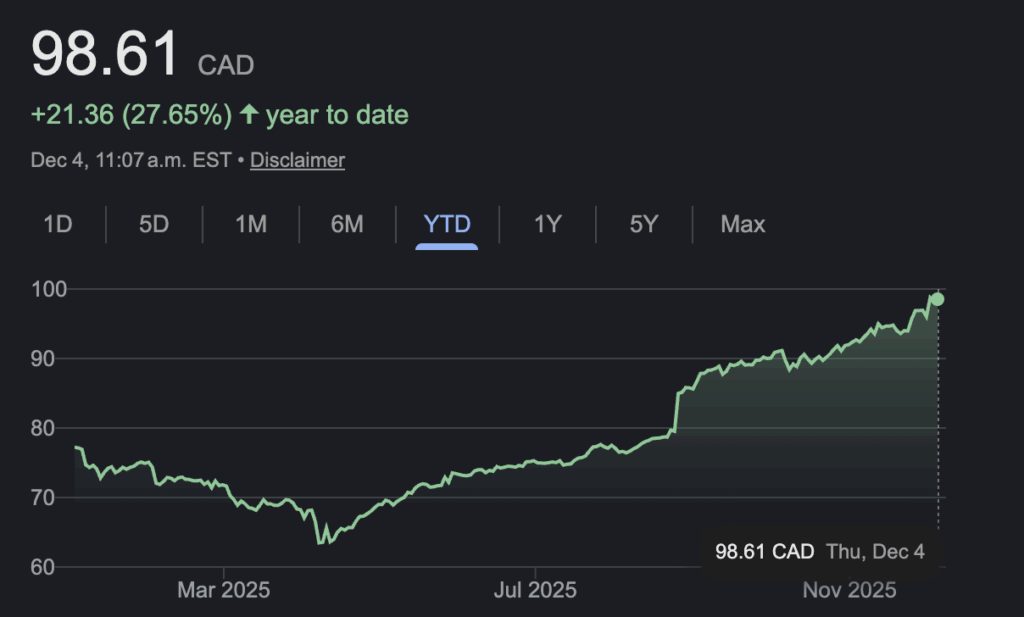 Source Google
National Bank reports $1.06B fourth-quarter profit, raises dividend
National Bank of Canada (TSX:NA)
Numbers for its fourth quarter:
- Profit: $1.06 billion (up from $955 million a year ago)
- Revenue: $3.70 billion (up from $2.94 billion)
National Bank of Canada raised its dividend as it reported a fourth-quarter profit of $1.06 billion. The bank said Wednesday it will now pay a quarterly dividend of $1.24 per share, an increase of six cents.
National Bank, which announced Tuesday that it was buying Laurentian Bank’s retail and small business segments, says its fourth-quarter profit amounted to $2.57 per diluted share, compared with net income of $955 million or $2.66 per diluted share a year ago when it had fewer shares outstanding.
Revenue for the quarter ended Oct. 31 totalled $3.70 billion, up from $2.94 billion a year earlier.
The bank’s provisions for credit losses amounted to $244 million, up from $162 million in the same quarter last year. On an adjusted basis, National Bank says it earned $2.82 per diluted share in its latest quarter, up from an adjusted profit of $2.58 per diluted share in the same quarter last year. Analysts on average had expected an adjusted profit of $2.62 per share, according to estimates compiled by LSEG Data & Analytics.
“With our strengthened national presence, diversified business mix, strong capital ratios and prudent credit profile, we are well-positioned to generate continued growth and superior returns, in what will remain a complex macro-environment,” National Bank chief executive Laurent Ferreira said in a statement.
The bank said its personal and commercial banking group earned $319 million in its latest quarter, down from $327 million a year ago, as it was hit by costs related to the acquisition of Canadian Western Bank.
National Bank’s wealth management business earned $258 million, up from $219 million, while its capital markets arm earned $432 million, up from $306 million.
National Bank’s U.S. specialty finance and international operations earned $174 million, up from $157 million in the same quarter last year.
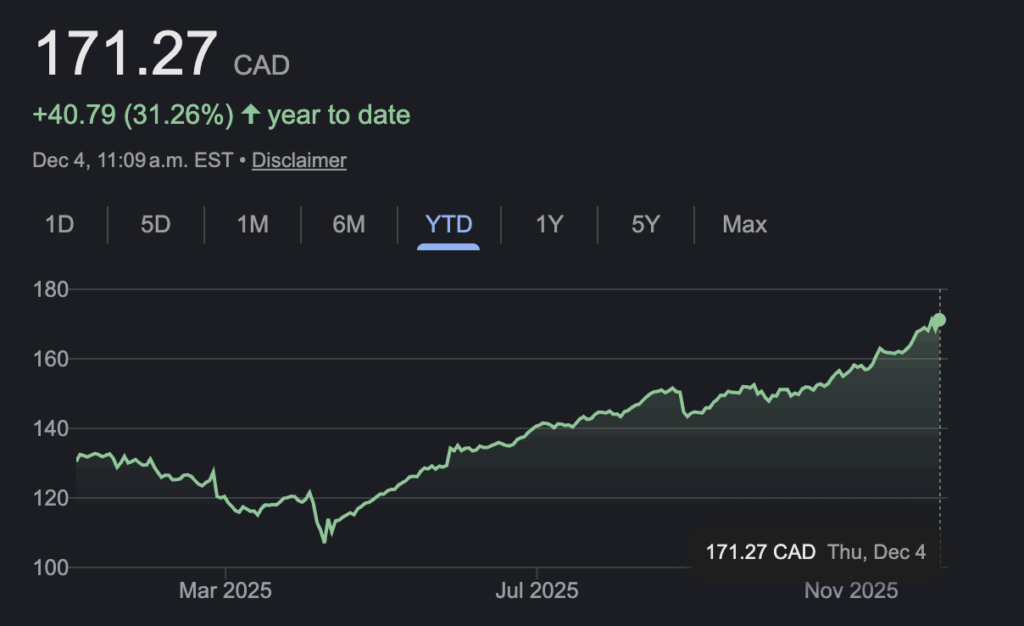 Source Google
RBC posts record Q4 profit but CEO raises concerns about uneven economic recovery
Royal Bank of Canada (TSX:RY)
Numbers for its fourth quarter:
- Profit: $5.43 billion (up from $4.22 billion a year ago)
- Revenue: $17.21 billion (up from $15.07 billion)
Royal Bank of Canada handily beat analyst expectations as it reported record fourth-quarter results that showed rising profits across most divisions.
The bank said Wednesday it made a profit of $5.43 billion in the quarter ending Oct. 31, up from a profit of $4.22 billion a year ago, as capital markets, wealth management and personal and commercial banking all saw higher returns, offset by lower results in insurance. The results helped lead RBC to increase its quarterly dividend to $1.64 per share, up from $1.54 per share.
The bank sees continued strength ahead, raising its return-on-equity target to 17 per cent, up from 16 per cent.
RBC’s results and outlook come despite continued trade and economic uncertainty, but chief executive Dave McKay expressed cautious optimism on the wider picture. “While the operating environment remains fluid and complex, and there is a lot of hard work yet to be done by governments and the private sector, I am cautiously optimistic on the outlook for Canada,” he said on an earnings call with analysts Wednesday.
McKay noted that overall Canada’s effective tariff rate remains low and has done little to impact exports to the U.S., while the ongoing shift to a service-oriented economy should also offset some trade-related headwinds. He did, however, express concern with the split economic recovery, which is leading to increased inequality.
“The impact of the K-shaped economy is increasingly polarizing, with more affluent consumers investing disposable income and growing markets, while less affluent consumers struggle with affordability.” The trend can be seen in RBC’s own results, with its capital markets and wealth management divisions driving much of the earnings beat.
Meanwhile, many borrowers continue to struggle, with the bank increasing its provisions for potentially bad loans in the quarter to $1.01 billion, up from $840 million a year ago.
Chief risk officer Graeme Hepworth said the overall Canadian economy has demonstrated strong resilience this past year with household spending strong, but the bank has maintained a prudent approach to provisions given trade issues are largely unresolved and pockets of concern remain.
“Rising unemployment in Ontario and the Greater Toronto Area, coupled with higher payments at mortgage renewal, have contributed to rising consumer impairments in these regions,” said Hepworth. “We expect retail losses to remain elevated in 2026 as we work through the lag effect of higher unemployment, consumer insolvencies, and ongoing payment shocks for mortgage renewals in Canada.”
The areas of concern did little to hold back overall results, with adjusted earnings of $3.85 per diluted share in the quarter, up from an adjusted profit of $3.07 per diluted share in the same quarter last year.
Analysts on average had expected an adjusted profit of $3.53 per share, according to estimates compiled by LSEG Data & Analytics.
Scotiabank analyst Mike Rizvanovic said that while credit losses were elevated, they remained manageable as other areas like capital markets and wealth shined. “A strong quarter overall for (Royal Bank) at first look, driven by outsized growth in the top line that benefited once again from solid gains in market-sensitive businesses, which comfortably offset a modest miss across other business lines,” he said in a note.
Revenue totalled $17.21 billion, up from $15.07 billion in the same quarter last year.
RBC’s wealth management arm earned $1.28 billion, up from $969 million a year ago, while the bank’s capital markets business earned $1.43 billion, up from $985 million in the same quarter last year. Personal banking earned $1.89 billion in the bank’s latest quarter, up from $1.58 billion a year ago. Commercial banking operations earned $810 million, up from $774 million. RBC’s insurance business earned $98 million, down from $162 million a year ago.
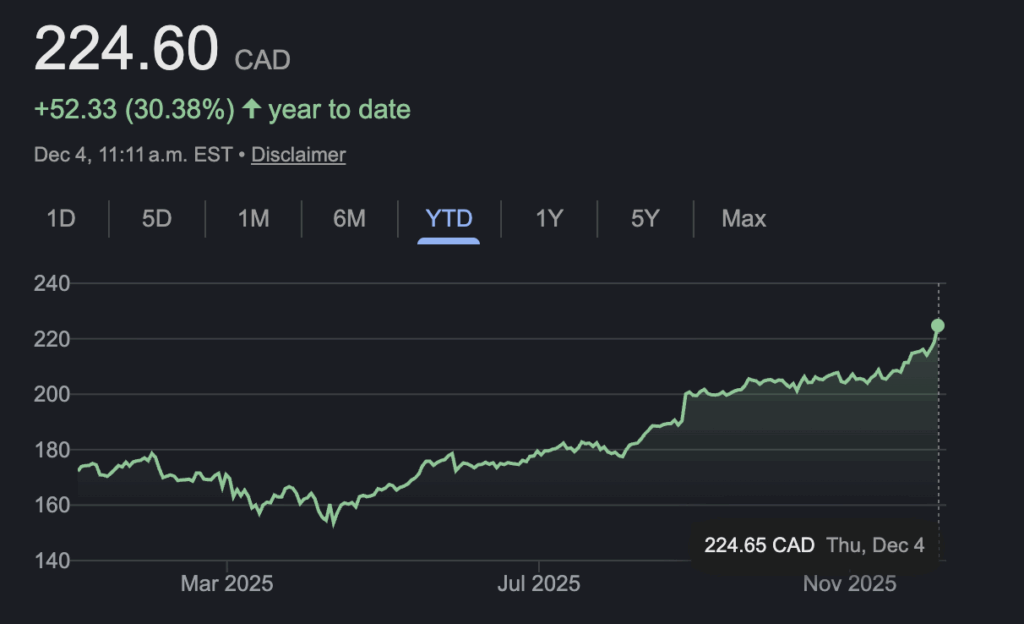 Source Google
CIBC reports fourth-quarter profit up from year ago, raises dividend
CIBC (TSX:CM)
Numbers for its fourth quarter:
- Profit: $2.18 billion (up from $1.88 billion a year ago)
- Revenue: $7.58 billion (up from $6.62 billion)
CIBC raised its dividend as it reported a fourth-quarter profit of $2.18 billion, up from $1.88 billion a year ago. The bank said Thursday it will now pay a quarterly dividend of $1.07 per share, up from 97 cents per share. CIBC says its profit for the quarter ended Oct. 31 amounted to $2.20 per diluted share, up from $1.90 per diluted share a year ago.
Revenue for the quarter totalled $7.58 billion, up from $6.62 billion, while the bank’s provision for credit losses amounted to $605 million, up from $419 million a year ago. On an adjusted basis, CIBC says it earned $2.21 per diluted share, up from an adjusted profit of $1.91 per diluted share in the same quarter last year.
Analysts on average had expected an adjusted profit of $2.08 per share, according to estimates compiled by LSEG Data & Analytics.
“In a dynamic operating environment, our proactive and disciplined approach to managing our business, our resilient capital position and our deep client relationships supported robust growth while maintaining strong credit quality,” CIBC chief executive Harry Culham said in a statement.
CIBC said the growth came as its Canadian personal and business banking business earned $796 million in its latest quarter, up from $792 million a year ago as higher revenue was partially offset by a higher provision for credit losses and higher expenses.
The bank’s Canadian commercial banking and wealth management group earned $603 million, up from $551 million a year ago, while its U.S. commercial banking and wealth management business earned $275 million, up from $200 million a year ago.
CIBC’s capital markets business earned $548 million, up from $346 million in the same quarter last year.
CIBC also announced several senior executive changes Thursday that will be effective Jan. 1. The bank said Sandy Sharman, senior executive vice-president and group head, people, culture and brand, will transition to the role of special adviser before retiring at the end of 2026. CIBC also said Christina Kramer, senior executive vice-president and chief administrative officer, will add responsibility for enterprise real estate, enterprise capabilities and organizational agility, brand, community investment, client experience, communications, and corporate events. Richard Jardim will be appointed senior executive vice-president and chief technology and information officer, global technology, data and AI, while Yvonne Dimitroff will become executive vice-president and chief human resources officer, people, culture and talent.
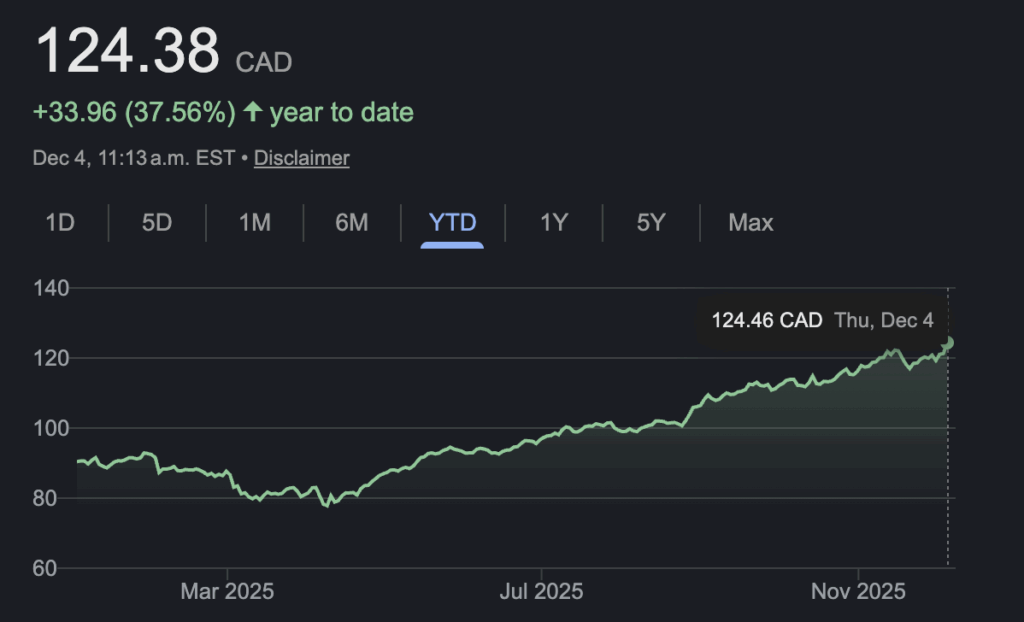 Source Google
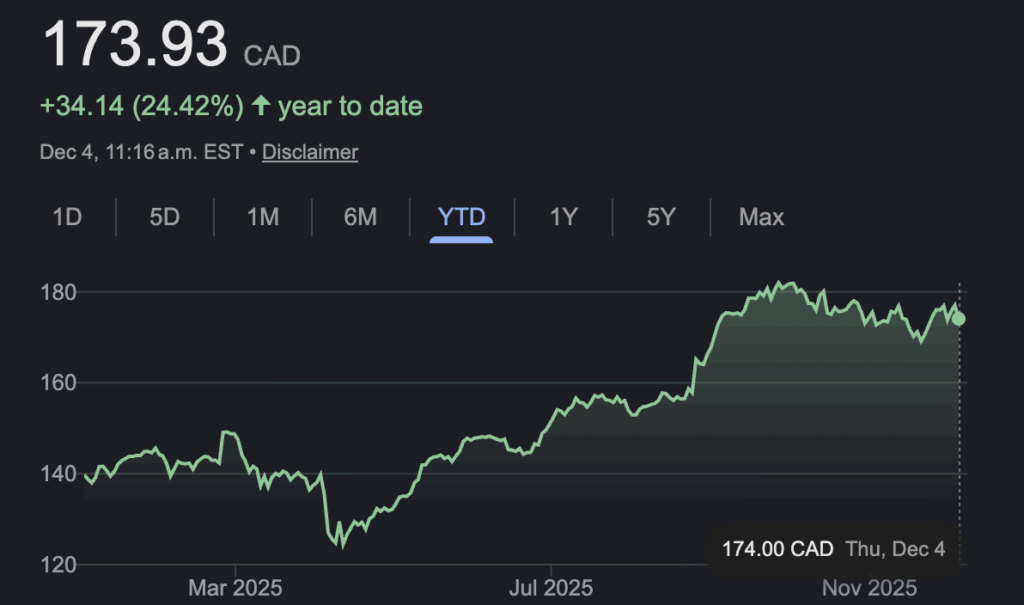
BMO Financial Group reports $2.3B fourth-quarter profit, raises dividend
BMO Financial Group (TSX:BMO)
Numbers for its fourth quarter:
- Profit: $2.30 billion (compared to $2.30 billion a year ago)
- Revenue: $9.34 billion (up from $8.96 billion)
BMO Financial Group raised its dividend as it reported a fourth-quarter profit of $2.30 billion. The bank said Thursday it will now pay a quarterly dividend of $1.67 per share, an increase of four cents per share. BMO says its profit amounted to $2.97 per diluted share for the quarter ended Oct. 31 compared with a profit of $2.30 billion or $2.94 per diluted share a year ago when it had more shares outstanding.
Revenue for the quarter totalled $9.34 billion, up from $8.96 billion last year, while the bank’s provision for credit losses totalled $755 million, down from $1.52 billion a year ago. On an adjusted basis, BMO says it earned $3.28 per diluted share, up from an adjusted profit of $1.90 per diluted in the same quarter last year.
Analysts on average had expected an adjusted profit of $3.03 per share, according to estimates compiled by LSEG Data & Analytics.
“Fiscal 2025 was a strong year for BMO, with consistent execution and growing momentum to achieve our commitments to shareholders,” BMO chief executive Darryl White said. “We enter 2026 in a position of financial strength, with a focused strategy and a winning culture that continues to grow and attract talent across the bank.”
BMO said its Canadian personal and commercial banking business earned $752 million, up from $750 million a year ago, while its U.S. banking business earned $807 million, up from $281 million in the same quarter last year.
The bank’s wealth management arm earned $383 million, up from $301 million a year ago.
BMO’s capital markets business earned $521 million, up from $251 million in the same quarter last year.
The bank also announced Thursday the appointment of Tammy Brown to its board of directors.
Brown previously served as deputy chair of KPMG Canada’s board of directors and was a partner and national industry leader for industrial markets at the firm.
 Source Google
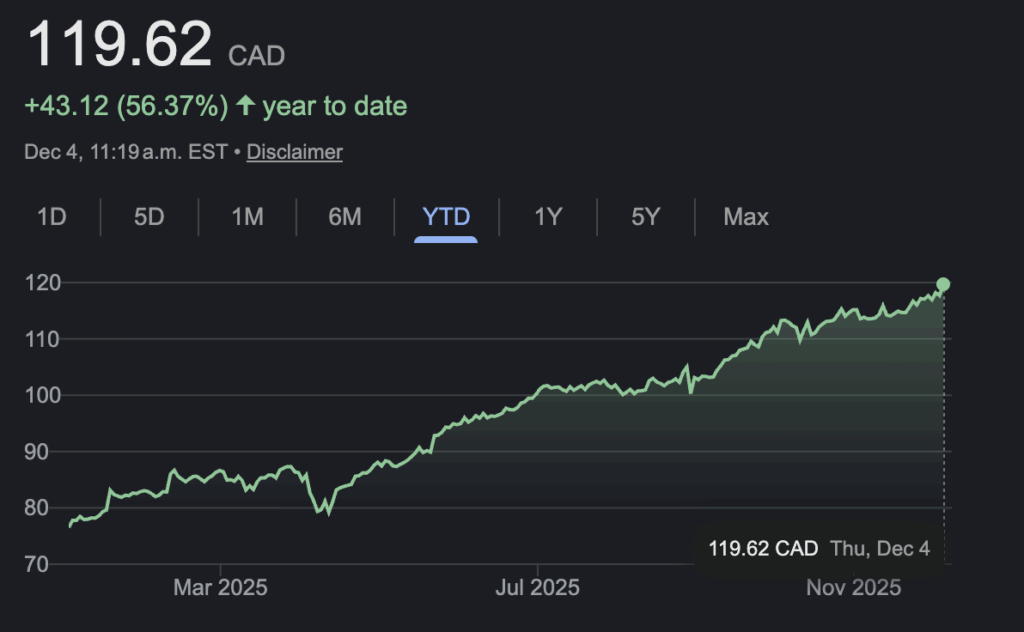
TD Bank reports $3.28B fourth-quarter profit, raises dividend
TD Bank Group (TSX:TD)
Numbers for its fourth quarter:
- Profit: $3.28 billion (down from $3.64 billion a year ago)
- Revenue: $15.49 billion (down from $15.51 billion)
TD Bank Group raised its dividend as it reported its fourth-quarter profit fell compared with a year ago, weighed down by one-time restructuring charges. The bank said Thursday it will pay a quarterly dividend of $1.08 per share, up from $1.05 per share.
TD says its profit amounted to $3.28 billion or $1.82 per diluted share for the quarter ended Oct. 31, compared with a profit of $3.64 billion or $1.97 per diluted share a year ago. On an adjusted basis, TD says it earned $2.18 per diluted share for its latest quarter, up from an adjusted profit of $1.72 per diluted share in the same quarter last year.
Revenue for the quarter totalled $15.49 billion, down from $15.51 billion a year ago, while the bank’s provision for credit losses amounted to $982 million, down from $1.11 billion in the same quarter last year.
Analysts on average had expected an adjusted profit of $2.03 per share, according to estimates compiled by LSEG Data & Analytics.
“TD had a strong fourth quarter, delivering robust fee and trading income in our markets-driven businesses as well as volume growth year-over-year in Canadian personal and commercial banking, capping a year of strong performance,” TD chief executive Raymond Chun said in a statement.
TD said its Canadian personal and commercial banking business earned $1.87 billion in its latest quarter, up from $1.82 billion a year ago as higher revenue was partially offset by higher provisions for credit losses and non-interest expenses.
The bank’s U.S. retail banking operations earned $719 million, up from $702 million in the same quarter last year.
TD’s wealth management business earned $699 million in the quarter, up from $349 million a year ago, while the bank’s wholesale baking group earned $494 million, up from $235 million in the same quarter last year.
 Source Google
Tools
MoneySense’s ETF Screener Tool
use tool
Read more news:
- News for investors: Barrick settles Mali dispute and Couche-Tard profit climbs
- Canadians aren’t as generous as they used to be
- Credit counselling calls surge as Canadians struggle with rising costs
- How cash ETFs keep your money working
The post Stock news for investors: Fourth-quarter earnings roll in from Canada’s big banks appeared first on MoneySense.
Market Opportunity
Rubic Price(RBC)
$0.005097
$0.005097$0.005097
USD
Rubic (RBC) Live Price Chart
Disclaimer: The articles reposted on this site are sourced from public platforms and are provided for informational purposes only. They do not necessarily reflect the views of MEXC. All rights remain with the original authors. If you believe any content infringes on third-party rights, please contact service@support.mexc.com for removal. MEXC makes no guarantees regarding the accuracy, completeness, or timeliness of the content and is not responsible for any actions taken based on the information provided. The content does not constitute financial, legal, or other professional advice, nor should it be considered a recommendation or endorsement by MEXC.
You May Also Like

Wormhole Unveils W Token 2.0 with Enhanced Tokenomics
The post Wormhole Unveils W Token 2.0 with Enhanced Tokenomics appeared on BitcoinEthereumNews.com. Joerg Hiller Sep 17, 2025 13:57 Wormhole introduces W Token 2.0, featuring upgraded tokenomics, a strategic Wormhole Reserve, and a 4% base yield, aiming to optimize ecosystem growth and align incentives. Wormhole has announced a significant upgrade to its native token, unveiling the W Token 2.0. This upgrade introduces new tokenomics including the establishment of a Wormhole Reserve, a 4% base yield, and an optimized unlock schedule, marking a pivotal development in the ecosystem, according to Wormhole. The W Token Evolution Launched in October 2020, Wormhole’s W token has been central to the platform’s mission of creating a connected internet economy. The latest upgrade aims to enhance the token’s utility across more than 40 blockchains. With a capped supply of 10 billion, the W token supports governance, staking, and ecosystem growth, aligning incentives for network security and development. Introducing the Wormhole Reserve The Wormhole Reserve will accumulate value from both onchain and offchain activities, supporting the ecosystem’s expansion. As Wormhole adoption grows, the token will capture value through network expansions and ecosystem applications, ensuring that growth is directly reflected in the token’s value. 4% Base Yield and Governance Rewards Wormhole 2.0 introduces a 4% base yield for W holders who actively participate in governance. The yield, derived from existing token supplies and protocol revenues, is designed to incentivize active participation without inflating the token supply. Optimized Unlock Schedule Updating its token release schedule, Wormhole replaces annual cliffs with bi-weekly unlocks, starting October 3, 2025. This change aims to reduce market pressure and provide a more stable environment for investors and contributors. The bi-weekly schedule will span over 4.5 years, affecting categories such as Guardian Nodes and Community & Launch. Wormhole’s Future Vision With these upgrades, Wormhole aims to expand its role as…
Share
BitcoinEthereumNews2025/09/18 15:48
![[OPINION] US National Security Strategy 2025: An iconoclastic document](https://www.rappler.com/tachyon/2025/12/AMERICANS-ARE-BACK-DEC-12-2025.jpg?resize=75%2C75&crop_strategy=attention)
[OPINION] US National Security Strategy 2025: An iconoclastic document
Trump's national security strategy signals a radical shift in US foreign policy, prioritizing economic power and regional interests over global commitments
Share
Rappler2025/12/16 12:30

Crucial US Stock Market Update: What Wednesday’s Mixed Close Reveals
BitcoinWorld Crucial US Stock Market Update: What Wednesday’s Mixed Close Reveals The financial world often keeps us on our toes, and Wednesday was no exception. Investors watched closely as the US stock market concluded the day with a mixed performance across its major indexes. This snapshot offers a crucial glimpse into current investor sentiment and economic undercurrents, prompting many to ask: what exactly happened? Understanding the Latest US Stock Market Movements On Wednesday, the closing bell brought a varied picture for the US stock market. While some indexes celebrated gains, others registered slight declines, creating a truly mixed bag for investors. The Dow Jones Industrial Average showed resilience, climbing by a notable 0.57%. This positive movement suggests strength in some of the larger, more established companies. Conversely, the S&P 500, a broader benchmark often seen as a barometer for the overall market, experienced a modest dip of 0.1%. The technology-heavy Nasdaq Composite also saw a slight retreat, sliding by 0.33%. This particular index often reflects investor sentiment towards growth stocks and the tech sector. These divergent outcomes highlight the complex dynamics currently at play within the American economy. It’s not simply a matter of “up” or “down” for the entire US stock market; rather, it’s a nuanced landscape where different sectors and company types are responding to unique pressures and opportunities. Why Did the US Stock Market See Mixed Results? When the US stock market delivers a mixed performance, it often points to a tug-of-war between various economic factors. Several elements could have contributed to Wednesday’s varied closings. For instance, positive corporate earnings reports from certain industries might have bolstered the Dow. At the same time, concerns over inflation, interest rate policies by the Federal Reserve, or even global economic uncertainties could have pressured growth stocks, affecting the S&P 500 and Nasdaq. Key considerations often include: Economic Data: Recent reports on employment, manufacturing, or consumer spending can sway market sentiment. Corporate Announcements: Strong or weak earnings forecasts from influential companies can significantly impact their respective sectors. Interest Rate Expectations: The prospect of higher or lower interest rates directly influences borrowing costs for businesses and consumer spending, affecting future profitability. Geopolitical Events: Global tensions or trade policies can introduce uncertainty, causing investors to become more cautious. Understanding these underlying drivers is crucial for anyone trying to make sense of daily market fluctuations in the US stock market. Navigating Volatility in the US Stock Market A mixed close, while not a dramatic downturn, serves as a reminder that market volatility is a constant companion for investors. For those involved in the US stock market, particularly individuals managing their portfolios, these days underscore the importance of a well-thought-out strategy. It’s important not to react impulsively to daily movements. Instead, consider these actionable insights: Diversification: Spreading investments across different sectors and asset classes can help mitigate risk when one area underperforms. Long-Term Perspective: Focusing on long-term financial goals rather than short-term gains can help weather daily market swings. Stay Informed: Keeping abreast of economic news and company fundamentals provides context for market behavior. Consult Experts: Financial advisors can offer personalized guidance based on individual risk tolerance and objectives. Even small movements in major indexes can signal shifts that require attention, guiding future investment decisions within the dynamic US stock market. What’s Next for the US Stock Market? Looking ahead, investors will be keenly watching for further economic indicators and corporate announcements to gauge the direction of the US stock market. Upcoming inflation data, statements from the Federal Reserve, and quarterly earnings reports will likely provide more clarity. The interplay of these factors will continue to shape investor confidence and, consequently, the performance of the Dow, S&P 500, and Nasdaq. Remaining informed and adaptive will be key to understanding the market’s trajectory. Conclusion: Wednesday’s mixed close in the US stock market highlights the intricate balance of forces influencing financial markets. While the Dow showed strength, the S&P 500 and Nasdaq experienced slight declines, reflecting a nuanced economic landscape. This reminds us that understanding the ‘why’ behind these movements is as important as the movements themselves. As always, a thoughtful, informed approach remains the best strategy for navigating the complexities of the market. Frequently Asked Questions (FAQs) Q1: What does a “mixed close” mean for the US stock market? A1: A mixed close indicates that while some major stock indexes advanced, others declined. It suggests that different sectors or types of companies within the US stock market are experiencing varying influences, rather than a uniform market movement. Q2: Which major indexes were affected on Wednesday? A2: On Wednesday, the Dow Jones Industrial Average gained 0.57%, while the S&P 500 edged down 0.1%, and the Nasdaq Composite slid 0.33%, illustrating the mixed performance across the US stock market. Q3: What factors contribute to a mixed stock market performance? A3: Mixed performances in the US stock market can be influenced by various factors, including specific corporate earnings, economic data releases, shifts in interest rate expectations, and broader geopolitical events that affect different market segments uniquely. Q4: How should investors react to mixed market signals? A4: Investors are generally advised to maintain a long-term perspective, diversify their portfolios, stay informed about economic news, and avoid impulsive decisions. Consulting a financial advisor can also provide personalized guidance for navigating the US stock market. Q5: What indicators should investors watch for future US stock market trends? A5: Key indicators to watch include upcoming inflation reports, statements from the Federal Reserve regarding monetary policy, and quarterly corporate earnings reports. These will offer insights into the future direction of the US stock market. Did you find this analysis of the US stock market helpful? Share this article with your network on social media to help others understand the nuances of current financial trends! To learn more about the latest stock market trends, explore our article on key developments shaping the US stock market‘s future performance. This post Crucial US Stock Market Update: What Wednesday’s Mixed Close Reveals first appeared on BitcoinWorld.
Share
Coinstats2025/09/18 05:30