Bitcoin miner revenues have fallen to their lowest levels in two months, according to analysts at on-chain and market data CryptoQuant . On June 22, daily earnings dropped to $34 million, a level not seen since April 20, 2025. The downturn is mainly being attributed to reduced transaction fees and a decline in the market price of Bitcoin. The combination of these factors is leading to an environment where miners are experiencing some of the lowest compensation rates recorded in the past year. As reported in CryptoQuant’s weekly analysis, miners are currently “the most underpaid they have been in the last year.” Bitcoin miners just saw their worst payday in a year. Daily revenue slipped to $34 million in June, the lowest since April. Falling fees and Bitcoin’s price drop are crushing margins. pic.twitter.com/TXdN06CU1F — CryptoQuant.com (@cryptoquant_com) June 26, 2025 Hashrate Falls, But Miner Selling Stays Low Despite the drop in revenue, miners have not responded with increased selling. CryptoQuant reports that Bitcoin outflows from miner wallets have steadily decreased, falling from a peak of 23,000 BTC per day in February to around 6,000 BTC today. This represents a significant reduction in selling activity, especially given the recent price volatility. Notably, the network’s hashrate has experienced a 3.5% drawdown since June 16, marking the largest decline in nearly a year. However, this drop in computational power has not translated into heightened liquidations by miners. In addition, so-called “Satoshi-era” miners have sold only 150 BTC so far in 2025, compared to nearly 10,000 BTC in 2024. Miner Reserves Grow Despite Lower Income CryptoQuant analysts also note that instead of selling, miners are increasing their reserves. Addresses holding between 100 and 1,000 BTC have grown their combined holdings from 61,000 BTC on March 31 to 65,000 BTC as of late June. This is the highest level of reserve accumulation by this group of miners since November 2024. The steady accumulation trend suggests that most miners are not facing immediate financial stress, even amid falling revenues. Their continued reserve growth indicates a long-term outlook and confidence in future price recovery, rather than capitulation under current market conditions. Overall, while Bitcoin miner revenues have declined to a two-month low, there is no evidence of widespread selling pressure in response. CryptoQuant’s findings portray a mining sector that, though underpaid by recent standards, remains resilient and strategically focused on long-term accumulation.Bitcoin miner revenues have fallen to their lowest levels in two months, according to analysts at on-chain and market data CryptoQuant . On June 22, daily earnings dropped to $34 million, a level not seen since April 20, 2025. The downturn is mainly being attributed to reduced transaction fees and a decline in the market price of Bitcoin. The combination of these factors is leading to an environment where miners are experiencing some of the lowest compensation rates recorded in the past year. As reported in CryptoQuant’s weekly analysis, miners are currently “the most underpaid they have been in the last year.” Bitcoin miners just saw their worst payday in a year. Daily revenue slipped to $34 million in June, the lowest since April. Falling fees and Bitcoin’s price drop are crushing margins. pic.twitter.com/TXdN06CU1F — CryptoQuant.com (@cryptoquant_com) June 26, 2025 Hashrate Falls, But Miner Selling Stays Low Despite the drop in revenue, miners have not responded with increased selling. CryptoQuant reports that Bitcoin outflows from miner wallets have steadily decreased, falling from a peak of 23,000 BTC per day in February to around 6,000 BTC today. This represents a significant reduction in selling activity, especially given the recent price volatility. Notably, the network’s hashrate has experienced a 3.5% drawdown since June 16, marking the largest decline in nearly a year. However, this drop in computational power has not translated into heightened liquidations by miners. In addition, so-called “Satoshi-era” miners have sold only 150 BTC so far in 2025, compared to nearly 10,000 BTC in 2024. Miner Reserves Grow Despite Lower Income CryptoQuant analysts also note that instead of selling, miners are increasing their reserves. Addresses holding between 100 and 1,000 BTC have grown their combined holdings from 61,000 BTC on March 31 to 65,000 BTC as of late June. This is the highest level of reserve accumulation by this group of miners since November 2024. The steady accumulation trend suggests that most miners are not facing immediate financial stress, even amid falling revenues. Their continued reserve growth indicates a long-term outlook and confidence in future price recovery, rather than capitulation under current market conditions. Overall, while Bitcoin miner revenues have declined to a two-month low, there is no evidence of widespread selling pressure in response. CryptoQuant’s findings portray a mining sector that, though underpaid by recent standards, remains resilient and strategically focused on long-term accumulation.

Bitcoin Miner Revenues Hit Two-Month Low, Selling Activity Remains Muted: CryptoQuant

2 min read

Bitcoin miner revenues have fallen to their lowest levels in two months, according to analysts at on-chain and market data CryptoQuant.

On June 22, daily earnings dropped to $34 million, a level not seen since April 20, 2025. The downturn is mainly being attributed to reduced transaction fees and a decline in the market price of Bitcoin.
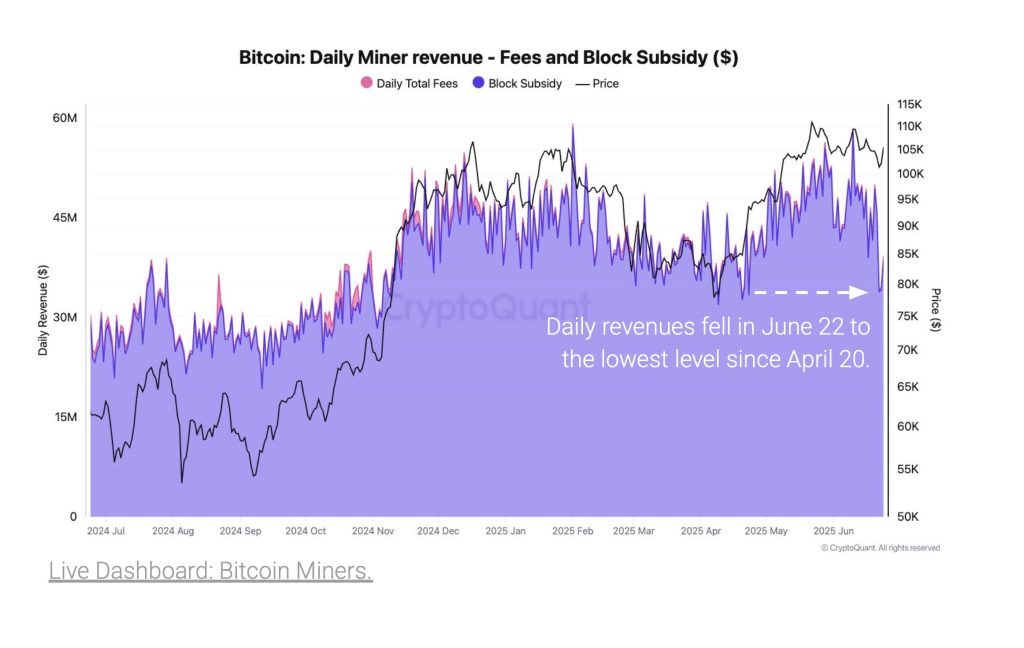
The combination of these factors is leading to an environment where miners are experiencing some of the lowest compensation rates recorded in the past year. As reported in CryptoQuant’s weekly analysis, miners are currently “the most underpaid they have been in the last year.”

Hashrate Falls, But Miner Selling Stays Low

Despite the drop in revenue, miners have not responded with increased selling. CryptoQuant reports that Bitcoin outflows from miner wallets have steadily decreased, falling from a peak of 23,000 BTC per day in February to around 6,000 BTC today.

This represents a significant reduction in selling activity, especially given the recent price volatility. Notably, the network’s hashrate has experienced a 3.5% drawdown since June 16, marking the largest decline in nearly a year.

However, this drop in computational power has not translated into heightened liquidations by miners. In addition, so-called “Satoshi-era” miners have sold only 150 BTC so far in 2025, compared to nearly 10,000 BTC in 2024.

Miner Reserves Grow Despite Lower Income

CryptoQuant analysts also note that instead of selling, miners are increasing their reserves. Addresses holding between 100 and 1,000 BTC have grown their combined holdings from 61,000 BTC on March 31 to 65,000 BTC as of late June. This is the highest level of reserve accumulation by this group of miners since November 2024.

The steady accumulation trend suggests that most miners are not facing immediate financial stress, even amid falling revenues. Their continued reserve growth indicates a long-term outlook and confidence in future price recovery, rather than capitulation under current market conditions.

Overall, while Bitcoin miner revenues have declined to a two-month low, there is no evidence of widespread selling pressure in response. CryptoQuant’s findings portray a mining sector that, though underpaid by recent standards, remains resilient and strategically focused on long-term accumulation.

Market Opportunity
Bitcoin Logo
Bitcoin Price(BTC)
$76,410.82
$76,410.82$76,410.82
-2.20%
USD
Bitcoin (BTC) Live Price Chart
Disclaimer: The articles reposted on this site are sourced from public platforms and are provided for informational purposes only. They do not necessarily reflect the views of MEXC. All rights remain with the original authors. If you believe any content infringes on third-party rights, please contact service@support.mexc.com for removal. MEXC makes no guarantees regarding the accuracy, completeness, or timeliness of the content and is not responsible for any actions taken based on the information provided. The content does not constitute financial, legal, or other professional advice, nor should it be considered a recommendation or endorsement by MEXC.

You May Also Like

Trump MAGA statue has strange crypto backstory

Trump MAGA statue has strange crypto backstory

The post Trump MAGA statue has strange crypto backstory appeared on BitcoinEthereumNews.com. A 15-foot-tall statue of former President Donald Trump, cast in bronze
Share
BitcoinEthereumNews2026/02/04 08:22
The real-life inspiration for the protagonist of "The Big Short": Bitcoin crash may trigger a $1 billion gold and silver sell-off.

The real-life inspiration for the protagonist of "The Big Short": Bitcoin crash may trigger a $1 billion gold and silver sell-off.

PANews reported on February 4th that, according to CoinDesk, Michael Burry, the real-life inspiration for the character in "The Big Short" (and an investor who
Share
PANews2026/02/04 08:22
October Probability Surges To 94%

October Probability Surges To 94%

The post October Probability Surges To 94% appeared on BitcoinEthereumNews.com. The financial world is buzzing with a significant development: the probability of a Fed rate cut in October has just seen a dramatic increase. This isn’t just a minor shift; it’s a monumental change that could ripple through global markets, including the dynamic cryptocurrency space. For anyone tracking economic indicators and their impact on investments, this update from the U.S. interest rate futures market is absolutely crucial. What Just Happened? Unpacking the FOMC Statement’s Impact Following the latest Federal Open Market Committee (FOMC) statement, market sentiment has decisively shifted. Before the announcement, the U.S. interest rate futures market had priced in a 71.6% chance of an October rate cut. However, after the statement, this figure surged to an astounding 94%. This jump indicates that traders and analysts are now overwhelmingly confident that the Federal Reserve will lower interest rates next month. Such a high probability suggests a strong consensus emerging from the Fed’s latest communications and economic outlook. A Fed rate cut typically means cheaper borrowing costs for businesses and consumers, which can stimulate economic activity. But what does this really signify for investors, especially those in the digital asset realm? Why is a Fed Rate Cut So Significant for Markets? When the Federal Reserve adjusts interest rates, it sends powerful signals across the entire financial ecosystem. A rate cut generally implies a more accommodative monetary policy, often enacted to boost economic growth or combat deflationary pressures. Impact on Traditional Markets: Stocks: Lower interest rates can make borrowing cheaper for companies, potentially boosting earnings and making stocks more attractive compared to bonds. Bonds: Existing bonds with higher yields might become more valuable, but new bonds will likely offer lower returns. Dollar Strength: A rate cut can weaken the U.S. dollar, making exports cheaper and potentially benefiting multinational corporations. Potential for…
Share
BitcoinEthereumNews2025/09/18 07:19