The post How and When They Become Core Finance appeared on BitcoinEthereumNews.com. September was a busy month with RWA Summit, KBW, and Token2049 back-to-back. One point is clear: tokenized securities are here to stay, and the questions revolve around “how” and “when” instead of “what” and “why.” Below are five takeaways and what they signal for the next year. Defi’s Utility is Undercounted Because the Best Infrastructure Runs Quietly Markets still miss what happens when tokenized assets actually work onchain. The practical benefits today are access and programmability for onchain investors:  24/7 settlement windows, access to new securities onchain, clear data, and faster reconciliation. DeFi connectivity is being solved for RWAs. Different designs are emerging to connect institutional assets with onchain liquidity: Horizon takes a permissioned assets, permissionless access path in a blue-chip market. Pendle supports permissioned or permissionless structures through yield/option primitives. Centrifuge uses a wrapped token on professional fund shares (deRWA) to provide optionality.  Under the hood, standards like ERC-4626 and ERC-7540 anchor these flows. In our case, 4626 handles real-time vault accounting and 7540 handles queued subscriptions and redemptions, so instruments behave like software while meeting institutional requirements. These standards make RWAs composable enabling liquidity and risk management across protocols. Once RWAs are composable, they stop being a “category” and become a feature of onchain capital markets. “Crypto is Fintech” is Now Table Stakes Across recent RWA gatherings the shift was the same: blockchain is moving to the background. Payment rails, stablecoins, neobanks, and cards are shipping consumer distribution while the chain does the work under the hood. Users want outcomes, not mechanics. If someone gets S&P 500 exposure in an app, they care about the index, not that it is delivered via tokenization. If a card pays 8% rewards sourced from DeFi lending, they care about the rewards, not the rails. Tokenization is no longer an innovation exercise.… The post How and When They Become Core Finance appeared on BitcoinEthereumNews.com. September was a busy month with RWA Summit, KBW, and Token2049 back-to-back. One point is clear: tokenized securities are here to stay, and the questions revolve around “how” and “when” instead of “what” and “why.” Below are five takeaways and what they signal for the next year. Defi’s Utility is Undercounted Because the Best Infrastructure Runs Quietly Markets still miss what happens when tokenized assets actually work onchain. The practical benefits today are access and programmability for onchain investors:  24/7 settlement windows, access to new securities onchain, clear data, and faster reconciliation. DeFi connectivity is being solved for RWAs. Different designs are emerging to connect institutional assets with onchain liquidity: Horizon takes a permissioned assets, permissionless access path in a blue-chip market. Pendle supports permissioned or permissionless structures through yield/option primitives. Centrifuge uses a wrapped token on professional fund shares (deRWA) to provide optionality.  Under the hood, standards like ERC-4626 and ERC-7540 anchor these flows. In our case, 4626 handles real-time vault accounting and 7540 handles queued subscriptions and redemptions, so instruments behave like software while meeting institutional requirements. These standards make RWAs composable enabling liquidity and risk management across protocols. Once RWAs are composable, they stop being a “category” and become a feature of onchain capital markets. “Crypto is Fintech” is Now Table Stakes Across recent RWA gatherings the shift was the same: blockchain is moving to the background. Payment rails, stablecoins, neobanks, and cards are shipping consumer distribution while the chain does the work under the hood. Users want outcomes, not mechanics. If someone gets S&P 500 exposure in an app, they care about the index, not that it is delivered via tokenization. If a card pays 8% rewards sourced from DeFi lending, they care about the rewards, not the rails. Tokenization is no longer an innovation exercise.…

How and When They Become Core Finance

5 min read

September was a busy month with RWA Summit, KBW, and Token2049 back-to-back. One point is clear: tokenized securities are here to stay, and the questions revolve around “how” and “when” instead of “what” and “why.”

Below are five takeaways and what they signal for the next year.

Defi’s Utility is Undercounted Because the Best Infrastructure Runs Quietly

Markets still miss what happens when tokenized assets actually work onchain. The practical benefits today are access and programmability for onchain investors:  24/7 settlement windows, access to new securities onchain, clear data, and faster reconciliation.

DeFi connectivity is being solved for RWAs. Different designs are emerging to connect institutional assets with onchain liquidity:

  • Horizon takes a permissioned assets, permissionless access path in a blue-chip market.
  • Pendle supports permissioned or permissionless structures through yield/option primitives.
  • Centrifuge uses a wrapped token on professional fund shares (deRWA) to provide optionality. 

Under the hood, standards like ERC-4626 and ERC-7540 anchor these flows. In our case, 4626 handles real-time vault accounting and 7540 handles queued subscriptions and redemptions, so instruments behave like software while meeting institutional requirements. These standards make RWAs composable enabling liquidity and risk management across protocols.

Once RWAs are composable, they stop being a “category” and become a feature of onchain capital markets.

“Crypto is Fintech” is Now Table Stakes

Across recent RWA gatherings the shift was the same: blockchain is moving to the background. Payment rails, stablecoins, neobanks, and cards are shipping consumer distribution while the chain does the work under the hood. Users want outcomes, not mechanics. If someone gets S&P 500 exposure in an app, they care about the index, not that it is delivered via tokenization. If a card pays 8% rewards sourced from DeFi lending, they care about the rewards, not the rails.

Tokenization is no longer an innovation exercise. It is an operational stack for issuance, distribution, and the treasury and risk workflows that sit around them.

We came into the cycle with SPXA already live. S&P 500 exposure on programmable rails with S&P Dow Jones Indices benchmarks and Janus Henderson as sub-investment manager. That made the conversations concrete: teams asked how we create liquidity, how subscriptions and redemptions run, and how reporting lands, rather than debating “tokens.”

As tokenization moves from pilots to core finance, the products that win will be fintech building blocks that disappear into apps and workflows.

Institutional Managers are Past “If”. The Question is How Fast

The hesitation phase is over. Large managers are setting deployment timelines and assigning owners for custody, transfer controls, distribution, and reporting. The brief is practical: map mandates, define the operating model, and plug into systems already in use.

On the market side, Aave Horizon provides a useful reference point. Qualified users can borrow onchain liquidity against tokenized treasuries and AAA credit, so RWAs function as collateral rather than only store of value. That pattern controlled access with clear paths to liquidity is what accelerates institutional rollout.

To keep new products on schedule, founders also need rails. That is the intent of RWA Bento: $500K from Onigiri Capital and $100K in Centrifuge infrastructure credits so teams can move from prototype to distribution without  rebuilding core plumbing.

Fragmentation is Fine When Money Moves Freely

There will be many chains and many stablecoins. That is acceptable if the value moves between them with no visible friction. Two things matter: chain-to-chain transfers that feel instant, and atomic, low-cost swaps between stablecoins.

The implementation details live in the backend. Canonical mint and burn, reliable messaging, and chain abstraction let managers operate from a hub and distribute to spokes.  Investors subscribe and redeem on the networks they already use, while routing and gas handling stay under the surface.

Primary RWA instruments carry their own access controls and transfer hooks on the native line. When broader distribution is needed, wrappers like deRWA provide a separate path into DeFi with wrapper-level rules, not a 1:1 inheritance of the primary instrument’s rules.

Do this well, and users do not have to pick a chain. Liquidity feels like one pool, and issuance and secondary activity scale without new tooling for the end user.

Investors are (Finally) Judging Protocols Like Businesses

The center of gravity is shifting from hype and narratives to fundamentals. Investors want to see revenue, unit economics, a path to profitability, and sustainable growth supported by a credible leadership team and disciplined IR.

For treasuries and index products, the focus is on fees, duration management, and operational rigor. For credit, it is loss buffers, collections, and exposure limits. For platforms, it is recurring fees, service levels, audit-ready reporting, and governance that travel with the asset.

Narratives still matter for direction, but durable value follows cash flows, controls, and execution.

What to Watch Next

Index products become standard collateral. SPXA shows how familiar market exposure meets programmable rails. Expect index fund tokens to join treasuries and credit as baseline collateral in onchain lending and hedging.

deRWA expands distribution. Wrapping institutional assets as deRWA puts them in DEXs, wallets, and lending markets that users already frequent. That reduces integration friction for both builders and traders.

Chain abstraction becomes table stakes. Issuers will expect hub-and-spoke control, chain abstraction, and auditable cross-chain messaging out of the box. The multichain debate belongs in the backend, not the boardroom.

Builders get capital plus rails. Programs that combine funding with infrastructure shorten time to market. RWA Bento is one template: founders can focus on underwriting, origination, distribution, and risk, not rebuilding core infrastructure.

RWAs are moving from pilot to production. The stack is open, modular, and designed to meet institutional requirements. The next leg depends on more than execution. It requires interoperable standards that work across chains, audit-ready disclosures on a regular cadence, resilient custody and incident response, and distribution that reaches users without exposing the rails. Add clear policy frameworks and deeper secondary liquidity, and tokenization becomes ordinary financial infrastructure. From there, the market compounds.

Source: https://beincrypto.com/tokenized-securities-how-when-next-year/

Market Opportunity
Core DAO Logo
Core DAO Price(CORE)
$0.08799
$0.08799$0.08799
-0.24%
USD
Core DAO (CORE) Live Price Chart
Disclaimer: The articles reposted on this site are sourced from public platforms and are provided for informational purposes only. They do not necessarily reflect the views of MEXC. All rights remain with the original authors. If you believe any content infringes on third-party rights, please contact service@support.mexc.com for removal. MEXC makes no guarantees regarding the accuracy, completeness, or timeliness of the content and is not responsible for any actions taken based on the information provided. The content does not constitute financial, legal, or other professional advice, nor should it be considered a recommendation or endorsement by MEXC.

You May Also Like

Fed Decides On Interest Rates Today—Here’s What To Watch For

Fed Decides On Interest Rates Today—Here’s What To Watch For

The post Fed Decides On Interest Rates Today—Here’s What To Watch For appeared on BitcoinEthereumNews.com. Topline The Federal Reserve on Wednesday will conclude a two-day policymaking meeting and release a decision on whether to lower interest rates—following months of pressure and criticism from President Donald Trump—and potentially signal whether additional cuts are on the way. President Donald Trump has urged the central bank to “CUT INTEREST RATES, NOW, AND BIGGER” than they might plan to. Getty Images Key Facts The central bank is poised to cut interest rates by at least a quarter-point, down from the 4.25% to 4.5% range where they have been held since December to between 4% and 4.25%, as Wall Street has placed 100% odds of a rate cut, according to CME’s FedWatch, with higher odds (94%) on a quarter-point cut than a half-point (6%) reduction. Fed governors Christopher Waller and Michelle Bowman, both Trump appointees, voted in July for a quarter-point reduction to rates, and they may dissent again in favor of a large cut alongside Stephen Miran, Trump’s Council of Economic Advisers’ chair, who was sworn in at the meeting’s start on Tuesday. It’s unclear whether other policymakers, including Kansas City Fed President Jeffrey Schmid and St. Louis Fed President Alberto Musalem, will favor larger cuts or opt for no reduction. Fed Chair Jerome Powell said in his Jackson Hole, Wyoming, address last month the central bank would likely consider a looser monetary policy, noting the “shifting balance of risks” on the U.S. economy “may warrant adjusting our policy stance.” David Mericle, an economist for Goldman Sachs, wrote in a note the “key question” for the Fed’s meeting is whether policymakers signal “this is likely the first in a series of consecutive cuts” as the central bank is anticipated to “acknowledge the softening in the labor market,” though they may not “nod to an October cut.” Mericle said he…
Share
BitcoinEthereumNews2025/09/18 00:23
While Shiba Inu and Turbo Chase Price, 63% APY Staking Puts APEMARS at the Forefront of the Best Meme Coin Presale 2026 – Stage 6 Ends in 3 Days!

While Shiba Inu and Turbo Chase Price, 63% APY Staking Puts APEMARS at the Forefront of the Best Meme Coin Presale 2026 – Stage 6 Ends in 3 Days!

What if your meme coin investment could generate passive income without selling a single token? Shiba Inu climbed 4.97% as 207 billion tokens left exchanges. Turbo
Share
Coinstats2026/02/04 03:15
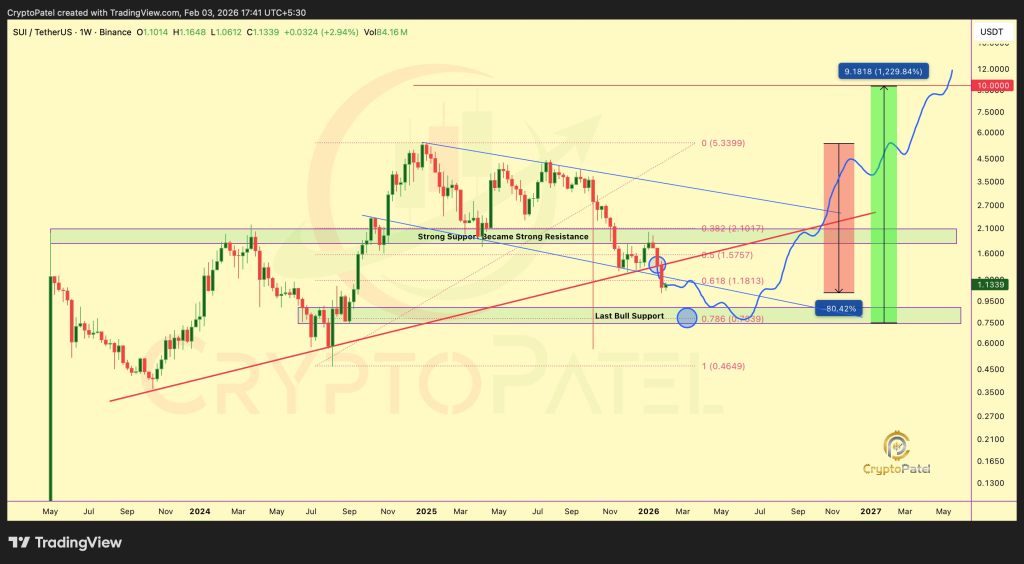
SUI Price Is Down 80%: Price Nears Level Bulls Cannot Afford to Lose

SUI Price Is Down 80%: Price Nears Level Bulls Cannot Afford to Lose

SUI price has quietly slipped into a zone that usually decides everything. Charts show an 80% drop from the peak, yet the market is no longer moving fast. This
Share
Captainaltcoin2026/02/04 03:00