

US Dollar Index Defies Gravity: Holds Near 99.00 Despite Shifting Rate Cut Expectations
BitcoinWorld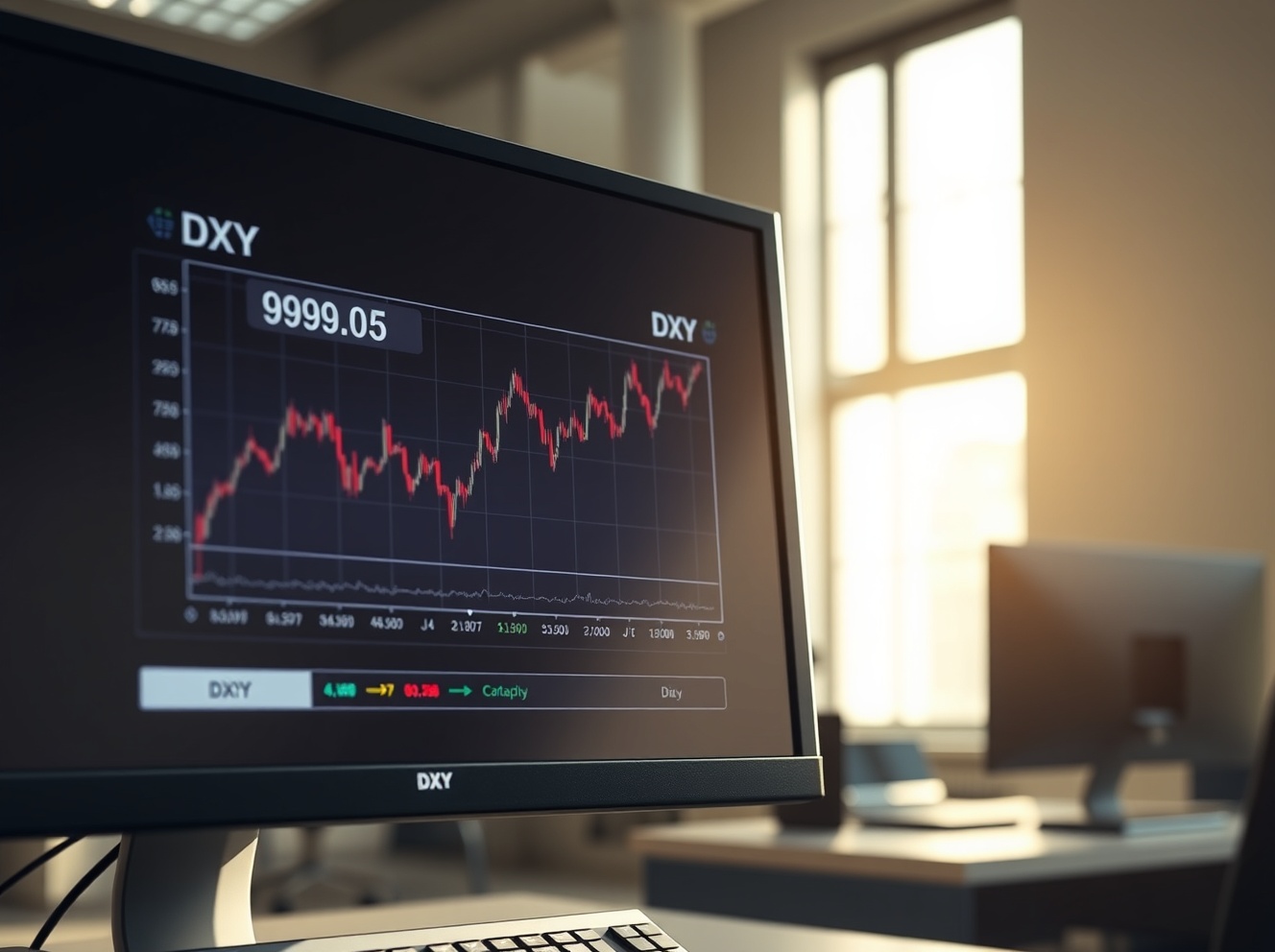
US Dollar Index Defies Gravity: Holds Near 99.00 Despite Shifting Rate Cut Expectations
NEW YORK, March 2025 – The US Dollar Index (DXY) continues to demonstrate remarkable resilience, maintaining losses near the critical 99.00 threshold despite significant shifts in market expectations for Federal Reserve rate cuts. This unexpected stability in the dollar’s value against a basket of major currencies presents a complex puzzle for forex traders and economists alike.
US Dollar Index Defies Conventional Market Logic
Currency markets typically react strongly to changes in interest rate expectations. However, the DXY’s current behavior contradicts this established pattern. Recent weeks have seen Federal Reserve officials consistently temper expectations for aggressive monetary easing. Consequently, market participants have adjusted their forecasts for rate cuts throughout 2025. Despite this hawkish shift in sentiment, the dollar index has failed to mount a substantial recovery. Instead, it remains anchored near the 99.00 level, a zone that has provided both support and resistance in recent trading sessions.
This apparent disconnect between monetary policy signals and currency valuation requires deeper examination. Several structural factors contribute to the dollar’s current positioning. First, global economic uncertainty continues to support demand for safe-haven assets. Second, relative economic performance between the United States and other major economies remains a crucial consideration. Third, technical factors and positioning data reveal that many traders had already priced in a stronger dollar narrative earlier this year.
Analyzing the Federal Reserve’s Evolving Stance
The Federal Reserve’s communication strategy has undergone noticeable refinement in recent months. Initially, markets anticipated a series of rate cuts beginning in early 2025. However, persistent inflation data and robust employment figures have forced a recalibration. Fed Chair Jerome Powell emphasized data dependency in recent congressional testimony. He specifically noted that the central bank requires “greater confidence” that inflation is moving sustainably toward the 2% target before considering policy easing.
Expert Perspectives on Monetary Policy Transmission
Financial analysts point to several mechanisms that might explain the dollar’s muted response. Dr. Eleanor Vance, Chief Economist at Sterling Financial Research, explains the phenomenon. “The transmission mechanism between rate expectations and currency values isn’t always immediate or linear,” she notes. “Market participants are currently weighing the Fed’s cautious stance against similar hesitancy from other central banks, particularly the European Central Bank and Bank of England.”
Furthermore, interest rate differentials remain a key driver. While expectations for Fed cuts have diminished, projections for other central banks have shifted in parallel. This synchronization has limited the dollar’s relative advantage. The table below illustrates recent changes in rate cut expectations for major central banks:
| Central Bank | Expected 2025 Cuts (March) | Expected 2025 Cuts (January) | Change |
|---|---|---|---|
| Federal Reserve | 2-3 cuts | 4-5 cuts | -2 cuts |
| European Central Bank | 2 cuts | 3-4 cuts | -1 to -2 cuts |
| Bank of England | 1-2 cuts | 3 cuts | -1 to -2 cuts |
Technical Analysis Reveals Key Support Levels
From a technical perspective, the 99.00 level represents a significant psychological and historical support zone. Chart analysis reveals several important patterns:
- Multiple Tests: The DXY has tested the 99.00 level four times in the past two months
- Volume Profile: Trading volume increases substantially near this level, indicating strong participant interest
- Moving Averages: The 50-day and 200-day moving averages are converging around 99.50, creating a technical equilibrium
- Relative Strength: The index shows neutral momentum readings, neither oversold nor overbought
Technical analysts emphasize that a sustained break below 98.50 could trigger further declines. Conversely, a recovery above 100.00 would signal renewed dollar strength. The current consolidation suggests market indecision as participants await clearer directional catalysts.
Global Economic Context and Currency Implications
The dollar’s performance cannot be analyzed in isolation. Global economic conditions significantly influence currency dynamics. Several international developments contribute to the current market environment:
First, European economic data has shown unexpected resilience. Manufacturing surveys and consumer confidence indicators have surpassed forecasts in recent weeks. Second, geopolitical tensions continue to create volatility in currency markets. Third, commodity price fluctuations, particularly in energy markets, affect currency correlations and trade balances.
Market participants also monitor capital flows closely. Recent Treasury International Capital (TIC) data reveals continued foreign investment in US assets. This sustained demand provides underlying support for the dollar despite shifting rate expectations. The dollar’s role as the world’s primary reserve currency creates inherent structural demand that buffers against short-term sentiment shifts.
Historical Precedents and Market Memory
Financial markets possess institutional memory that influences current behavior. Similar episodes of policy expectation shifts occurred in 2016 and 2019. In both instances, the dollar exhibited delayed reactions to changing Fed narratives. Historical analysis suggests that currency markets sometimes require confirmation through actual policy implementation rather than forward guidance alone.
Furthermore, positioning data from the Commodity Futures Trading Commission (CFTC) reveals that speculative net long positions on the dollar reached extreme levels earlier this year. This overcrowded trade likely contributed to the dollar’s vulnerability to position unwinding, even as fundamental factors appeared supportive.
Market Participants Adjust Strategies
Professional traders and institutional investors have adapted their approaches in response to the evolving landscape. Several strategic shifts are evident across currency markets:
- Reduced Leverage: Many funds have decreased leverage amid increased uncertainty
- Options Positioning: There’s growing demand for options strategies that profit from range-bound trading
- Cross-Currency Analysis: Traders increasingly focus on relative value between currency pairs rather than outright dollar direction
- Algorithmic Adjustments: Quantitative models have been recalibrated to account for changing correlation structures
These adaptations reflect the market’s recognition that traditional dollar trading paradigms may require modification. The relationship between rate expectations and currency values appears more nuanced than in previous cycles.
Conclusion
The US Dollar Index’s persistence near 99.00 despite fading rate cut expectations highlights the complexity of modern currency markets. Multiple factors, including global economic synchronization, technical support levels, and positioning dynamics, contribute to this apparent anomaly. Market participants must consider a broader range of variables beyond simple interest rate differentials. The dollar’s trajectory will likely depend on upcoming economic data releases, Federal Reserve communications, and international developments. As always in forex markets, adaptability and comprehensive analysis remain essential for navigating these evolving conditions successfully.
FAQs
Q1: What is the US Dollar Index (DXY)?
The US Dollar Index is a measure of the value of the United States dollar relative to a basket of foreign currencies. It includes the euro, Japanese yen, British pound, Canadian dollar, Swedish krona, and Swiss franc.
Q2: Why isn’t the dollar strengthening despite reduced rate cut expectations?
Several factors offset the dollar’s potential strength, including synchronized shifts in other central banks’ policies, technical support levels, previous overcrowded long positions, and global safe-haven demand dynamics.
Q3: What level represents critical support for the DXY?
The 99.00 level has emerged as significant support, with multiple tests in recent months. A sustained break below 98.50 could signal further weakness, while holding above suggests consolidation.
Q4: How do other central banks’ policies affect the dollar index?
Since the DXY measures the dollar against other currencies, policy shifts by the European Central Bank, Bank of England, and other central banks directly impact the index through changing interest rate differentials and economic outlook comparisons.
Q5: What should traders watch for signals of dollar direction?
Key indicators include upcoming inflation data, Federal Reserve meeting minutes, technical breaks of support/resistance levels, CFTC positioning reports, and relative economic performance data from major US trading partners.
This post US Dollar Index Defies Gravity: Holds Near 99.00 Despite Shifting Rate Cut Expectations first appeared on BitcoinWorld.
Potrebbe anche piacerti

Pi Network Set to Become First Cryptocurrency Granted Access to Federal Reserve Core Payment System
