Quantum risk has become a recurring stress point in Bitcoin discourse, often framed as an existential threat. The claim usually follows a familiar arc: quantum Quantum risk has become a recurring stress point in Bitcoin discourse, often framed as an existential threat. The claim usually follows a familiar arc: quantum

Bitcoin And The Quantum Panic: What Developers Are Actually Doing

2025/12/15 22:00

Quantum risk has become a recurring stress point in Bitcoin discourse, often framed as an existential threat. The claim usually follows a familiar arc: quantum computing is advancing quickly, cryptography is vulnerable, and Bitcoin isn’t adapting fast enough.

Marty Bent doesn’t buy that framing. In his Dec. 14 episode, Bent acknowledged that quantum computing represents a genuine risk — not just for Bitcoin, but for any system built on modern cryptography — while pushing back on the idea that Bitcoin developers are ignoring the issue.

“Short answer is yes, it is a risk,” Bent said. “But it’s not only a risk for Bitcoin. It’s a risk for any system that depends on cryptography for security.”

What Developers Are Doing To Make Bitcoin Quantum-Safe

What tends to get lost, he argued, is the work already underway. Bent pointed to ongoing developer discussions and, more recently, a research paper published by Blockstream’s Jonas Nick and Mikhail Kutunov examining hash-based, post-quantum signature schemes tailored specifically for Bitcoin.

“I just wanted to make this video to push back on that notion,” Bent said, referring to claims that Bitcoin isn’t moving fast enough. “Because I think it’s pretty clear if you’ve been following Bitcoin development discussions over the last year, the quantum risk is certainly being taken seriously and the conversations have started.”

Nick summarized the paper in a Dec. 9 post on X, describing it as an analysis of post-quantum schemes optimized for Bitcoin’s constraints rather than generic cryptographic benchmarks. Bent described the work as a signal that research is shifting from abstract concern to concrete design space.

Nick wrote via X: “Hash-based signatures are conceptually simple and rely solely on hash functions, which is a primitive Bitcoin already trusts. While NIST has standardized SLH-DSA (SPHINCS+), we investigate alternatives that are better suited to Bitcoin’s specific needs. We explore in detail how various optimizations and parameter choices affect size and performance. Signature size can be reduced to ~3-4KB, which is comparable to lattice-based signature schemes (ML-DSA).”

The challenge, Bent emphasized, isn’t a lack of candidate solutions. It’s that Bitcoin is a globally distributed system with nearly 17 years of operational history, and changes at the protocol level come with heavy trade-offs. “Bitcoin is a globally distributed peer-to-peer system that depends on consensus protocol rules that are very hard to change,” Bent said. “And you really don’t want to change them too often.”

That reality complicates any transition to quantum-resistant signatures. Existing address types, HD wallets, multisig setups, and threshold schemes all need to be considered. And beyond compatibility, there’s the question of performance.

“One of the biggest hurdles when approaching this problem in Bitcoin is that many quantum-resistant schemes are very data intensive,” Bent said. “Yes, there are many different schemes that can be implemented. However, they come with trade-offs — particularly verification and bandwidth trade-offs.”

Larger signatures can slow block propagation and make it more expensive to run a full node, which directly impacts decentralization. The Blockstream paper focuses heavily on that tension, exploring optimizations that could reduce signature sizes to a few kilobytes while keeping verification costs manageable.

“They feel pretty confident that they’ve done the research to find signature schemes that would have a nice trade-off balance,” Bent said. “You get quantum resistance, but at the same time it remains conducive for people to download full nodes and verify transactions without needing a significant amount of bandwidth and data storage.”

Bent was careful not to frame the research as a finished solution. Instead, he described it as groundwork — mapping the problem space early so the network isn’t caught flat-footed if quantum capabilities advance faster than expected.

“This is by no means like, ‘hey, we solved the problem,’” he said. “But we are taking this problem seriously, doing research and beginning to figure out ways in which we could solve the quantum risk that may or may not manifest in the medium to long term.”

He also noted that BTC tends to be singled out in quantum discussions, even though most of the internet relies on cryptographic assumptions that would face similar pressure in a true post-quantum scenario.

“If quantum computers do come, Bitcoin is not the only thing,” Bent said. “Almost everything you touch on the internet is depending on some cryptographic security at some point.”

For now, Bent’s takeaway was measured. Quantum risk exists. Progress in quantum computing is real. But the narrative that developers are ignoring the issue doesn’t align with what’s happening in technical circles.

“Very smart developers, cryptographers more importantly, are researching the problem,” he said. “If you know where to look, it’s pretty clear that people are preparing for this.” Not solved. Not ignored. Just quietly being worked on.

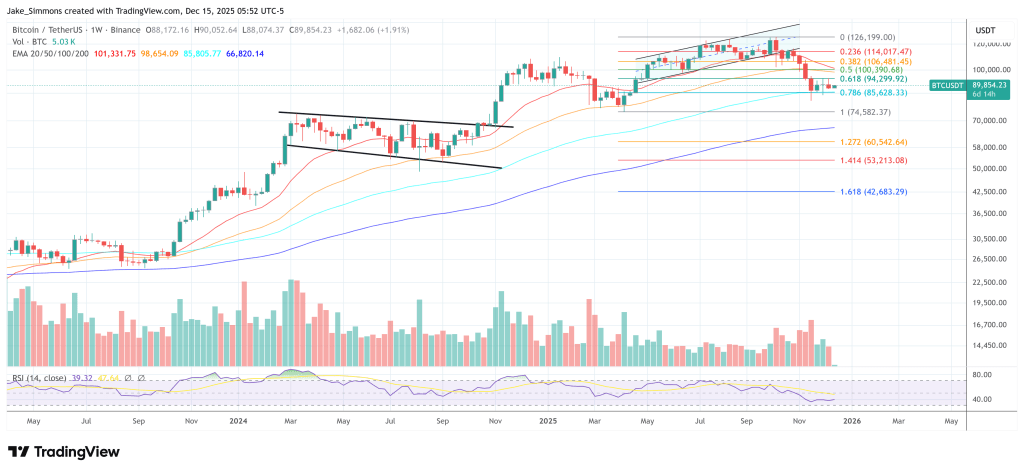
At press time, BTC traded at $89,854.
Bitcoin price
הזדמנות שוק
QUANTUM סֵמֶל
QUANTUM מְחִיר(QUANTUM)
$0.003197
$0.003197$0.003197
-0.52%
USD
QUANTUM (QUANTUM) טבלת מחירים חיה
הצהרת סיכום: המאמרים המתפרסמים מחדש באתר זה מקורם בפלטפורמות ציבוריות ונמסרים לצרכי מידע בלבד. הם אינם משקפים בהכרח את עמדותיה של MEXC. כל הזכויות שמורות למחברים המקוריים. אם אתה סבור שתוכן כלשהו מפר זכויות צד שלישי, אנא צרו קשר עם service@support.mexc.com לבקשת הסרה. MEXC אינה מתחייבת לדיוק, לשלמות או לעדכניות התוכן, ואינה אחראית לכל פעולה שתינקט על סמך המידע המסופק. התוכן אינו מהווה ייעוץ פיננסי, משפטי או מקצועי אחר, ואין לראות בו המלצה או אישור מטעם MEXC.

אולי תאהב גם

China Blocks Nvidia’s RTX Pro 6000D as Local Chips Rise

China Blocks Nvidia’s RTX Pro 6000D as Local Chips Rise

The post China Blocks Nvidia’s RTX Pro 6000D as Local Chips Rise appeared on BitcoinEthereumNews.com. China Blocks Nvidia’s RTX Pro 6000D as Local Chips Rise China’s internet regulator has ordered the country’s biggest technology firms, including Alibaba and ByteDance, to stop purchasing Nvidia’s RTX Pro 6000D GPUs. According to the Financial Times, the move shuts down the last major channel for mass supplies of American chips to the Chinese market. Why Beijing Halted Nvidia Purchases Chinese companies had planned to buy tens of thousands of RTX Pro 6000D accelerators and had already begun testing them in servers. But regulators intervened, halting the purchases and signaling stricter controls than earlier measures placed on Nvidia’s H20 chip. Image: Nvidia An audit compared Huawei and Cambricon processors, along with chips developed by Alibaba and Baidu, against Nvidia’s export-approved products. Regulators concluded that Chinese chips had reached performance levels comparable to the restricted U.S. models. This assessment pushed authorities to advise firms to rely more heavily on domestic processors, further tightening Nvidia’s already limited position in China. China’s Drive Toward Tech Independence The decision highlights Beijing’s focus on import substitution — developing self-sufficient chip production to reduce reliance on U.S. supplies. “The signal is now clear: all attention is focused on building a domestic ecosystem,” said a representative of a leading Chinese tech company. Nvidia had unveiled the RTX Pro 6000D in July 2025 during CEO Jensen Huang’s visit to Beijing, in an attempt to keep a foothold in China after Washington restricted exports of its most advanced chips. But momentum is shifting. Industry sources told the Financial Times that Chinese manufacturers plan to triple AI chip production next year to meet growing demand. They believe “domestic supply will now be sufficient without Nvidia.” What It Means for the Future With Huawei, Cambricon, Alibaba, and Baidu stepping up, China is positioning itself for long-term technological independence. Nvidia, meanwhile, faces…
לַחֲלוֹק
BitcoinEthereumNews2025/09/18 01:37
Gold continues to hit new highs. How to invest in gold in the crypto market?

Gold continues to hit new highs. How to invest in gold in the crypto market?

As Bitcoin encounters a "value winter", real-world gold is recasting the iron curtain of value on the blockchain.
לַחֲלוֹק
PANews2025/04/14 17:12
Why The Green Bay Packers Must Take The Cleveland Browns Seriously — As Hard As That Might Be

Why The Green Bay Packers Must Take The Cleveland Browns Seriously — As Hard As That Might Be

The post Why The Green Bay Packers Must Take The Cleveland Browns Seriously — As Hard As That Might Be appeared on BitcoinEthereumNews.com. Jordan Love and the Green Bay Packers are off to a 2-0 start. Getty Images The Green Bay Packers are, once again, one of the NFL’s better teams. The Cleveland Browns are, once again, one of the league’s doormats. It’s why unbeaten Green Bay (2-0) is a 8-point favorite at winless Cleveland (0-2) Sunday according to betmgm.com. The money line is also Green Bay -500. Most expect this to be a Packers’ rout, and it very well could be. But Green Bay knows taking anyone in this league for granted can prove costly. “I think if you look at their roster, the paper, who they have on that team, what they can do, they got a lot of talent and things can turn around quickly for them,” Packers safety Xavier McKinney said. “We just got to kind of keep that in mind and know we not just walking into something and they just going to lay down. That’s not what they going to do.” The Browns certainly haven’t laid down on defense. Far from. Cleveland is allowing an NFL-best 191.5 yards per game. The Browns gave up 141 yards to Cincinnati in Week 1, including just seven in the second half, but still lost, 17-16. Cleveland has given up an NFL-best 45.5 rushing yards per game and just 2.1 rushing yards per attempt. “The biggest thing is our defensive line is much, much improved over last year and I think we’ve got back to our personality,” defensive coordinator Jim Schwartz said recently. “When we play our best, our D-line leads us there as our engine.” The Browns rank third in the league in passing defense, allowing just 146.0 yards per game. Cleveland has also gone 30 straight games without allowing a 300-yard passer, the longest active streak in the NFL.…
לַחֲלוֹק
BitcoinEthereumNews2025/09/18 00:41