Some observers noted that even if Iran controlled 5% of global hashrate, the network would continue functioning without disruption.Some observers noted that even if Iran controlled 5% of global hashrate, the network would continue functioning without disruption.

U.S. Strikes on Iran Spark Debate Over Bitcoin Hashrate and Market Stability

2026/02/28 22:15
3 min read

Bitcoin mining in Iran is back in the spotlight after a viral X post on February 27 claimed the country runs a $1 billion operation that could be wiped out.

The debate has split crypto observers, with some warning of a temporary hashrate shock and others dismissing the claims as exaggerated fear, uncertainty, and doubt (FUD).

Iran’s Mining Footprint and the Strike Scenario

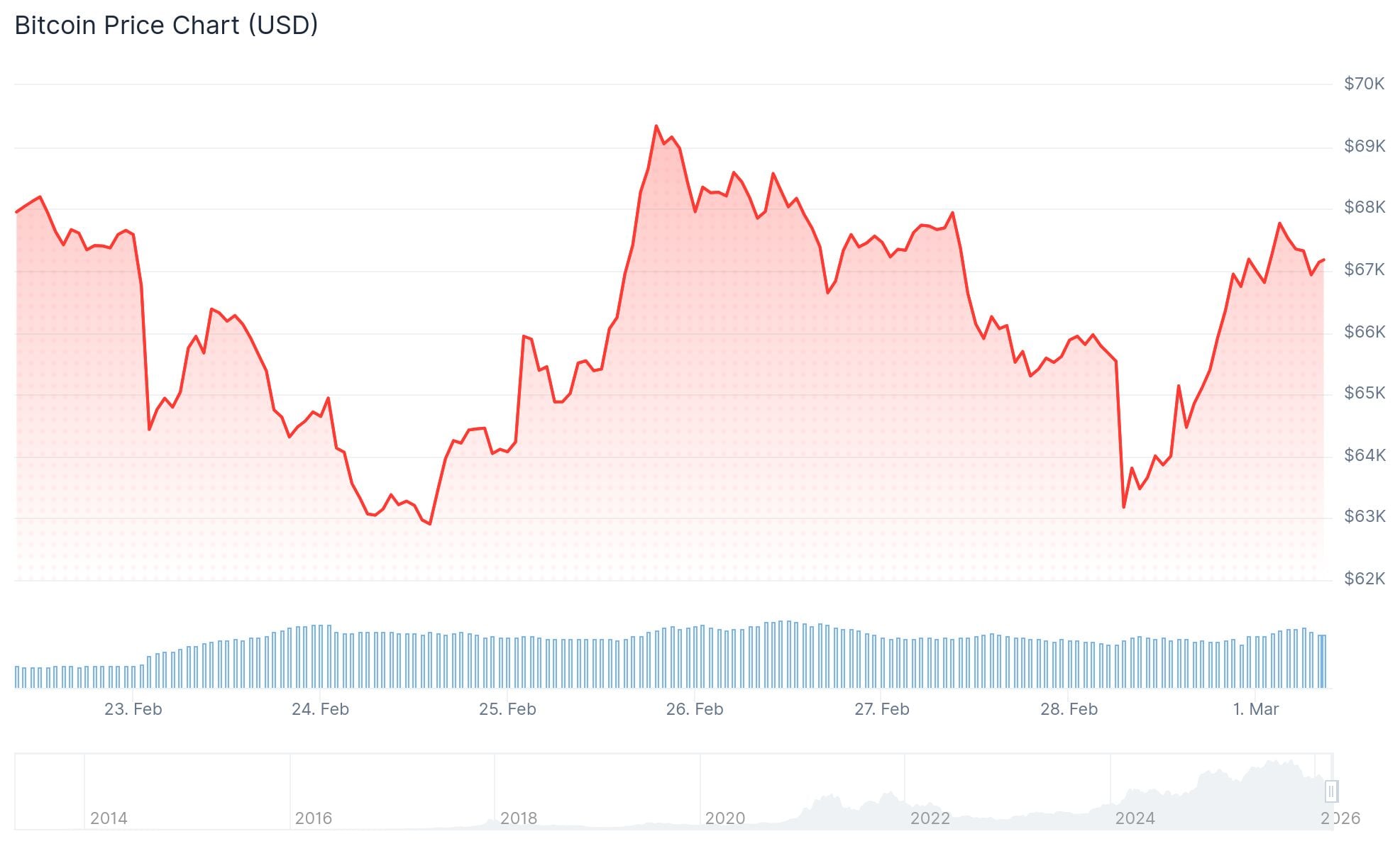
The discussion began when independent analyst Shanaka Anslem Perera posted that Iran mines Bitcoin at a theoretical cost of $1,320 per BTC using heavily subsidized electricity and then selling it at the current price near $68,000 to extract what he described as a 50x gross margin.

He alleged that around 700,000 mining rigs consume roughly 2,000 megawatts daily, much of it tied to operations linked to the Islamic Revolutionary Guard Corps, or IRGC.

Perera tied the argument to sanctions, saying Bitcoin allows Iran to convert restricted energy resources into liquid capital beyond the reach of SWIFT prohibitions.

A January 16 report by Chainalysis found that Iran’s total crypto activity exceeded $7.78 billion in 2025. Furthermore, the report said addresses linked to IRGC facilitation networks received more than $3 billion last year, up from just over $2 billion in 2024, and that activity often spiked during military or political crises.

Nonetheless, critics quickly challenged the mining cost assumptions, with analyst Dasha calling the $1,320 figure “100% fake news,” arguing it relies on household electricity rates that cannot be achieved in practice due to blackouts and shortages.

Hashrate Shocks Are Not New

The objections did not stop there, as miner ZynxBTC dismissed the concern entirely:

Recent U.S. events support that argument. Earlier in the year, the network continued operating even after a severe winter storm forced major Texas miners offline, pushing the hashrate down from 1.133 ZH/s to 690 EH/s in just a couple of days.

However, Perera argued that grid failure differs from voluntary shutdown. According to his analysis, with tensions brewing in the Middle East, a 7-to-10-day air campaign targeting Iranian military infrastructure would likely collapse electricity generation by an estimated 30% to 50%.

He insisted that mining rigs require continuous power, and even brief outages could destroy active operations. As such, he postulated that a strike on Iran’s already fragile grid could see the country’s estimated 2% to 5% share of the global hashrate drop to zero within days, triggering a difficulty adjustment that would extend block times and temporarily spike transaction fees. As CryptoPotato reported, the US and Israel have already launched strikes on Iran earlier today.

Still, others argued that the Bitcoin network has withstood even larger shocks, with researcher Furkan Yildirim noting that China removed more than half of the global hashrate in 2021, yet the network soon adjusted as miners relocated.

The post U.S. Strikes on Iran Spark Debate Over Bitcoin Hashrate and Market Stability appeared first on CryptoPotato.

Market Opportunity
Union Logo
Union Price(U)
$0.001104
$0.001104$0.001104
-13.61%
USD
Union (U) Live Price Chart
Disclaimer: The articles reposted on this site are sourced from public platforms and are provided for informational purposes only. They do not necessarily reflect the views of MEXC. All rights remain with the original authors. If you believe any content infringes on third-party rights, please contact crypto.news@mexc.com for removal. MEXC makes no guarantees regarding the accuracy, completeness, or timeliness of the content and is not responsible for any actions taken based on the information provided. The content does not constitute financial, legal, or other professional advice, nor should it be considered a recommendation or endorsement by MEXC.

You May Also Like

Top 5 Cryptocurrencies for Long-Term Investment in 2026: Expert Analysis

Top 5 Cryptocurrencies for Long-Term Investment in 2026: Expert Analysis

Discover the top 5 cryptocurrencies for long-term investment in 2026. Bitcoin, Ethereum, Solana, Chainlink, and Avalanche lead with institutional backing. The post
Share
Blockonomi2026/03/01 19:48
Tindig Pilipinas backs clergy’s complaint to fast-track Sara Duterte impeachment

Tindig Pilipinas backs clergy’s complaint to fast-track Sara Duterte impeachment

'Consolidating our support behind the third complaint will strengthen our position and help move the case forward to the Senate impeachment court,' Tindig Pilipinas
Share
Rappler2026/03/01 19:47
3 Paradoxes of Altcoin Season in September

3 Paradoxes of Altcoin Season in September

The post 3 Paradoxes of Altcoin Season in September appeared on BitcoinEthereumNews.com. Analyses and data indicate that the crypto market is experiencing its most active altcoin season since early 2025, with many altcoins outperforming Bitcoin. However, behind this excitement lies a paradox. Most retail investors remain uneasy as their portfolios show little to no profit. This article outlines the main reasons behind this situation. Altcoin Market Cap Rises but Dominance Shrinks Sponsored TradingView data shows that the TOTAL3 market cap (excluding BTC and ETH) reached a new high of over $1.1 trillion in September. Yet the share of OTHERS (excluding the top 10) has declined since 2022, now standing at just 8%. OTHERS Dominance And TOTAL3 Capitalization. Source: TradingView. In past cycles, such as 2017 and 2021, TOTAL3 and OTHERS.D rose together. That trend reflected capital flowing not only into large-cap altcoins but also into mid-cap and low-cap ones. The current divergence shows that capital is concentrated in stablecoins and a handful of top-10 altcoins such as SOL, XRP, BNB, DOG, HYPE, and LINK. Smaller altcoins receive far less liquidity, making it hard for their prices to return to levels where investors previously bought. This creates a situation where only a few win while most face losses. Retail investors also tend to diversify across many coins instead of adding size to top altcoins. That explains why many portfolios remain stagnant despite a broader market rally. Sponsored “Position sizing is everything. Many people hold 25–30 tokens at once. A 100x on a token that makes up only 1% of your portfolio won’t meaningfully change your life. It’s better to make a few high-conviction bets than to overdiversify,” analyst The DeFi Investor said. Altcoin Index Surges but Investor Sentiment Remains Cautious The Altcoin Season Index from Blockchain Center now stands at 80 points. This indicates that over 80% of the top 50 altcoins outperformed…
Share
BitcoinEthereumNews2025/09/18 01:43