XRP slipped sharply on February 28. After fresh geopolitical tensions rattled global markets. The drop came as reports emerged of major U.S. and Israeli strikesXRP slipped sharply on February 28. After fresh geopolitical tensions rattled global markets. The drop came as reports emerged of major U.S. and Israeli strikes

XRP Falls as US-Israel Strikes Iran Spark Market Risk Off

2026/02/28 19:44
3 min read

XRP slipped sharply on February 28. After fresh geopolitical tensions rattled global markets. The drop came as reports emerged of major U.S. and Israeli strikes on Iran. This quickly pushed investors into risk-off mode. XRP traded near $1.29, down about 7% in 24 hours, according to market trackers. 

The selloff was not isolated. BTC, ETH and major altcoins also pulled back. As traders reacted to rising Middle East uncertainty. While some analysts expect a possible rebound if tensions cool. The immediate mood across crypto markets remains cautious.

Middle East Escalation Triggers

Market nerves spiked after multiple reports pointed to direct military escalation. That involves the US, Israel and Iran. Regional reports say Iranian forces responded. By targeting US military assets across parts of the Middle East. Such geopolitical shocks often push investors away from volatile assets. 

Crypto markets tend to react quickly. Because they trade around the clock and have deep leverage exposure. As fear spread, traders reduced risk. Then moved capital into safer assets like the U.S. dollar and gold. The tone online also turned tense. Market watchers warned that continued escalation could keep pressure on risk assets in the near term.

XRP Falls Alongside Broader Crypto Market

XRP’s drop reflects the wider crypto pullback. Rather than any Ripple specific development. The token fell roughly 7.3% over 24 hours. It is bringing the price near the $1.29 level. Meanwhile, other major assets also weakened. 
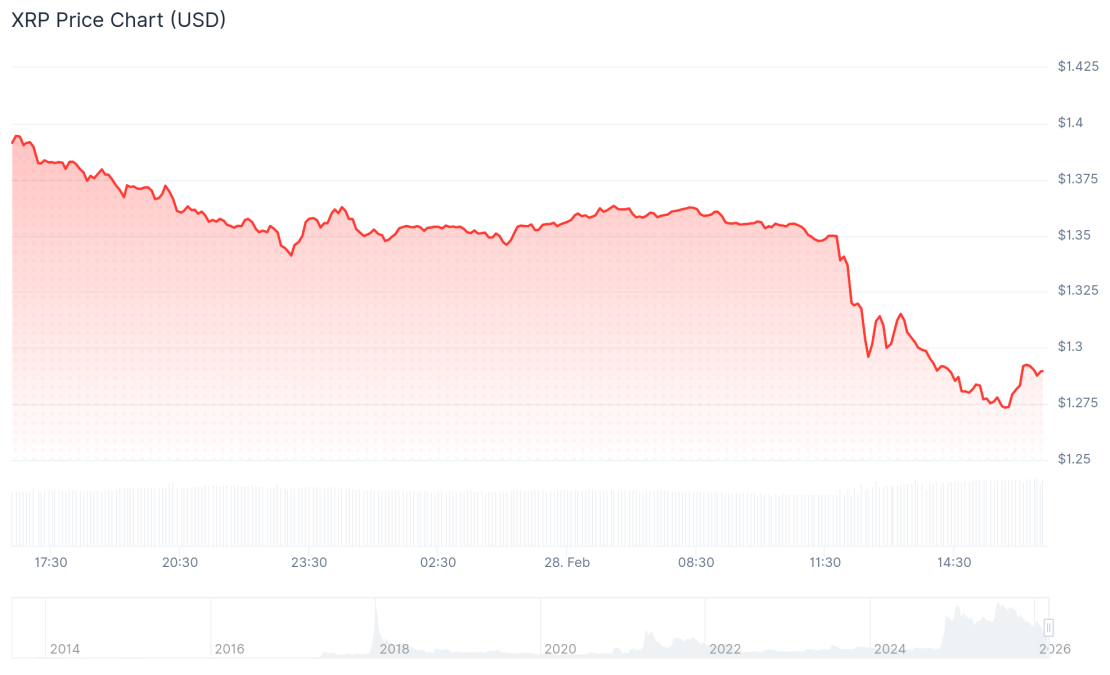
XRP Price (USD) on Coingecko on February 28, 2026

Chart: XRP Price (USD) on Coingecko on February 28, 2026

ETH saw sharper percentage losses during parts of the session. While BTC briefly dipped as traders unwound leveraged positions. Liquidations across derivatives platforms added to the downward momentum. Despite the drop, XRP still holds a relatively strong position. In comparison with deeper corrections seen in past geopolitical shocks. Some analysts note that the move so far looks like a typical risk reaction rather than a structural breakdown.

Volatility Highlights Crypto’s Sensitivity to Global Events

The latest swing again shows how sensitive digital assets remain to macro headlines. Unlike traditional markets that close overnight. Crypto reacts instantly to breaking news. This often amplifies short term volatility. Historically, major geopolitical events like the 2022 Russia-Ukraine conflict. Often triggered double-digit crypto corrections before markets later stabilized. 

Because of this pattern, some traders are watching closely for signs of panic selling versus normal risk repricing. Derivatives data suggests leveraged traders were caught offside during the sudden move. When prices fall quickly, forced liquidations can accelerate the drop.

What to Expect?

Looking ahead, XRP’s next move will likely depend more on macro conditions. Rather than on crypto specific news. If tensions in the Middle East ease. The risk appetite could return quickly. Crypto markets have often rebounded fast after geopolitical scares. But if the conflict expands or uncertainty drags on. The volatility may remain elevated. Traders are now closely watching military updates and broader market sentiment. For now, XRP’s pullback reflects a familiar crypto reality. When global fear rises, digital assets rarely stay calm for long.

The post XRP Falls as US-Israel Strikes Iran Spark Market Risk Off appeared first on Coinfomania.

Market Opportunity
XRP Logo
XRP Price(XRP)
$1.3219
$1.3219$1.3219
-0.14%
USD
XRP (XRP) Live Price Chart
Disclaimer: The articles reposted on this site are sourced from public platforms and are provided for informational purposes only. They do not necessarily reflect the views of MEXC. All rights remain with the original authors. If you believe any content infringes on third-party rights, please contact crypto.news@mexc.com for removal. MEXC makes no guarantees regarding the accuracy, completeness, or timeliness of the content and is not responsible for any actions taken based on the information provided. The content does not constitute financial, legal, or other professional advice, nor should it be considered a recommendation or endorsement by MEXC.

You May Also Like

OpenVPP accused of falsely advertising cooperation with the US government; SEC commissioner clarifies no involvement

OpenVPP accused of falsely advertising cooperation with the US government; SEC commissioner clarifies no involvement

PANews reported on September 17th that on-chain sleuth ZachXBT tweeted that OpenVPP ( $OVPP ) announced this week that it was collaborating with the US government to advance energy tokenization. SEC Commissioner Hester Peirce subsequently responded, stating that the company does not collaborate with or endorse any private crypto projects. The OpenVPP team subsequently hid the response. Several crypto influencers have participated in promoting the project, and the accounts involved have been questioned as typical influencer accounts.
Share
PANews2025/09/17 23:58
Aave DAO to Shut Down 50% of L2s While Doubling Down on GHO

Aave DAO to Shut Down 50% of L2s While Doubling Down on GHO

The post Aave DAO to Shut Down 50% of L2s While Doubling Down on GHO appeared on BitcoinEthereumNews.com. Aave DAO is gearing up for a significant overhaul by shutting down over 50% of underperforming L2 instances. It is also restructuring its governance framework and deploying over $100 million to boost GHO. This could be a pivotal moment that propels Aave back to the forefront of on-chain lending or sparks unprecedented controversy within the DeFi community. Sponsored Sponsored ACI Proposes Shutting Down 50% of L2s The “State of the Union” report by the Aave Chan Initiative (ACI) paints a candid picture. After a turbulent period in the DeFi market and internal challenges, Aave (AAVE) now leads in key metrics: TVL, revenue, market share, and borrowing volume. Aave’s annual revenue of $130 million surpasses the combined cash reserves of its competitors. Tokenomics improvements and the AAVE token buyback program have also contributed to the ecosystem’s growth. Aave global metrics. Source: Aave However, the ACI’s report also highlights several pain points. First, regarding the Layer-2 (L2) strategy. While Aave’s L2 strategy was once a key driver of success, it is no longer fit for purpose. Over half of Aave’s instances on L2s and alt-L1s are not economically viable. Based on year-to-date data, over 86.6% of Aave’s revenue comes from the mainnet, indicating that everything else is a side quest. On this basis, ACI proposes closing underperforming networks. The DAO should invest in key networks with significant differentiators. Second, ACI is pushing for a complete overhaul of the “friendly fork” framework, as most have been unimpressive regarding TVL and revenue. In some cases, attackers have exploited them to Aave’s detriment, as seen with Spark. Sponsored Sponsored “The friendly fork model had a good intention but bad execution where the DAO was too friendly towards these forks, allowing the DAO only little upside,” the report states. Third, the instance model, once a smart…
Share
BitcoinEthereumNews2025/09/18 02:28
Banking Regulator Floats New Stablecoin Yield Rules—Do They Hurt Coinbase?

Banking Regulator Floats New Stablecoin Yield Rules—Do They Hurt Coinbase?

The post Banking Regulator Floats New Stablecoin Yield Rules—Do They Hurt Coinbase? appeared on BitcoinEthereumNews.com. In brief The OCC proposed rules that would
Share
BitcoinEthereumNews2026/03/01 00:34
