

Russia’s Central Bank Says Bitcoin Mining Is Strengthening the Ruble
Russia’s Central Bank has acknowledged that crypto mining contributes to the ruble’s strength, though quantifying its exact impact remains difficult as much of the industry operates in gray areas.
Governor Elvira Nabiullina made the statement while responding to questions about the sector’s influence on foreign exchange markets, according to a local report.
The acknowledgment comes as senior Kremlin officials push to formally classify mining as an export activity in Russia’s trade accounts, which further shows the sector’s growing importance to the national economy despite regulatory uncertainties.
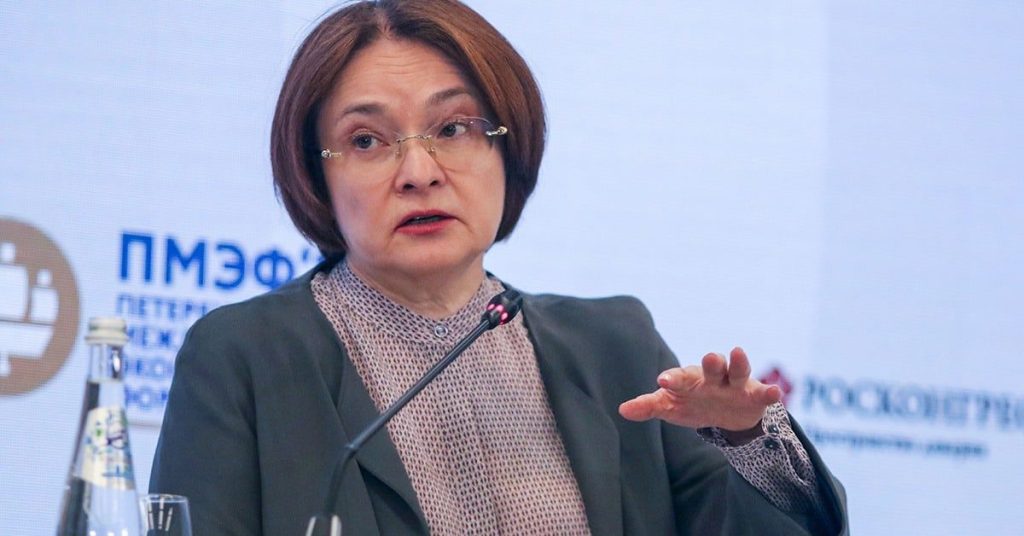 Governor Elvira Nabiullina. | Source: GFMAG
Mining Emerges as Informal Export Driver
Deputy Chief of Staff Maxim Oreshkin argued at the VTB “Russia Calling!” forum that crypto mining should be treated as an export activity because mined digital assets effectively flow abroad even without crossing physical borders.
He described the sector as “a new export item” that Russia “doesn’t value very well,” citing the underestimation of mining-related financial flows as the reason for incorrect ruble exchange rate forecasts.
Industry figures estimate Russia produces tens of thousands of Bitcoins annually, with daily mining revenue reaching approximately 1 billion rubles.
The Industrial Mining Association reports Russia ranks second globally for mining, accounting for over 16% of the world’s hashrate in the summer months, though network halving reduced output from roughly 55,000 BTC in 2023 to around 35,000 BTC in 2024.
Nabiullina acknowledged mining’s currency market impact but emphasized context, stating that for mining, “it’s probably difficult to quantify its impact right now, because a significant portion of it is still in the gray zone. But in any case, this mining didn’t emerge this year, meaning the exchange rate appreciation can’t be attributed to the fact that it has risen sharply.“
Gray Market Operations Cost Billions Despite Legalization
Russia legalized crypto mining on November 1, 2024, requiring legal entities and entrepreneurs to register with the Federal Tax Service, while exempting individual miners who consume less than 6,000 kWh per month.
Corporate mining is taxed at 25%, while individuals pay progressive rates of 13-22%, with non-residents paying 30%.
Despite legalization efforts, illegal and quasi-legal mining continues costing Russia millions annually through stolen electricity and unpaid taxes.
Broadcaster Ren TV reported that fear of high taxes and electricity costs is driving many miners underground, with annual budget losses reaching billions of rubles as operators resort to meter manipulation, bribery, and secret agreements with utility workers.
 Illegal crypto miners in a Russian facility. | Source: Ren TV/Izvestia/Screenshot
Recent investigations uncovered widespread theft, including a St. Petersburg operator who bypassed meters since 2018, costing the grid half a billion rubles, and a Dagestan farm hidden in coolant tanks.
A power supply employee described the scale of the illegal operation, saying: “The illegal crypto mining farm was using more power than an entire five-story building.”
Police arrested an employee of Omsk Thermal Power Plant who accepted 500,000 rubles in bribes to facilitate grid theft.
Banks Enter Digital Assets While Payments Remain Banned
Sberbank, Russia’s largest lender, is testing decentralized finance tools and offering regulated crypto-linked investments totaling 1.5 billion rubles in structured bonds and digital financial assets tied to Bitcoin, Ethereum, and broader crypto portfolios.
Deputy Chairman Anatoly Popov confirmed active dialogue with the Bank of Russia and Rosfinmonitoring on integrating crypto services within regulated frameworks while building proprietary blockchain infrastructure.
Despite the growth across verticals, State Duma Committee Chairman Anatoly Aksakov recently reaffirmed the country’s strict payment bans, declaring at a TASS press conference: “We must understand that cryptocurrencies will never become money within our country.”
“They can only be used as an investment instrument. If payment is required, it will only be in rubles,” he added.
Central Bank Governor Nabiullina has repeatedly called for bans on crypto exchanges and token trading, despite Russia recording $376.3 billion in incoming transactions between July 2024 and June 2025.
First Deputy Chairman Vladimir Chistyukhin emphasized the urgency of regulatory action, stating that laws governing cryptocurrency transactions “must be passed as quickly as possible.“
However, the bank also supports tokenization solutions to grant foreign buyers access to Russian company shares as a potential sanctions workaround.
You May Also Like

Quick Tips for Passing Your MyCPR NOW Final Exam

Top Altcoins To Hold Before 2026 For Maximum ROI – One Is Under $1!
