Anika Collier Navaroli was a senior policy official on Twitter's safety team. She warned that coded calls to arms could lead to offline violence. But despite herAnika Collier Navaroli was a senior policy official on Twitter's safety team. She warned that coded calls to arms could lead to offline violence. But despite her

How Whistleblowing Affects the Careers of Black Women in Tech

The Markup, now a part of CalMatters, uses investigative reporting, data analysis, and software engineering to challenge technology to serve the public good. Sign up for Klaxon, a newsletter that delivers our stories and tools directly to your inbox.

\ This article was copublished with The 19th, a nonprofit newsroom covering gender, politics, and policy. Sign up for The 19th’s newsletter here.

\ The night of Jan. 5, 2021, Anika Collier Navaroli slept poorly. She had an uneasy feeling about what might happen in Washington, D.C., the next day.

\ Back then, Navaroli was a senior policy official at Twitter and the longest-tenured employee on the platform’s now-extinct safety policy team. For weeks, she and her team reviewed and cataloged a raft of troubling posts containing coded calls to arms, with some urging a “Civil War part two” and a “new American Revolution.”

\ The posts Navaroli reviewed followed a December call to action from then-president Donald Trump, who had tweeted a claim that the 2020 presidential election was rigged against him; he invited his supporters to the Capitol for a big protest on January 6—“Be there, will be wild!” he wrote. The post took off on Twitter: Users claimed to be “locked and loaded” for the protest; others demanded the hanging of Trump’s perceived enemies.

\ Navaroli, an attorney, had repeatedly reported the trend to leaders at the platform, warning the dangerous call-and-response could prompt actual offline violence. She later testified before Congress that she knew something “very, very bad was going to happen.”

\ “I was sitting there giving all these warnings,” she told The Markup last month. “It became clear to me that in many ways I was already a whistleblower.”

\ But despite her alerting Twitter’s higher-ups, and her insistence on adopting a rule banning posts like the ones promising a violent January 6, the company ignored her. So, the president’s tweets and those of his supporters not only remained, they multiplied.

\ “I was dumbstruck at how I was unable to do my job,” Navaroli later said in congressional testimony.

\ Two days after the deadly attack on the U.S. Capitol on January 6, Twitter suspended Trump’s account “due to the risk of further incitement to violence.”

\ More stressful days and sleepless nights followed for Navaroli. She continued to appeal for rules banning calls to violence, but Twitter still did not adopt a policy for coded incitement. And the platform’s leadership did not hold any meetings about how its decision-making might have influenced the events of January 6, Navaroli said.

\ Navaroli left Twitter in March 2021 and tried to put things behind her. She moved on to another job at a large tech company and then into academia. But back in the halls of the Capitol, lawmakers wanted to hear from her. In the summer of 2022, after receiving a U.S. House Committee subpoena, Navaroli testified as part of its investigation into the role of social media companies in January 6.

\ But she hadn’t planned to go public about her experience at Twitter. Inviting that kind of professional risk—plus the threat of online attacks—was completely unappealing.

\ “I knew how dangerous it was,” she said. “I’m a Black, queer woman who’s worked on the internet. So I knew the sort of harassment and abuse that I would be signing myself up for.”

\ The committee allowed her and some other Twitter employees to testify anonymously, and gave Navaroli the pseudonym “J. Smith.” Audio excerpts of the committee’s interviews with her, later made public, used a digitally altered voice to obscure her identity.

\ A prominent news organization soon falsely reported J. Smith was a man. To Navaroli, it was an editorial choice that reflected uncomfortable, but familiar assumptions about the tech industry. (The error was never corrected.)

\ “The Associated Press thought I was a man,” she said. “I am not a man, I’m not straight, I am not White. … I think for so long we’ve kind of held that up and held that person up to be who powerful tech workers are and who powerful tech whistleblowers are.”

\ Going public, as Navaroli ultimately did in a second congressional testimony in September 2022 about the internal decision-making around January 6 at Twitter, has a crushing price for whistleblowers. Disclosing the secrets of powerful corporations, organizations, and agencies can threaten a whistleblower’s freedom, reputation, and career. Litigation from one’s employer or others named in the wrongdoing is also very possible, and costly.

\ “From the very beginning, when you get labeled a truth-teller, people become really invested in making you out to be a liar,” Navaroli said. As she’d expected, going public turned on a fire hose of racist and sexist messages, sent to her publicly and privately, including vivid death and rape threats. She regularly received images of nooses and messages promising harm to her and her family.

\ For these reasons, whistleblowers who go public represent a “significant minority,” said Jennifer Gibson, legal director of the Whistleblower Protection Program at The Signals Network, a nonprofit run by journalists and lawyers.

\ Even when they only report problems internally, whistleblowers can face retaliation at work, including threats, demotion and firing, increased scrutiny of their daily responsibilities, negative performance reviews, verbal harassment, intimidation, ostracism and isolation, and gaslighting. The mental and emotional tax on truth-telling can strain relationships and families.

\ However, Black women who report bad behavior at work like Navaroli—who is now a senior fellow at the Tow Center for Digital Journalism at Columbia University—not only jeopardize their professional careers, but often weather more intense backlash when they report wrongdoing, attorneys who work with whistleblowers said.

\ “We have a tendency to punish the messenger,” Gibson said. “When the messenger doesn’t look like us, that is even worse.”

“People Don’t Listen to Black Women Anyway”

In Gibson’s experience, women employees and employees of color are less likely to raise red flags than men or White employees. “One reason for that might be that if you take women, for example, they financially are less able to take the risk,” she said. “They may have children they’re caring for, they may have family they’re caring for, they may not be able to take the risk inherent in whistleblowing on a more sustained basis than perhaps a single male.”

\ Black women, who represent a slim share of employees in the tech industry, may also face more significant employment hurdles than others, like discrimination at work.

\ “When you especially are talking about Black women whistleblowers, the biggest issue is that, first of all, people don’t listen to Black women anyway, right?” said Siri Nelson, the executive director of the National Whistleblower Center and adjunct professor at the Northeastern University School of Law. “Navigating that reality is something important to think about when you’re considering blowing the whistle.”

\ Black women who go public alleging wrongdoing at work also face unique social backlash, experts said. Public scrutiny can focus instead on the individual and their motivations “to the detriment of dealing with the problem,” Gibson said.

\ Other Black women in tech who have aired problems at their companies have experienced similar abuse.

\ “Being a Black woman, it was very different,” researcher and former Google employee Timnit Gebru told The Guardian in 2021. Gebru was ousted from the company in 2020 after she refused to retract research she co-authored detailing some of the risks of the language models that power Google’s search engine. A campaign of racist and sexist harassment followed. “There’s a specific strand of vitriol you deal with.”

\ After reporting workplace problems, Black women have even been physically harmed at work.

\ In early 2003, when she was a high-ranking civilian employee in the Army Corps of Engineers, Bunny Greenhouse objected to a $7 billion no-bid contract awarded to a subsidiary of Halliburton, the company then–vice president Dick Cheney once ran as chief executive. After lodging her concerns about the contract’s legality, the longtime civil servant was demoted. Greenhouse also lost her security clearance. And after filing a whistleblower suit against the agency, someone laid a trip wire down near her workspace. Greenhouse fell over it, injuring herself so badly she needed a knee replacement. She settled her lawsuit against the Department of Defense and the Army Corps of Engineers for $970,000 in 2011.

\ This treatment stands in contrast to the experiences of other whistleblowers, including other women.

\ Frances Haugen, who worked at Meta and later revealed that the platform knowingly used algorithms that boosted extremist views—was even invited to one of President Joe Biden’s State of the Union addresses. During his speech in 2022, Biden thanked Haugen for her “courage.” Vogue also wrote a profile of Haugen, celebrating her “poise and clarity.”

\ Since their disclosures, Haugen and other White women whistleblowers—like Chelsey Glasson, who worked at Google, and ex-Uber employee Susan Fowler—have been awarded book deals.

Read This Before You Blow the Whistle

Attorneys for whistleblowers strongly encourage those considering reporting wrongdoing at work to develop a plan. This can include reaching out to whistleblower protection organizations for guidance and securing a new job before making any disclosures.

\ “It sounds simple, but just sitting down and figuring out what it is you want to say and what it is … you want to achieve is quite important,” Gibson said.

\ “Then, go find a support system, go find a network before you do anything,” she added. Get advice, whether it’s through an organization like The Signals Network, or a friend or lawyer. Understand what your risks are because the best way to mitigate them is to understand them.”

\ The Signals Network provides whistleblowers with legal and psychosocial help, plus assistance with digital and physical security. Other organizations, like the National Whistleblower Center, advocate for stronger laws for whistleblowers and educate those considering whistleblowing on the laws and practices that protect them.

\ One suggestion from Nelson at the National Whistleblower Center: Consider an anonymous reporting avenue, which can be safer than going through internal or public channels. “Sometimes people [are] so upset about what they’re seeing and they take action in a way that can actually cause them to experience harm,” she said.

\ “When you can report without revealing your identity, that’s the safest role to take,” she added.

\ It’s been almost two years since Navaroli, as J. Smith, took the risky step of revealing her identity and testifying about what happened when she warned Twitter about the coded calls to violence on the platform after the 2020 presidential election. Today, Twitter is named X, and users can report tweets for the same kinds of incitements she first flagged in late 2020.

\ “That is unfortunately the history of technology, Twitter, Black women, right?” Navaroli said. “Our contributions, our brains, our bodies, deteriorate under the weight of the work of doing this thing and creating safety that we don’t ever get the credit, acknowledgement, profit from.”

\ While she is confident she made the right choice, she still lives with the considerable cost—including a financial cost.

\ “I was doing just fine for myself,” she said. “And I gave all of that up. I gave all of that up to now work for a literal fraction of what I used to make. That’s a decision that I’m having to live with every day. Just because you blow the whistle doesn’t mean the bills stop.”

\ Interested in sharing information with reporters at The Markup? Reach us via Signal, the encrypted messaging application, at (917) 407-0635, or via any of these other options.


Credits

  • Ese Olumhense, Investigative Reporter

Visual Direction

  • Gabriel Hongsdusit

Illustration

  • Beck Deresse

Engagement

  • Maria Puertas

Copy Editing

  • Emerson Malone

Editing

  • Ko Bragg
  • Sisi Wei

\ Also published here

\ Photo by Jakob Braun on Unsplash

\

Market Opportunity
BLACKHOLE Logo
BLACKHOLE Price(BLACK)
$0,05912
$0,05912$0,05912
-2,26%
USD
BLACKHOLE (BLACK) Live Price Chart
Disclaimer: The articles reposted on this site are sourced from public platforms and are provided for informational purposes only. They do not necessarily reflect the views of MEXC. All rights remain with the original authors. If you believe any content infringes on third-party rights, please contact service@support.mexc.com for removal. MEXC makes no guarantees regarding the accuracy, completeness, or timeliness of the content and is not responsible for any actions taken based on the information provided. The content does not constitute financial, legal, or other professional advice, nor should it be considered a recommendation or endorsement by MEXC.

You May Also Like

Huang Licheng Holds Controversial 25x ETH Long Position

Huang Licheng Holds Controversial 25x ETH Long Position

The post Huang Licheng Holds Controversial 25x ETH Long Position appeared on BitcoinEthereumNews.com. Key Points: Huang Licheng, known as “Machi,” holds a 25x leveraged
Share
BitcoinEthereumNews2025/12/22 03:49
Crucial Fed Rate Cut: October Probability Surges to 94%
Crucial Fed Rate Cut: October Probability Surges to 94%

BitcoinWorld Crucial Fed Rate Cut: October Probability Surges to 94% The financial world is buzzing with a significant development: the probability of a Fed rate cut in October has just seen a dramatic increase. This isn’t just a minor shift; it’s a monumental change that could ripple through global markets, including the dynamic cryptocurrency space. For anyone tracking economic indicators and their impact on investments, this update from the U.S. interest rate futures market is absolutely crucial. What Just Happened? Unpacking the FOMC Statement’s Impact Following the latest Federal Open Market Committee (FOMC) statement, market sentiment has decisively shifted. Before the announcement, the U.S. interest rate futures market had priced in a 71.6% chance of an October rate cut. However, after the statement, this figure surged to an astounding 94%. This jump indicates that traders and analysts are now overwhelmingly confident that the Federal Reserve will lower interest rates next month. Such a high probability suggests a strong consensus emerging from the Fed’s latest communications and economic outlook. A Fed rate cut typically means cheaper borrowing costs for businesses and consumers, which can stimulate economic activity. But what does this really signify for investors, especially those in the digital asset realm? Why is a Fed Rate Cut So Significant for Markets? When the Federal Reserve adjusts interest rates, it sends powerful signals across the entire financial ecosystem. A rate cut generally implies a more accommodative monetary policy, often enacted to boost economic growth or combat deflationary pressures. Impact on Traditional Markets: Stocks: Lower interest rates can make borrowing cheaper for companies, potentially boosting earnings and making stocks more attractive compared to bonds. Bonds: Existing bonds with higher yields might become more valuable, but new bonds will likely offer lower returns. Dollar Strength: A rate cut can weaken the U.S. dollar, making exports cheaper and potentially benefiting multinational corporations. Potential for Cryptocurrency Markets: The cryptocurrency market, while often seen as uncorrelated, can still react significantly to macro-economic shifts. A Fed rate cut could be interpreted as: Increased Risk Appetite: With traditional investments offering lower returns, investors might seek higher-yielding or more volatile assets like cryptocurrencies. Inflation Hedge Narrative: If rate cuts are perceived as a precursor to inflation, assets like Bitcoin, often dubbed “digital gold,” could gain traction as an inflation hedge. Liquidity Influx: A more accommodative monetary environment generally means more liquidity in the financial system, some of which could flow into digital assets. Looking Ahead: What Could This Mean for Your Portfolio? While the 94% probability for a Fed rate cut in October is compelling, it’s essential to consider the nuances. Market probabilities can shift, and the Fed’s ultimate decision will depend on incoming economic data. Actionable Insights: Stay Informed: Continue to monitor economic reports, inflation data, and future Fed statements. Diversify: A diversified portfolio can help mitigate risks associated with sudden market shifts. Assess Risk Tolerance: Understand how a potential rate cut might affect your specific investments and adjust your strategy accordingly. This increased likelihood of a Fed rate cut presents both opportunities and challenges. It underscores the interconnectedness of traditional finance and the emerging digital asset space. Investors should remain vigilant and prepared for potential volatility. The financial landscape is always evolving, and the significant surge in the probability of an October Fed rate cut is a clear signal of impending change. From stimulating economic growth to potentially fueling interest in digital assets, the implications are vast. Staying informed and strategically positioned will be key as we approach this crucial decision point. The market is now almost certain of a rate cut, and understanding its potential ripple effects is paramount for every investor. Frequently Asked Questions (FAQs) Q1: What is the Federal Open Market Committee (FOMC)? A1: The FOMC is the monetary policymaking body of the Federal Reserve System. It sets the federal funds rate, which influences other interest rates and economic conditions. Q2: How does a Fed rate cut impact the U.S. dollar? A2: A rate cut typically makes the U.S. dollar less attractive to foreign investors seeking higher returns, potentially leading to a weakening of the dollar against other currencies. Q3: Why might a Fed rate cut be good for cryptocurrency? A3: Lower interest rates can reduce the appeal of traditional investments, encouraging investors to seek higher returns in alternative assets like cryptocurrencies. It can also be seen as a sign of increased liquidity or potential inflation, benefiting assets like Bitcoin. Q4: Is a 94% probability a guarantee of a rate cut? A4: While a 94% probability is very high, it is not a guarantee. Market probabilities reflect current sentiment and data, but the Federal Reserve’s final decision will depend on all available economic information leading up to their meeting. Q5: What should investors do in response to this news? A5: Investors should stay informed about economic developments, review their portfolio diversification, and assess their risk tolerance. Consider how potential changes in interest rates might affect different asset classes and adjust strategies as needed. Did you find this analysis helpful? Share this article with your network to keep others informed about the potential impact of the upcoming Fed rate cut and its implications for the financial markets! To learn more about the latest crypto market trends, explore our article on key developments shaping Bitcoin price action. This post Crucial Fed Rate Cut: October Probability Surges to 94% first appeared on BitcoinWorld.
Share
Coinstats2025/09/18 02:25
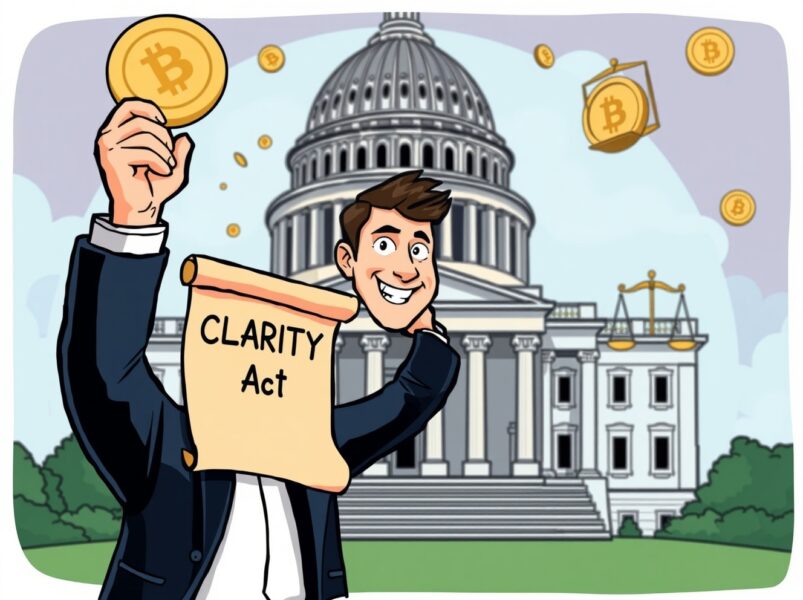
Urgent: Coinbase CEO Pushes for Crucial Crypto Market Structure Bill

Urgent: Coinbase CEO Pushes for Crucial Crypto Market Structure Bill

BitcoinWorld Urgent: Coinbase CEO Pushes for Crucial Crypto Market Structure Bill The cryptocurrency world is buzzing with significant developments as Coinbase CEO Brian Armstrong recently took to Washington, D.C., advocating passionately for a clearer regulatory path. His mission? To champion the passage of a vital crypto market structure bill, specifically the Digital Asset Market Clarity (CLARITY) Act. This legislative push is not just about policy; it’s about safeguarding investor rights and fostering innovation in the digital asset space. Why a Clear Crypto Market Structure Bill is Essential Brian Armstrong’s visit underscores a growing sentiment within the crypto industry: the urgent need for regulatory clarity. Without clear guidelines, the market operates in a gray area, leaving both innovators and investors vulnerable. The proposed crypto market structure bill aims to bring much-needed definition to this dynamic sector. Armstrong explicitly stated on X that this legislation is crucial to prevent a recurrence of actions that infringe on investor rights, citing past issues with former U.S. Securities and Exchange Commission (SEC) Chair Gary Gensler. This proactive approach seeks to establish a stable and predictable environment for digital assets. Understanding the CLARITY Act: A Blueprint for Digital Assets The Digital Asset Market Clarity (CLARITY) Act is designed to establish a robust regulatory framework for the cryptocurrency industry. It seeks to delineate the responsibilities of key regulatory bodies, primarily the SEC and the Commodity Futures Trading Commission (CFTC). Here are some key provisions: Clear Jurisdiction: The bill aims to specify which digital assets fall under the purview of the SEC as securities and which are considered commodities under the CFTC. Investor Protection: By defining these roles, the act intends to provide clearer rules for market participants, thereby enhancing investor protection. Exemption Conditions: A significant aspect of the bill would exempt certain cryptocurrencies from the stringent registration requirements of the Securities Act of 1933, provided they meet specific criteria. This could reduce regulatory burdens for legitimate projects. This comprehensive approach promises to bring structure to a rapidly evolving market. The Urgency Behind the Crypto Market Structure Bill The call for a dedicated crypto market structure bill is not new, but Armstrong’s direct engagement highlights the increasing pressure for legislative action. The lack of a clear framework has led to regulatory uncertainty, stifling innovation and sometimes leading to enforcement actions that many in the industry view as arbitrary. Passing this legislation would: Foster Innovation: Provide a clear roadmap for developers and entrepreneurs, encouraging new projects and technologies. Boost Investor Confidence: Offer greater certainty and protection for individuals investing in digital assets. Prevent Future Conflicts: Reduce the likelihood of disputes between regulatory bodies and crypto firms, creating a more harmonious ecosystem. The industry believes that a well-defined regulatory landscape is essential for the long-term health and growth of the digital economy. What a Passed Crypto Market Structure Bill Could Mean for You If the CLARITY Act or a similar crypto market structure bill passes, its impact could be profound for everyone involved in the crypto space. For investors, it could mean a more secure and transparent market. For businesses, it offers a predictable environment to build and scale. Conversely, continued regulatory ambiguity could: Stifle Growth: Drive innovation overseas and deter new entrants. Increase Risks: Leave investors exposed to unregulated practices. Create Uncertainty: Lead to ongoing legal battles and market instability. The stakes are incredibly high, making the advocacy efforts of leaders like Brian Armstrong all the more critical. The push for a clear crypto market structure bill is a pivotal moment for the digital asset industry. Coinbase CEO Brian Armstrong’s efforts in Washington, D.C., reflect a widespread desire for regulatory clarity that protects investors, fosters innovation, and ensures the long-term viability of cryptocurrencies. The CLARITY Act offers a potential blueprint for this future, aiming to define jurisdictional boundaries and streamline regulatory requirements. Its passage could unlock significant growth and stability, cementing the U.S. as a leader in the global digital economy. Frequently Asked Questions (FAQs) What is the Digital Asset Market Clarity (CLARITY) Act? The CLARITY Act is a proposed crypto market structure bill aimed at establishing a clear regulatory framework for digital assets in the U.S. It seeks to define the roles of the SEC and CFTC and exempt certain cryptocurrencies from securities registration requirements under specific conditions. Why is Coinbase CEO Brian Armstrong advocating for this bill? Brian Armstrong is advocating for the CLARITY Act to bring regulatory certainty to the crypto industry, protect investor rights from unclear enforcement actions, and foster innovation within the digital asset space. He believes it’s crucial for the industry’s sustainable growth. How would this bill impact crypto investors? For crypto investors, the passage of this crypto market structure bill would mean greater clarity on which assets are regulated by whom, potentially leading to enhanced consumer protections, reduced market uncertainty, and a more stable investment environment. What are the primary roles of the SEC and CFTC concerning this bill? The bill aims to delineate the responsibilities of the SEC (Securities and Exchange Commission) and the CFTC (Commodity Futures Trading Commission) regarding digital assets. It seeks to clarify which assets fall under securities regulation and which are considered commodities, reducing jurisdictional ambiguity. What could happen if a crypto market structure bill like CLARITY Act does not pass? If a clear crypto market structure bill does not pass, the industry may continue to face regulatory uncertainty, potentially leading to stifled innovation, increased legal challenges for crypto companies, and a less secure environment for investors due to inconsistent enforcement and unclear rules. Did you find this article insightful? Share it with your network to help spread awareness about the crucial discussions shaping the future of digital assets! To learn more about the latest crypto market trends, explore our article on key developments shaping crypto regulation and institutional adoption. This post Urgent: Coinbase CEO Pushes for Crucial Crypto Market Structure Bill first appeared on BitcoinWorld.
Share
Coinstats2025/09/18 20:35