As Bitcoin encounters a "value winter", real-world gold is recasting the iron curtain of value on the blockchain.As Bitcoin encounters a "value winter", real-world gold is recasting the iron curtain of value on the blockchain.

Gold continues to hit new highs. How to invest in gold in the crypto market?

2025/04/14 17:12

Author: Frank, PANews

As Bitcoin encounters a "value winter", real-world gold is recasting the iron curtain of value on the blockchain.

Recently, the volatility of the crypto market has become increasingly uncertain with the changes in the international financial market, and the price trends of mainstream crypto assets such as Bitcoin, Ethereum, and SOL have also fallen into a slump. The market's enthusiasm for crypto trading seems to be moving from optimism to a bearish state. In sharp contrast, the international gold price has been rising all the way to over $3,240 per ounce, constantly setting new historical highs, and the price has once again verified that gold is a safe-haven asset.

In the crypto market, the market value of assets linked to gold has also been rising. On April 11, the market value of tokenized gold assets exceeded US$2 billion. From the perspective of risk hedging, gold-related crypto assets seem to be becoming a new high-quality option. PANews takes stock of the current exposure of mainstream gold-related transactions in the crypto market.

The exposure to gold-related transactions in the crypto market is currently divided into tokenized gold, such as TetherGold (XAUT) or PAXGold (PAXG), which are essentially digital certificates of ownership of physical gold. And derivative transactions using these tokenized gold to trade with stablecoins. For example, XAUT or PAXG spot trading pairs or contract trading pairs provided by exchanges. In addition, some online precious metals traders support cryptocurrencies as payment methods when trading physical gold. These gold participation methods have deviations in risk appetite, funding flexibility, etc.

XAUT and PAXG: Leading Projects in Tokenized Gold

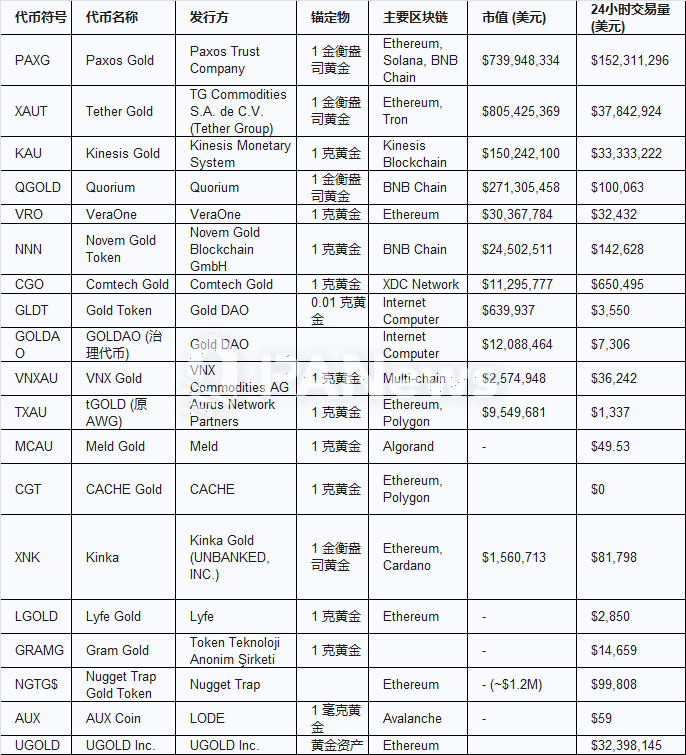
TetherGold (XAUT) and PAXGold (PAXG) are the two largest varieties in the tokenized gold market. XAUT is issued by Tether, the issuer of USDT. 1XAUT corresponds to the ownership of 1 troy ounce of gold on a specific LBMA (London Bullion Market Association)-approved "good delivery" gold bar. Gold is allocated in designated quantities, and holders can query the unique serial number, purity, and weight of the gold bar associated with their address through the official website. Tether claims that its reserves 100% support the issued tokens, and XAUT is partially supported by the gold in the reserves. As of April 12, the total support of XAUT is 7,667.7 kilograms of gold, distributed on 644 gold bars, and the market value of XAUT tokens is approximately US$797 million.
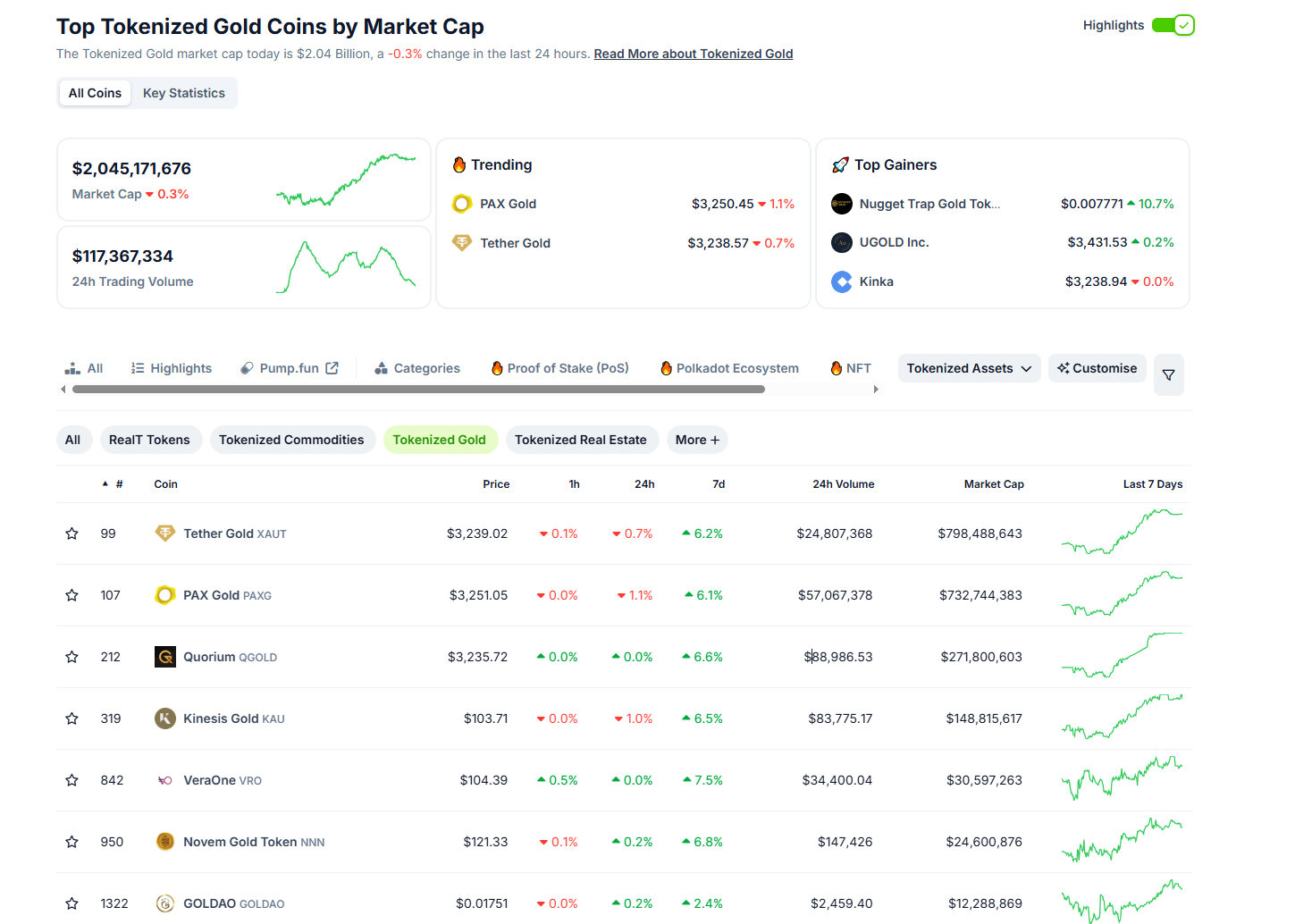
Gold continues to hit new highs. How to invest in gold in the crypto market? The issuer of PAXG is Paxos Trust Company, a trust company and custodian regulated by the New York State Department of Financial Services (NYDFS). PAXG is also the ownership of 1 troy ounce of London Good Delivery gold bar for each token. A third-party auditing company will issue a report on the monthly issuance of PAXG. As of February 28, the report shows that the company holds 209,160 ounces of gold (about 5,929 kilograms).

Compared to traditional gold ETFs or futures, XAUT and PAXG’s tokenized gold have no custody fees and have a smaller minimum purchase amount.

PAXG has a different fee structure than XAUT. Creating or destroying PAXG directly through the Paxos platform incurs a tiered fee based on transaction volume, and on-chain transfers are charged a 0.02% Paxos fee. In contrast, XAUT claims to have no custody fees, but charges a 0.25% fee on direct purchases/redemptions. This means that for small users, trading PAXG on a secondary exchange may be more cost-effective than operating directly through the Paxos platform to avoid creation or destruction fees. Frequent on-chain transfers will incur additional costs for PAXG.

Kinesis, the self-operated mint, and Quorium, the gold mining model

In addition, there are other tokenized gold products with a market value of more than 100 million, including Quorium (QGLOD) and KinesisGold (KAU). QGLOD's business model is relatively special. The gold it holds is essentially a gold mine reserve rather than spot gold. In addition, although the project claims to have regular reports on gold reserves, PANews found that these web pages can no longer be opened. Therefore, it is impossible to understand the reserve situation of QGLOD. The information is vague and contradictory, and lacks key details that are independently verified by a third party. In particular, the concept of "undeveloped reserves", how to provide stable support for liquidity tokens, and how to conduct audits and valuations are all unresolved issues, which brings great uncertainty and risks to investors.

In addition, QGOLD's market data presents some warning signs. Its market capitalization (about $270 million) is relatively high, but its daily trading volume is abnormally low (about $100,000) and concentrated in a few less well-known exchanges. This serious mismatch between market capitalization and trading volume and exchange liquidity, coupled with a lack of transparency, makes QGOLD's security seem unconvincing.

KinesisGold is priced differently from PAXG or XAUT, with each token representing 1 gram of gold. Its core differentiation lies in its unique revenue sharing model. Unlike tokens such as PAXG and XAUT that only track gold prices, KAU returns part of the platform's transaction fees to holders in the form of gold (KAU). However, this income is not fixed or risk-free, and its size depends directly on the overall transaction volume and fee income of the Kinesis platform. In addition, Kinesis has also launched a corresponding virtual card, and users can directly use KAU for daily consumption, which is also different from KAU. In terms of transparency, Kinesis chooses to audit every six months and supports physical delivery of every 100 grams. According to Kinesis' official information, Kinesis operates a 5,600-square-meter mint and refinery, KinesisMint, which produces high-quality gold and silver ingot products.

In terms of market circulation, XAUT and PAXG are still the two most liquid tokenized golds, and can be traded on many mainstream centralized exchanges and DEXs. KAU can be traded on its own KinesisExchange platform as well as centralized exchanges such as BitMart and Emirex, but its liquidity is slightly insufficient.
Gold continues to hit new highs. How to invest in gold in the crypto market?

There is a lot of exposure to spot delivery payments, and gold tokens are difficult to break the DeFi dimension wall

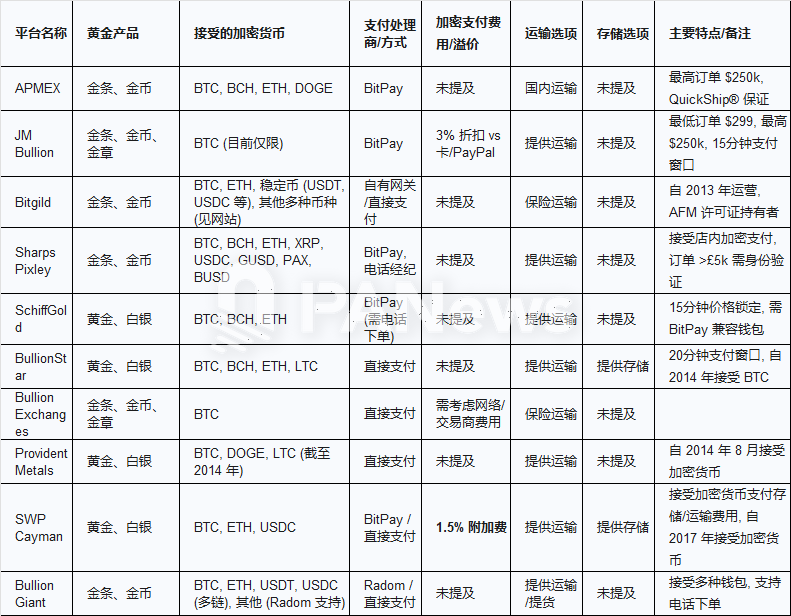
In addition to tokenized gold, many traditional precious metals traders also support payment in cryptocurrencies. This gold exposure is mainly applicable to spot trading, and cryptocurrencies are only used as a payment method, rather than a fundamental change in the business model. In addition, this type of trading method usually requires a higher threshold for one-time investment, and many platforms trade products such as gold coins or gold medals. In addition to the value of gold itself, users may also need to have product identification and premium identification capabilities.
Gold continues to hit new highs. How to invest in gold in the crypto market?

In addition to trading tokenized gold such as PAXG or XAUT, there are some centralized exchanges that offer different types of gold trading. For example, Bybit offers gold contracts for difference (CFDs), which allow traders to speculate on price changes of assets (such as gold) without actually owning the asset. This type of trading is similar to index contract trading in the financial market, that is, users only follow the trend of gold prices to open contract orders, but ultimately cannot deliver spot gold. Among the mainstream centralized exchanges, it seems that only Bybit offers similar products, but many traditional XAU/USD CFD platforms now also accept cryptocurrency deposits, such as FP Markets, Fusion Markets, easyMarkets, etc. This trading method is more suitable for professional traders who are familiar with gold and foreign exchange transactions rather than cryptocurrency investors.

In addition, although gold tokens have the attributes of RWA, the adoption of such products on mainstream DeFi lending platforms seems limited. In addition to PAXG, which can earn staking income through Morpho, leading protocols such as Aave and Compound do not accept gold tokens as native collateral. This may be due to several factors: first, there may be challenges in reliable and decentralized gold price oracles, which are crucial for liquidation mechanisms; second, potential regulatory uncertainties; third, the market demand for gold tokens as collateral may be relatively low compared to ETH or mainstream stablecoins.

In general, the most mainstream way for the crypto market to participate in gold asset exposure may still be to hold mainstream, highly liquid gold tokens such as PAXG or XAUT. In addition, although there are many similar tokenized gold products, due to the identification of issuers and transparency, users may have to consider the security issues involved when choosing these assets. Although buying physical gold directly through traditional precious metal dealers who accept cryptocurrency payments provides the most direct ownership, it is also accompanied by higher thresholds and potential product premium issues. In the field of DeFi, the participation methods of gold assets are still relatively limited, which may also be the difficulty of the deep integration of most RWA assets with on-chain finance.

When Bitcoin holders in the downward cycle begin to turn their attention to real gold, this is not only a footnote to the maturity of the crypto market, but also a value counterattack launched by digital gold against the real world.

Market Opportunity
RealLink Logo
RealLink Price(REAL)
$0.07402
$0.07402$0.07402
+0.31%
USD
RealLink (REAL) Live Price Chart
Disclaimer: The articles reposted on this site are sourced from public platforms and are provided for informational purposes only. They do not necessarily reflect the views of MEXC. All rights remain with the original authors. If you believe any content infringes on third-party rights, please contact service@support.mexc.com for removal. MEXC makes no guarantees regarding the accuracy, completeness, or timeliness of the content and is not responsible for any actions taken based on the information provided. The content does not constitute financial, legal, or other professional advice, nor should it be considered a recommendation or endorsement by MEXC.

You May Also Like

Huang Licheng Holds Controversial 25x ETH Long Position

Huang Licheng Holds Controversial 25x ETH Long Position

The post Huang Licheng Holds Controversial 25x ETH Long Position appeared on BitcoinEthereumNews.com. Key Points: Huang Licheng, known as “Machi,” holds a 25x leveraged
Share
BitcoinEthereumNews2025/12/22 03:49
Crucial Fed Rate Cut: October Probability Surges to 94%

Crucial Fed Rate Cut: October Probability Surges to 94%

BitcoinWorld Crucial Fed Rate Cut: October Probability Surges to 94% The financial world is buzzing with a significant development: the probability of a Fed rate cut in October has just seen a dramatic increase. This isn’t just a minor shift; it’s a monumental change that could ripple through global markets, including the dynamic cryptocurrency space. For anyone tracking economic indicators and their impact on investments, this update from the U.S. interest rate futures market is absolutely crucial. What Just Happened? Unpacking the FOMC Statement’s Impact Following the latest Federal Open Market Committee (FOMC) statement, market sentiment has decisively shifted. Before the announcement, the U.S. interest rate futures market had priced in a 71.6% chance of an October rate cut. However, after the statement, this figure surged to an astounding 94%. This jump indicates that traders and analysts are now overwhelmingly confident that the Federal Reserve will lower interest rates next month. Such a high probability suggests a strong consensus emerging from the Fed’s latest communications and economic outlook. A Fed rate cut typically means cheaper borrowing costs for businesses and consumers, which can stimulate economic activity. But what does this really signify for investors, especially those in the digital asset realm? Why is a Fed Rate Cut So Significant for Markets? When the Federal Reserve adjusts interest rates, it sends powerful signals across the entire financial ecosystem. A rate cut generally implies a more accommodative monetary policy, often enacted to boost economic growth or combat deflationary pressures. Impact on Traditional Markets: Stocks: Lower interest rates can make borrowing cheaper for companies, potentially boosting earnings and making stocks more attractive compared to bonds. Bonds: Existing bonds with higher yields might become more valuable, but new bonds will likely offer lower returns. Dollar Strength: A rate cut can weaken the U.S. dollar, making exports cheaper and potentially benefiting multinational corporations. Potential for Cryptocurrency Markets: The cryptocurrency market, while often seen as uncorrelated, can still react significantly to macro-economic shifts. A Fed rate cut could be interpreted as: Increased Risk Appetite: With traditional investments offering lower returns, investors might seek higher-yielding or more volatile assets like cryptocurrencies. Inflation Hedge Narrative: If rate cuts are perceived as a precursor to inflation, assets like Bitcoin, often dubbed “digital gold,” could gain traction as an inflation hedge. Liquidity Influx: A more accommodative monetary environment generally means more liquidity in the financial system, some of which could flow into digital assets. Looking Ahead: What Could This Mean for Your Portfolio? While the 94% probability for a Fed rate cut in October is compelling, it’s essential to consider the nuances. Market probabilities can shift, and the Fed’s ultimate decision will depend on incoming economic data. Actionable Insights: Stay Informed: Continue to monitor economic reports, inflation data, and future Fed statements. Diversify: A diversified portfolio can help mitigate risks associated with sudden market shifts. Assess Risk Tolerance: Understand how a potential rate cut might affect your specific investments and adjust your strategy accordingly. This increased likelihood of a Fed rate cut presents both opportunities and challenges. It underscores the interconnectedness of traditional finance and the emerging digital asset space. Investors should remain vigilant and prepared for potential volatility. The financial landscape is always evolving, and the significant surge in the probability of an October Fed rate cut is a clear signal of impending change. From stimulating economic growth to potentially fueling interest in digital assets, the implications are vast. Staying informed and strategically positioned will be key as we approach this crucial decision point. The market is now almost certain of a rate cut, and understanding its potential ripple effects is paramount for every investor. Frequently Asked Questions (FAQs) Q1: What is the Federal Open Market Committee (FOMC)? A1: The FOMC is the monetary policymaking body of the Federal Reserve System. It sets the federal funds rate, which influences other interest rates and economic conditions. Q2: How does a Fed rate cut impact the U.S. dollar? A2: A rate cut typically makes the U.S. dollar less attractive to foreign investors seeking higher returns, potentially leading to a weakening of the dollar against other currencies. Q3: Why might a Fed rate cut be good for cryptocurrency? A3: Lower interest rates can reduce the appeal of traditional investments, encouraging investors to seek higher returns in alternative assets like cryptocurrencies. It can also be seen as a sign of increased liquidity or potential inflation, benefiting assets like Bitcoin. Q4: Is a 94% probability a guarantee of a rate cut? A4: While a 94% probability is very high, it is not a guarantee. Market probabilities reflect current sentiment and data, but the Federal Reserve’s final decision will depend on all available economic information leading up to their meeting. Q5: What should investors do in response to this news? A5: Investors should stay informed about economic developments, review their portfolio diversification, and assess their risk tolerance. Consider how potential changes in interest rates might affect different asset classes and adjust strategies as needed. Did you find this analysis helpful? Share this article with your network to keep others informed about the potential impact of the upcoming Fed rate cut and its implications for the financial markets! To learn more about the latest crypto market trends, explore our article on key developments shaping Bitcoin price action. This post Crucial Fed Rate Cut: October Probability Surges to 94% first appeared on BitcoinWorld.
Share
Coinstats2025/09/18 02:25
Urgent: Coinbase CEO Pushes for Crucial Crypto Market Structure Bill

Urgent: Coinbase CEO Pushes for Crucial Crypto Market Structure Bill

BitcoinWorld Urgent: Coinbase CEO Pushes for Crucial Crypto Market Structure Bill The cryptocurrency world is buzzing with significant developments as Coinbase CEO Brian Armstrong recently took to Washington, D.C., advocating passionately for a clearer regulatory path. His mission? To champion the passage of a vital crypto market structure bill, specifically the Digital Asset Market Clarity (CLARITY) Act. This legislative push is not just about policy; it’s about safeguarding investor rights and fostering innovation in the digital asset space. Why a Clear Crypto Market Structure Bill is Essential Brian Armstrong’s visit underscores a growing sentiment within the crypto industry: the urgent need for regulatory clarity. Without clear guidelines, the market operates in a gray area, leaving both innovators and investors vulnerable. The proposed crypto market structure bill aims to bring much-needed definition to this dynamic sector. Armstrong explicitly stated on X that this legislation is crucial to prevent a recurrence of actions that infringe on investor rights, citing past issues with former U.S. Securities and Exchange Commission (SEC) Chair Gary Gensler. This proactive approach seeks to establish a stable and predictable environment for digital assets. Understanding the CLARITY Act: A Blueprint for Digital Assets The Digital Asset Market Clarity (CLARITY) Act is designed to establish a robust regulatory framework for the cryptocurrency industry. It seeks to delineate the responsibilities of key regulatory bodies, primarily the SEC and the Commodity Futures Trading Commission (CFTC). Here are some key provisions: Clear Jurisdiction: The bill aims to specify which digital assets fall under the purview of the SEC as securities and which are considered commodities under the CFTC. Investor Protection: By defining these roles, the act intends to provide clearer rules for market participants, thereby enhancing investor protection. Exemption Conditions: A significant aspect of the bill would exempt certain cryptocurrencies from the stringent registration requirements of the Securities Act of 1933, provided they meet specific criteria. This could reduce regulatory burdens for legitimate projects. This comprehensive approach promises to bring structure to a rapidly evolving market. The Urgency Behind the Crypto Market Structure Bill The call for a dedicated crypto market structure bill is not new, but Armstrong’s direct engagement highlights the increasing pressure for legislative action. The lack of a clear framework has led to regulatory uncertainty, stifling innovation and sometimes leading to enforcement actions that many in the industry view as arbitrary. Passing this legislation would: Foster Innovation: Provide a clear roadmap for developers and entrepreneurs, encouraging new projects and technologies. Boost Investor Confidence: Offer greater certainty and protection for individuals investing in digital assets. Prevent Future Conflicts: Reduce the likelihood of disputes between regulatory bodies and crypto firms, creating a more harmonious ecosystem. The industry believes that a well-defined regulatory landscape is essential for the long-term health and growth of the digital economy. What a Passed Crypto Market Structure Bill Could Mean for You If the CLARITY Act or a similar crypto market structure bill passes, its impact could be profound for everyone involved in the crypto space. For investors, it could mean a more secure and transparent market. For businesses, it offers a predictable environment to build and scale. Conversely, continued regulatory ambiguity could: Stifle Growth: Drive innovation overseas and deter new entrants. Increase Risks: Leave investors exposed to unregulated practices. Create Uncertainty: Lead to ongoing legal battles and market instability. The stakes are incredibly high, making the advocacy efforts of leaders like Brian Armstrong all the more critical. The push for a clear crypto market structure bill is a pivotal moment for the digital asset industry. Coinbase CEO Brian Armstrong’s efforts in Washington, D.C., reflect a widespread desire for regulatory clarity that protects investors, fosters innovation, and ensures the long-term viability of cryptocurrencies. The CLARITY Act offers a potential blueprint for this future, aiming to define jurisdictional boundaries and streamline regulatory requirements. Its passage could unlock significant growth and stability, cementing the U.S. as a leader in the global digital economy. Frequently Asked Questions (FAQs) What is the Digital Asset Market Clarity (CLARITY) Act? The CLARITY Act is a proposed crypto market structure bill aimed at establishing a clear regulatory framework for digital assets in the U.S. It seeks to define the roles of the SEC and CFTC and exempt certain cryptocurrencies from securities registration requirements under specific conditions. Why is Coinbase CEO Brian Armstrong advocating for this bill? Brian Armstrong is advocating for the CLARITY Act to bring regulatory certainty to the crypto industry, protect investor rights from unclear enforcement actions, and foster innovation within the digital asset space. He believes it’s crucial for the industry’s sustainable growth. How would this bill impact crypto investors? For crypto investors, the passage of this crypto market structure bill would mean greater clarity on which assets are regulated by whom, potentially leading to enhanced consumer protections, reduced market uncertainty, and a more stable investment environment. What are the primary roles of the SEC and CFTC concerning this bill? The bill aims to delineate the responsibilities of the SEC (Securities and Exchange Commission) and the CFTC (Commodity Futures Trading Commission) regarding digital assets. It seeks to clarify which assets fall under securities regulation and which are considered commodities, reducing jurisdictional ambiguity. What could happen if a crypto market structure bill like CLARITY Act does not pass? If a clear crypto market structure bill does not pass, the industry may continue to face regulatory uncertainty, potentially leading to stifled innovation, increased legal challenges for crypto companies, and a less secure environment for investors due to inconsistent enforcement and unclear rules. Did you find this article insightful? Share it with your network to help spread awareness about the crucial discussions shaping the future of digital assets! To learn more about the latest crypto market trends, explore our article on key developments shaping crypto regulation and institutional adoption. This post Urgent: Coinbase CEO Pushes for Crucial Crypto Market Structure Bill first appeared on BitcoinWorld.
Share
Coinstats2025/09/18 20:35
