World Liberty Financial is facing mounting criticism from its community after a governance vote approving a USD1 growth proposal passed with decisive support fromWorld Liberty Financial is facing mounting criticism from its community after a governance vote approving a USD1 growth proposal passed with decisive support from

WLFI Backlash as 9 ‘Team Wallets’ Swing 59% Vote on USD1 Growth Proposal

World Liberty Financial is facing mounting criticism from its community after a governance vote approving a USD1 growth proposal passed with decisive support from a small cluster of large wallets.

The vote saw objections from the community over the lack of voting access for locked WLFI holders, reigniting concerns about control, dilution, and the limits of WLFI’s on-chain governance.
Source: WLFI

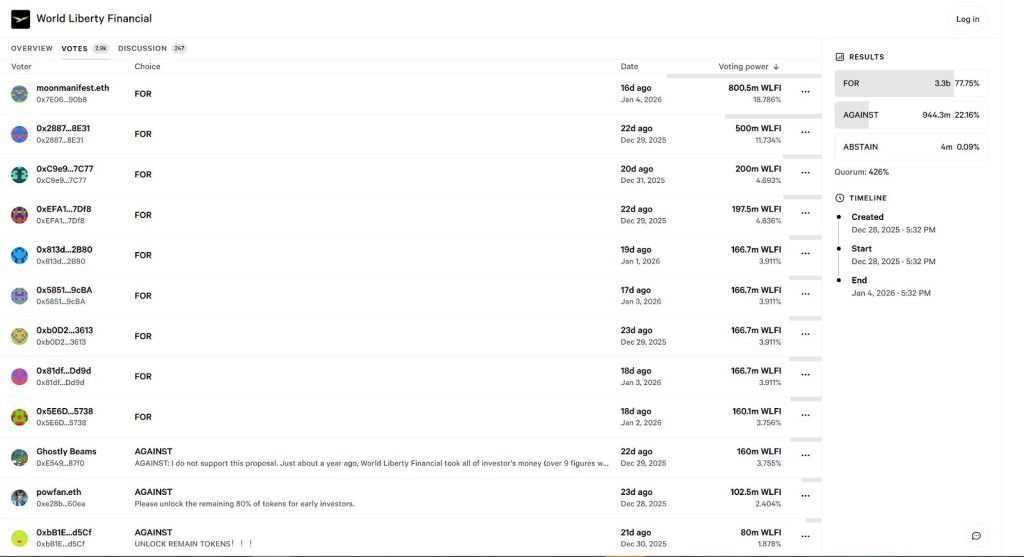
On-chain voting data reviewed by market participants shows that the top nine wallets backing the proposal accounted for roughly 59% of the total voting power.

The single largest wallet alone represented 18.786% of votes cast in the snapshot.

WLFI Vote Passes 78%, but Access Dispute Overshadows Outcome

Analysis shared by pseudonymous trader and researcher DeFi^2 showed that several of these addresses are flagged by on-chain mapping tools as team-linked or strategic partner wallets, effectively allowing a narrow group of insiders to determine the outcome.

The proposal itself authorized World Liberty Financial to deploy less than 5% of its unlocked WLFI treasury holdings to support the adoption of USD1, the project’s dollar-backed stablecoin.

The vote, created on December 28 and closed on January 4, attracted 2,931 participants and passed comfortably, with 3.3 billion votes, or 77.75%, in favor.

Votes against totaled 944.3 million, while abstentions were negligible. The quorum level reached 426%, far exceeding the threshold required for validity.

Source: WLFI

The backlash has centered less on the mechanics of the proposal and more on who was able to participate.

Many WLFI holders remain locked out of their tokens following the project’s token generation event and cannot vote on governance matters until unlock conditions are changed.

Several community members pointed out that while these holders are unable to influence decisions, team and partner wallets appear to have had full voting access.

DeFi^2 described the episode as an “alarming governance vote,” arguing that a measure unrelated to token unlocks was pushed through despite repeated calls from holders to address access restrictions first.

Tokenholders opposing the proposal have also questioned its economic logic.

WLFI holders are not entitled to protocol revenue, according to the project’s own documentation, which allocates 75% of revenue to the Trump family and 25% to the Witkoff family.

WLFI Holders Voice Frustration Over Incentives and Locked Supply

Against that backdrop, critics argue that using WLFI tokens to incentivize USD1 growth increases dilution without offering a direct upside to tokenholders.

One tokenholder who voted against the proposal said the project had previously deployed more than nine figures of investor capital to accumulate assets such as Bitcoin, Ether, and Chainlink, yet WLFI holders saw no tangible benefit from those holdings.

Tensions increased further after on-chain data showed a transfer of 500 million WLFI tokens to Jump Trading shortly after the vote concluded, while early investor allocations remain locked.

Community members have described the situation as asymmetric, with emissions rising and liquidity becoming available to select counterparties while long-term holders wait for unlocks.

Calls to release the remaining 80% of tokens for early investors have grown louder across social channels.

The governance dispute is unfolding as World Liberty Financial accelerates its broader expansion.

On January 8, the group disclosed that World Liberty Trust had filed a de novo application for a U.S. national banking charter with the Office of the Comptroller of the Currency.

If approved, the charter would allow the trust to issue and safeguard USD1 directly within the U.S. banking system.

Days later, on January 12, World Liberty Financial announced the launch of World Liberty Markets, a lending and borrowing platform built around USD1 and WLFI.

Market Opportunity
WLFI Logo
WLFI Price(WLFI)
$0.1592
$0.1592$0.1592
+1.79%
USD
WLFI (WLFI) Live Price Chart
Disclaimer: The articles reposted on this site are sourced from public platforms and are provided for informational purposes only. They do not necessarily reflect the views of MEXC. All rights remain with the original authors. If you believe any content infringes on third-party rights, please contact service@support.mexc.com for removal. MEXC makes no guarantees regarding the accuracy, completeness, or timeliness of the content and is not responsible for any actions taken based on the information provided. The content does not constitute financial, legal, or other professional advice, nor should it be considered a recommendation or endorsement by MEXC.

You May Also Like

Silver Golub & Teitell Launches Free App for Tracking Connecticut Court Cases

Silver Golub & Teitell Launches Free App for Tracking Connecticut Court Cases

STAMFORD, Conn., Jan. 29, 2026 /PRNewswire/ — Silver Golub & Teitell LLP, a leading litigation law firm based in Stamford, announced today the launch of SGT Docket
Share
AI Journal2026/01/29 23:31
Crypto Executives Advocate for U.S. Strategic Bitcoin Reserve Legislation

Crypto Executives Advocate for U.S. Strategic Bitcoin Reserve Legislation

Crypto execs, led by Michael Saylor, push for the U.S. to acquire 1 million BTC, establishing a Strategic Bitcoin Reserve.   Crypto executives, led by Strategy co-founder Michael Saylor, have gathered in Washington to advocate for a new piece of legislation. This bill, known as the BITCOIN Act, proposes the establishment of a U.S. Strategic […] The post Crypto Executives Advocate for U.S. Strategic Bitcoin Reserve Legislation appeared first on Live Bitcoin News.
Share
LiveBitcoinNews2025/09/18 05:00
Hong Kong Backs Commercial Bank Tokenized Deposits in 2025

Hong Kong Backs Commercial Bank Tokenized Deposits in 2025

The post Hong Kong Backs Commercial Bank Tokenized Deposits in 2025 appeared on BitcoinEthereumNews.com. HKMA to support tokenized deposits and regular issuance of digital bonds. SFC drafting licensing framework for trading, custody, and stablecoin issuers. New rules will cover stablecoin issuers, digital asset trading, and custody services. Hong Kong is stepping up its digital finance ambitions with a policy blueprint that places tokenization at the core of banking innovation.  In the 2025 Policy Address, Chief Executive John Lee outlined measures that will see the Hong Kong Monetary Authority (HKMA) encourage commercial banks to roll out tokenized deposits and expand the city’s live tokenized-asset transactions. Hong Kong’s Project Ensemble to Drive Tokenized Deposits Lee confirmed that the HKMA will “continue to take forward Project Ensemble, including encouraging commercial banks to introduce tokenised deposits, and promoting live transactions of tokenised assets, such as the settlement of tokenised money market funds with tokenised deposits.” The initiative aims to embed tokenized deposits, bank liabilities represented as blockchain-based tokens, into mainstream financial operations. These deposits could facilitate the settlement of money-market funds and other financial instruments more quickly and efficiently. To ensure a controlled rollout, the HKMA will utilize its regulatory sandbox to enable banks to test tokenized products while enhancing risk management. Tokenized Bonds to Become a Regular Feature Beyond deposits, the government intends to make tokenized bond issuance a permanent element of Hong Kong’s financial markets. After successful pilots, including green bonds, the HKMA will help regularize the issuance process to build deep and liquid markets for digital bonds accessible to both local and international investors. Related: Beijing Blocks State-Owned Firms From Stablecoin Businesses in Hong Kong Hong Kong’s Global Financial Role The policy address also set out a comprehensive regulatory framework for digital assets. Hong Kong is implementing a regime for stablecoin issuers and drafting licensing rules for digital asset trading and custody services. The Securities…
Share
BitcoinEthereumNews2025/09/18 07:10