Versan Aljarrah of Black Swan Capitalist is making a broader case for XRP than the usual market-cycle prediction. In a X post titled How XRP Becomes a Global ReserveVersan Aljarrah of Black Swan Capitalist is making a broader case for XRP than the usual market-cycle prediction. In a X post titled How XRP Becomes a Global Reserve

Pundit Explains How XRP Becomes A Global Reserve Asset

2026/03/03 16:45
4 min read
For feedback or concerns regarding this content, please contact us at crypto.news@mexc.com

Versan Aljarrah of Black Swan Capitalist is making a broader case for XRP than the usual market-cycle prediction. In a X post titled How XRP Becomes a Global Reserve Asset, he argues that XRP’s long-term role is not limited to payments or bridge liquidity, but could extend to becoming a neutral settlement layer inside a digitized global financial system.

Aljarrah’s central point is that the XRP debate has been trapped in the wrong frame. “The conversation around XRP is usually clouded by speculation and price predictions,” he wrote. “But beneath all the noise lies a far more fascinating story, one that bridges regulation, sovereign integration, and institutional recognition at the highest levels of global finance. The true potential for XRP isn’t just as a payments token or bridge asset. It’s a foundational layer in a digitized financial order where liquidity, interoperability, and neutrality are all that matter.”

How XRP Becomes A Global Reserve Asset

That thesis rests on three pillars. “To understand how XRP evolves into a global reserve asset, there are a few pillars that must align, sovereign adoption, regulatory clarity, and institutional recognition, which ultimately comes from the IMF,” Aljarrah wrote. In his telling, the process starts with nation-state usage rather than market enthusiasm.

He argues that reserve assets derive legitimacy from official acceptance, not price action. “Before any asset can become a global reserve instrument, it first needs sovereign legitimacy,” he wrote. “Reserve assets, whether gold, the US dollar, or Electronic Special Drawing Rights (ESDRs) derive their credibility not from market speculation but from their acceptance and usage by nation-states.”

From there, Aljarrah shifts to how XRP could fit into cross-border finance, especially for countries looking to reduce dependence on dollar-based settlement systems. “Emerging markets are all exploring blockchain-based solutions to improve liquidity, reduce costs, and stabilize their currencies,” he wrote.“For nations with volatile or dollar-dependent economies like the BRICS, XRP’s design presents a unique advantage as a neutral settlement bridge, meaning it can connect local currencies without forcing countries into the geopolitical influence of the military-industrial complex that comes with the dollar-based system.”

That leads into one of the strongest claims in the thread. “Therefore, it is not a matter of ‘if,’ but ‘when’ nations begin leveraging XRP to solve monetary inefficiencies,” Aljarrah said. “Countries all over the world have already integrated XRP into their payment rails and are already using it for cross-border settlements. That sets the stage for global institutional acknowledgment.”

The next phase, in his view, is legal clarity. Aljarrah points to the CLARITY Act as a turning point because it could make XRP more accessible to institutions and sovereigns if Ripple’s influence over supply is reduced far enough.

“By reducing its holdings, Ripple effectively decentralizes its influence over XRP, making it legally neutral, non-sovereign, and globally accessible, requirements for an asset to achieve reserve and settlement status,” he wrote. “Once Ripple’s holdings fall under the Clarity Act’s compliance thresholds, institutional adoption accelerates, and sovereign nations can hold and transact with XRP without triggering securities laws.”

Only after those two conditions are met does Aljarrah bring in the IMF. He argues that in a tokenized financial system, XRP could begin to resemble a programmable reserve settlement instrument. “Once integrated as a reserve asset, the valuation of XRP would be determined by its settlement utility, liquidity depth, and transaction output within a network of sovereign participants and multilateral institutions such as the BRICS,” he wrote.

“This is probably the most important piece because price discovery would shift from noise to institutional liquidity corridors, where value reflects the asset’s function in global settlement operations. In essence, XRP’s price would be measured by how much value it moves.”

Aljarrah closes by framing XRP less as a speculative crypto asset and more as infrastructure. “This isn’t just about XRP, it’s about the transition from a centralized, dollar-dominated financial order to a multipolar, interoperable system powered by digital assets, infrastructure, and neutral settlement technologies,” he wrote.

For readers following the XRP story, the message is clear: this is not a near-term trading thesis, but a long-horizon argument about reserve status, monetary plumbing and the future architecture of global liquidity.

At press time, XRP traded at $1.3576.
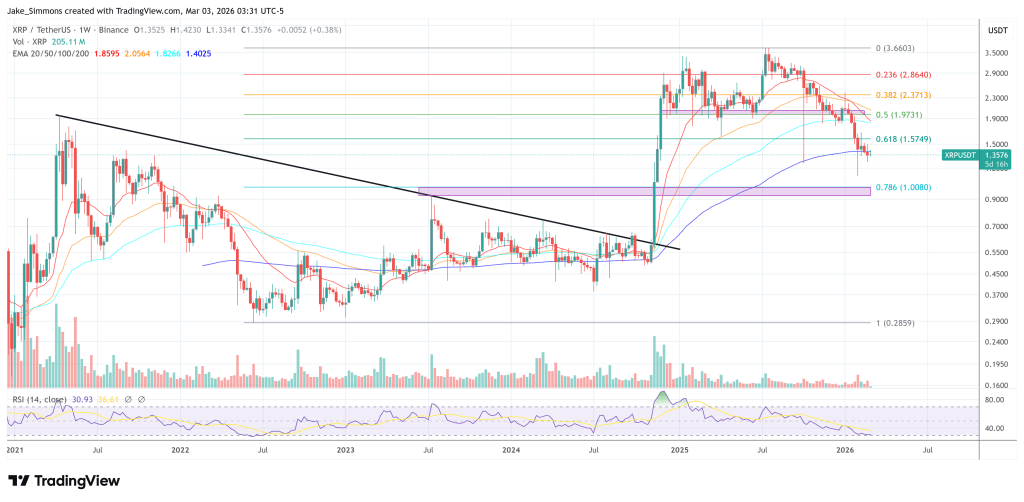
XRP price chart
Disclaimer: The articles reposted on this site are sourced from public platforms and are provided for informational purposes only. They do not necessarily reflect the views of MEXC. All rights remain with the original authors. If you believe any content infringes on third-party rights, please contact crypto.news@mexc.com for removal. MEXC makes no guarantees regarding the accuracy, completeness, or timeliness of the content and is not responsible for any actions taken based on the information provided. The content does not constitute financial, legal, or other professional advice, nor should it be considered a recommendation or endorsement by MEXC.

You May Also Like

PayPal USD Goes Live on Stellar, Expanding Access to Stablecoin Payments

PayPal USD Goes Live on Stellar, Expanding Access to Stablecoin Payments

PayPal USD (PYUSD), the fully regulated U.S. dollar-backed stablecoin, is now live on the Stellar network, announced on Thursday. The launch marks a milestone for both PayPal and Stellar, extending PYUSD’s reach into new wallets, platforms, and business use cases across global payments. The announcement was made at the Stellar Meridian event in Copacabana, Rio de Janeiro, on September 18, a flagship annual gathering of blockchain leaders, investors, and policymakers. Expanding Access Through Stellar’s Ecosystem By deploying on Stellar, PYUSD integrates with wallets and platforms including Bitcoin.com, Chipper Cash, Decaf, Arculus, Meru, CiNKO, COCA, Lobstr, and others. This expansion alllows millions of users to access a stablecoin option designed for low-cost payments. “Expanding PYUSD to the Stellar network is an exciting step toward making stable, trusted digital dollars more accessible and useful worldwide,” said Corbin Fraser, CEO of Bitcoin.com. “By supporting PYUSD on Stellar, we’re enabling our millions of users to enjoy fast, low-cost transfers while strengthening the role of stablecoins in real-world payments.” Empowering Businesses and SMEs Beyond consumer payments, PYUSD on Stellar offers small and medium-sized businesses access to near-instant settlement and real-time working capital. Companies can use PYUSD to pay suppliers, manage inventory, or cover operational costs without the delays typically associated with traditional finance. According to Paypal liquidity providers can participate by backing these financing opportunities and earning potential returns linked to real-world commerce. This creates a virtuous cycle of faster payments, improved liquidity, and enhanced financial inclusion, explains PayPal. PYUSD’s fully backed reserves—held in U.S. dollar deposits, U.S. Treasuries, and similar cash equivalents—add trust and transparency. Oversight from the New York State Department of Financial Services (NYDFS) ensures a high regulatory standard. PayPal Deepens Onchain Presence “PayPal continues to be at the forefront of payments, meeting our customers where they are — online, offline, and now onchain,” said May Zabaneh, Vice President of Crypto at PayPal. “Expanding PYUSD to Stellar broadens access to PYUSD and opens up new use cases and opportunities for seamless transactions for customers.” With this move, PayPal strengthens its role in the stablecoin ecosystem, offering consumers and enterprises a digital currency that bridges traditional finance with blockchain-powered efficiency. Stellar’s Growing Role in Digital Payments Stellar, which has processed over 20 billion operations across nearly 10 million accounts, provides a proven network for innovation in payments. Developers can integrate PYUSD into programmable payment solutions and enterprise-grade platforms using Stellar’s open-source SDKs and Soroban smart contracts. “Having a global leader like PayPal bring PYUSD to the Stellar network is a major step forward in how stablecoins can power real-world payments,” said Denelle Dixon, CEO of the Stellar Development Foundation. “This milestone sets the stage for broader adoption and innovation.”
Share
CryptoNews2025/09/19 01:00
MEXC Expands Zero Fee Tokenized Equities With Ondo Batch

MEXC Expands Zero Fee Tokenized Equities With Ondo Batch

TLDR MEXC lists 17 ERC20 tokenized US equities with 30-day zero fees All pairs trade in USDT and use MEXC proprietary liquidity tech Launch marks ninth Ondo Finance
Share
Coincentral2026/03/05 14:02
On the eve of Web4, a guide for ordinary workers to avoid being left behind.

On the eve of Web4, a guide for ordinary workers to avoid being left behind.

Author: TT3LABS, Web3/AI/SaaS Remote Recruitment Platform On February 26, 2026, fintech giant Block announced layoffs of over 4,000 employees, reducing its team
Share
PANews2026/03/05 14:22