

Why Bitcoin Seasonality Failed: Inside BTC’s Structural Breakdown In February 2026
Bitcoin is currently consolidating between $62,000 and $69,000, compressing within a narrowing range as geopolitical tensions in the Middle East inject fresh uncertainty into global risk markets. Rather than trending decisively, price action reflects hesitation. Buyers have defended the lower bound near $62K, yet repeated failures below $69K indicate that upside conviction remains limited in the current environment.
According to XWIN Research Japan, February 2026 marked a notable break in historical seasonality. Bitcoin closed the month down 14.94%, despite February traditionally ranking among its stronger periods, often delivering double-digit average gains. This year, the pattern failed. The decline was not driven by a single headline event but by structural fragilities: thin liquidity conditions, leverage imbalances across derivatives markets, and persistently weak spot demand.
At the beginning of February, Bitcoin was trading near $84,000. However, on-chain indicators already signaled underlying stress. SOPR remained below 1, confirming that coins were being spent at a loss. Realized Cap flattened, pointing to a slowdown in fresh capital entering the network. Meanwhile, the Coinbase Premium lacked consistent strength, suggesting that US spot demand had not materially returned.
Leverage Unwinds and Weak Spot Demand Undermine February’s Rebound
The mid-February drawdown was not simply a directional selloff; it was a leverage event. As the price weakened, liquidation cascades accelerated the decline, forcing long positions out of the market. Open Interest contracted sharply, confirming that the move was driven by derivatives unwinds rather than steady spot distribution. In a thin liquidity regime, these leverage resets tend to exaggerate volatility. When order books are shallow, relatively modest flows can push prices disproportionately, amplifying downside extensions.

Although Fear & Greed dropped into Extreme Fear, sentiment exhaustion alone proved insufficient to engineer a durable reversal. Capitulation without follow-through demand often produces reflex bounces, not structural bottoms.
The more structural constraint was the absence of consistent spot participation. ETF flows recorded intermittent daily inflows, but they lacked sustained weekly momentum. At the same time, stablecoin supply growth remained muted, indicating limited sidelined capital ready to deploy. Consequently, rebounds were largely short-covering rallies, driven by position unwinds rather than fresh accumulation.
Macro context reinforced this fragility. Equity weakness and dollar strength framed Bitcoin as a high-beta liquidity proxy, not a defensive asset. In February, structural supply-demand imbalances overpowered historical seasonality. A durable shift now depends on persistent spot inflows and disciplined Open Interest rebuilding.
Bitcoin Tests Weekly Support as $69K Turns Into Overhead Resistance
On the weekly timeframe, price is attempting to stabilize near the $66,000 region after a sharp rejection from the $90,000–$100,000 supply zone. The structure shows a clear shift from expansion to distribution: following the late-2025 peak, Bitcoin printed a sequence of lower highs and ultimately lost the 50-week moving average (blue), which had previously acted as dynamic support throughout the uptrend.
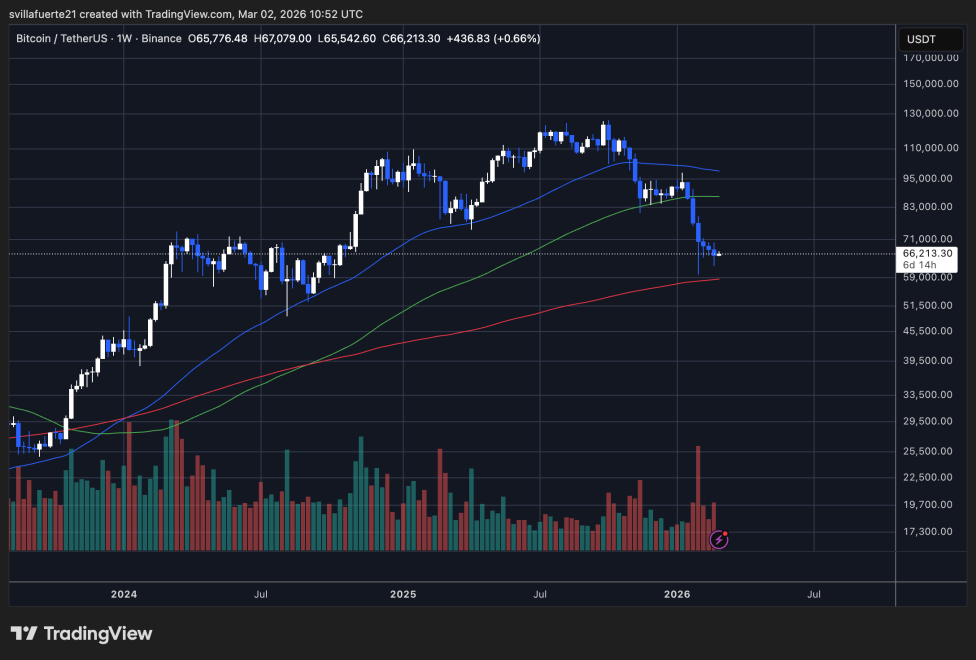
The breakdown accelerated once price slipped below the 100-week moving average (green), triggering a fast move toward the mid-$60K area. Notably, the 200-week moving average (red), currently rising near the high-$50K region, remains intact. This level historically defines macro bull-market structure. As long as the price holds above it, the broader cycle cannot be considered structurally broken.
Volume expanded meaningfully during the selloff, particularly on large red weekly candles, suggesting forced unwinds rather than gradual distribution. However, the most recent candles show compression and reduced downside momentum, indicating short-term equilibrium between buyers and sellers.
Technically, $69K now acts as immediate resistance, aligning with prior support turned overhead supply. A weekly close reclaiming that zone would open room toward the 50-week average. Failure to hold $62K, however, would increase the probability of a deeper test of the 200-week baseline.
Featured image from ChatGPT, chart from TradingView.com
You May Also Like

USD/JPY Price Forecast: Resilient Pair Holds Critical Gains Near 157.00 Monthly Peak

Fed Makes First Rate Cut of the Year, Lowers Rates by 25 Bps
