Ripple has signed a partnership with Jeel, the innovation and technology arm of Riyad Bank, to explore blockchain applications across cross-border payments, digitalRipple has signed a partnership with Jeel, the innovation and technology arm of Riyad Bank, to explore blockchain applications across cross-border payments, digital

Ripple Links Up With $130 Billion Riyad Bank’s Innovation Arm Jeel

Ripple has signed a partnership with Jeel, the innovation and technology arm of Riyad Bank, to explore blockchain applications across cross-border payments, digital asset custody, and tokenization in Saudi Arabia. The collaboration positions Ripple inside a regulated testing environment as the Kingdom accelerates its Vision 2030 digital transformation agenda.

Ripple Expands In Saudi With Riyad Bank

Jeel announced the tie-up on X: “We are pleased to announce in Jil our partnership with Ripple to explore advanced applications aimed at enhancing the speed and efficiency of payments. This partnership focuses on studying use cases for the custody of digital assets, alongside developing prototypes within Jil’s regulatory sandbox, in support of the objectives of Vision 2030.”

In a press release dated January 26, 2026, Jeel said the partnership will evaluate how blockchain can improve the “speed, cost efficiency, and transparency of cross-border payments,” while also exploring digital asset custody and tokenization use cases. The firms plan to develop proofs-of-concept within Jeel’s sandbox to test Ripple’s technologies “in a controlled, compliant environment,” with an emphasis on scalable and interoperable infrastructure for financial services across the Kingdom.

Jeel CEO George Harrak positioned the sandbox as the core mechanism for turning blockchain concepts into regulated experimentation. “This partnership with Ripple reflects our strategy of using the Jeel Sandbox to responsibly explore next-generation financial infrastructure,” Harrak said. “By combining regulated experimentation with global blockchain expertise, we are building the foundations to evaluate scalable use cases that enhance cross-border payments and digital asset capabilities in line with the Kingdom’s long-term digital ambitions.”

Ripple’s Managing Director for the Middle East and Africa, Reece Merrick, described the work as an effort to integrate enterprise blockchain into Saudi financial architecture, explicitly tying it to the Vision 2030 roadmap.

“Saudi Arabia’s visionary leadership has established the Kingdom as a forward-thinking global hub for digital transformation,” Merrick said. “It is against this progressive backdrop that Ripple has signed an MOU with Jeel to explore integrating secure, efficient blockchain solutions into the national financial architecture. We are committed to demonstrating how Ripple’s enterprise-grade digital assets technology can unlock significant efficiencies in areas like cross-border payments, aligning directly with Saudi Arabia’s goal of building a world-leading, competitive fintech ecosystem.”

Merrick echoed that messaging in a separate post, saying the partners will explore use cases spanning “cross-border payments, digital asset custody, and tokenization,” and adding that he is “excited to help shape the future of Saudi Arabia’s financial infrastructure.”

For Jeel, the partnership is pitched as a step beyond conventional fintech acceleration into “regulated blockchain experimentation,” extending its innovation mandate while supporting Riyad Bank’s ambitions to evaluate next-generation digital financial services. For Ripple, Jeel’s sandbox and institutional network offer a pathway into the Kingdom’s fast-growing fintech landscape, with the press release noting that the arrangement creates a venue to showcase Ripple’s infrastructure in a “highly regulated and innovation-driven environment.”

At press time, XRP traded at $1.90.
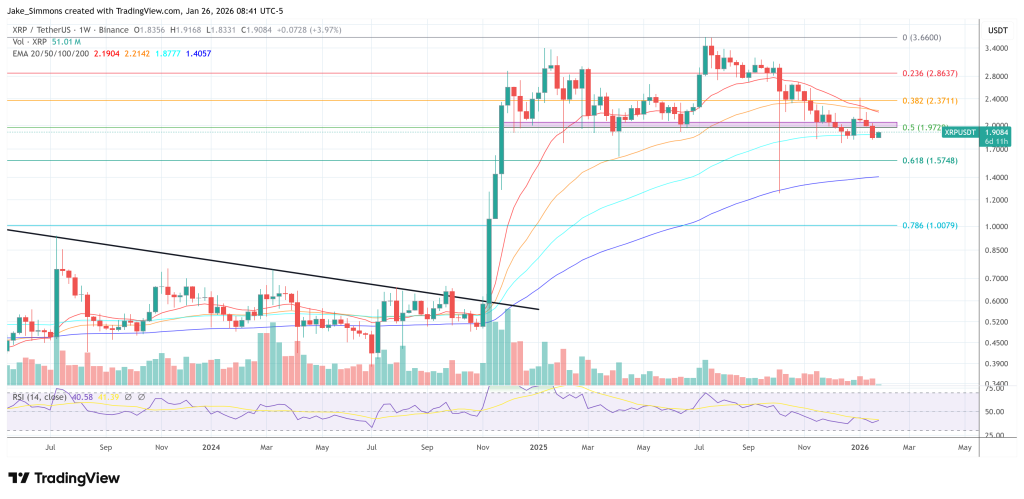
XRP price chart
Disclaimer: The articles reposted on this site are sourced from public platforms and are provided for informational purposes only. They do not necessarily reflect the views of MEXC. All rights remain with the original authors. If you believe any content infringes on third-party rights, please contact service@support.mexc.com for removal. MEXC makes no guarantees regarding the accuracy, completeness, or timeliness of the content and is not responsible for any actions taken based on the information provided. The content does not constitute financial, legal, or other professional advice, nor should it be considered a recommendation or endorsement by MEXC.

You May Also Like

Gold Hits $3,700 as Sprott’s Wong Says Dollar’s Store-of-Value Crown May Slip

Gold Hits $3,700 as Sprott’s Wong Says Dollar’s Store-of-Value Crown May Slip

The post Gold Hits $3,700 as Sprott’s Wong Says Dollar’s Store-of-Value Crown May Slip appeared on BitcoinEthereumNews.com. Gold is strutting its way into record territory, smashing through $3,700 an ounce Wednesday morning, as Sprott Asset Management strategist Paul Wong says the yellow metal may finally snatch the dollar’s most coveted role: store of value. Wong Warns: Fiscal Dominance Puts U.S. Dollar on Notice, Gold on Top Gold prices eased slightly to $3,678.9 […] Source: https://news.bitcoin.com/gold-hits-3700-as-sprotts-wong-says-dollars-store-of-value-crown-may-slip/
Share
BitcoinEthereumNews2025/09/18 00:33
China Blocks Nvidia’s RTX Pro 6000D as Local Chips Rise

China Blocks Nvidia’s RTX Pro 6000D as Local Chips Rise

The post China Blocks Nvidia’s RTX Pro 6000D as Local Chips Rise appeared on BitcoinEthereumNews.com. China Blocks Nvidia’s RTX Pro 6000D as Local Chips Rise China’s internet regulator has ordered the country’s biggest technology firms, including Alibaba and ByteDance, to stop purchasing Nvidia’s RTX Pro 6000D GPUs. According to the Financial Times, the move shuts down the last major channel for mass supplies of American chips to the Chinese market. Why Beijing Halted Nvidia Purchases Chinese companies had planned to buy tens of thousands of RTX Pro 6000D accelerators and had already begun testing them in servers. But regulators intervened, halting the purchases and signaling stricter controls than earlier measures placed on Nvidia’s H20 chip. Image: Nvidia An audit compared Huawei and Cambricon processors, along with chips developed by Alibaba and Baidu, against Nvidia’s export-approved products. Regulators concluded that Chinese chips had reached performance levels comparable to the restricted U.S. models. This assessment pushed authorities to advise firms to rely more heavily on domestic processors, further tightening Nvidia’s already limited position in China. China’s Drive Toward Tech Independence The decision highlights Beijing’s focus on import substitution — developing self-sufficient chip production to reduce reliance on U.S. supplies. “The signal is now clear: all attention is focused on building a domestic ecosystem,” said a representative of a leading Chinese tech company. Nvidia had unveiled the RTX Pro 6000D in July 2025 during CEO Jensen Huang’s visit to Beijing, in an attempt to keep a foothold in China after Washington restricted exports of its most advanced chips. But momentum is shifting. Industry sources told the Financial Times that Chinese manufacturers plan to triple AI chip production next year to meet growing demand. They believe “domestic supply will now be sufficient without Nvidia.” What It Means for the Future With Huawei, Cambricon, Alibaba, and Baidu stepping up, China is positioning itself for long-term technological independence. Nvidia, meanwhile, faces…
Share
BitcoinEthereumNews2025/09/18 01:37
Sharps Technology posts robust Solana staking returns despite volatile markets

Sharps Technology posts robust Solana staking returns despite volatile markets

The post Sharps Technology posts robust Solana staking returns despite volatile markets appeared on BitcoinEthereumNews.com. Sharps Technology announced it has
Share
BitcoinEthereumNews2026/01/27 11:16