Dogecoin is ending the first week of 2026 parked on a cluster of long-watched supports, and three chart-focused analysts are converging on the same question: isDogecoin is ending the first week of 2026 parked on a cluster of long-watched supports, and three chart-focused analysts are converging on the same question: is

Is The Dogecoin Bottom In? 3 Analysts Break Down the Charts

2026/01/03 01:00

Dogecoin is ending the first week of 2026 parked on a cluster of long-watched supports, and three chart-focused analysts are converging on the same question: is this the higher low that starts a broader bottoming process, or just another pause inside a larger corrective leg?

The Yearly Dogecoin Chart

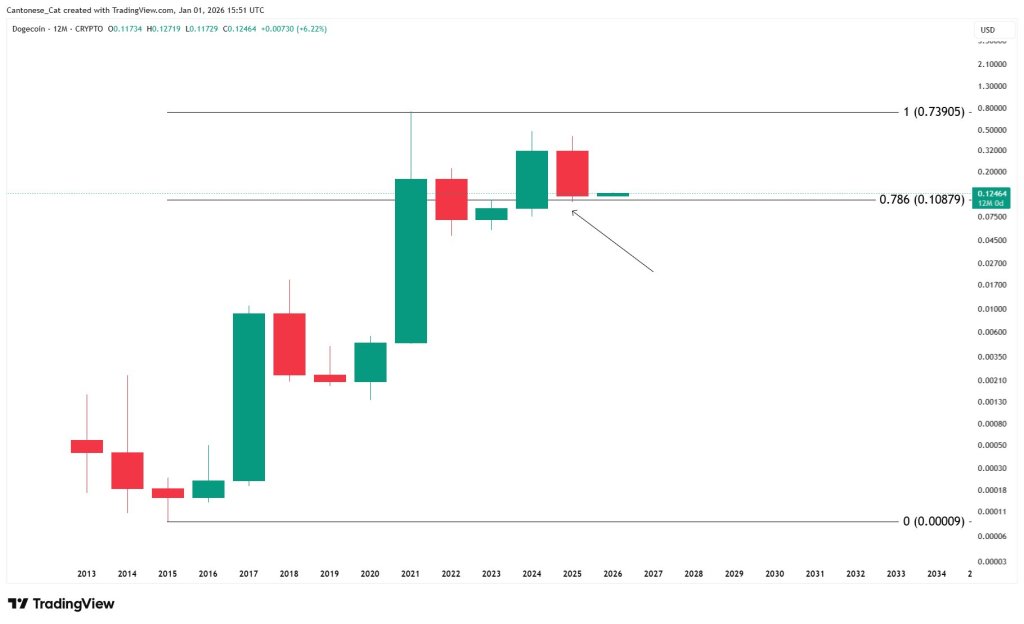
On the yearly view, Cantonese Cat’s chart frames 2025 as a hold of the 0.786 log Fibonacci support at roughly $0.10879, with the market printing an inside candle into year-end. In that construction, the key takeaway is not momentum but structure: price respected a major retracement line on a log scale and stayed boxed inside the prior year’s range: “DOGE ended 2025 holding 0.786 log fib as support, forming an inside candle, favors bullish continuation,” the analyst writes.
Dogecoin yearly chart analysis

The same yearly chart also contextualizes what “continuation” on the yearly view means: the next major reference level is the 1.0 fib line up near $0.73905. That is not being presented as an imminent target, but it does underscore why analysts care about this zone, if the 0.786 level holds on higher timeframes, the chart’s mapped upside is structurally open, even if the path is not linear.

The Monthly DOGE Chart

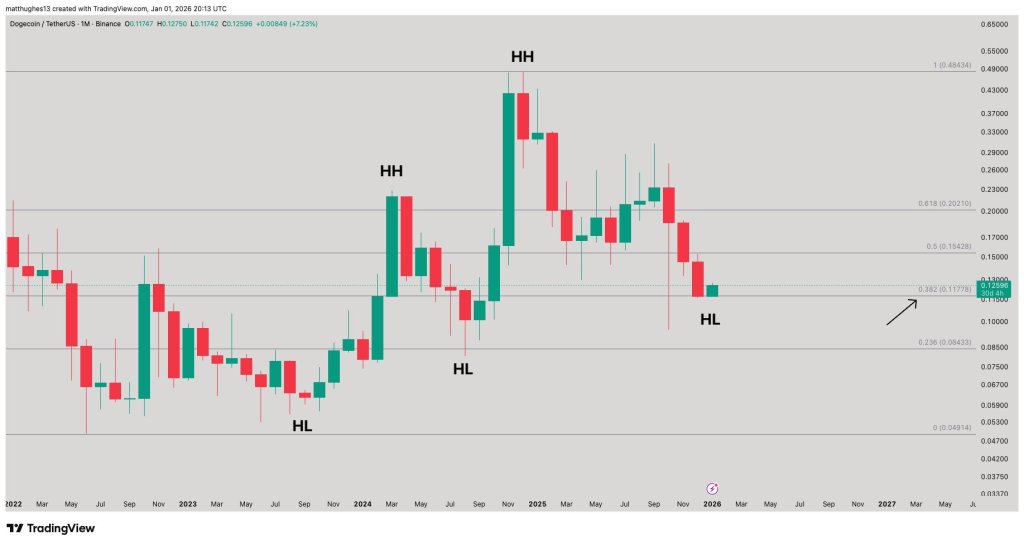
Matt Hughes aka “The Great Mattsby’s” monthly chart tightens the focus to a single, precise level: the 0.382 Fibonacci retracement at $0.11778. Price is shown holding that line while carving out what the chart labels as a higher low, and the analyst is explicit about what that would mean in market-structure terms.
Dogecoin monthly chart

“To me, this looks like the higher low needed to start the bottoming process, especially with price holding the 0.382 Fib retracement at 0.11778,” Mattsby wrote, adding that he views the “.11–.12 zone” as compelling on a risk/reward basis. In this framing, the thesis is conditional: the market is not “bullish” because it bounced, it’s constructive because it is attempting to stop making lower lows while defending a defined retracement.

If that $0.11778 level gives way on a monthly basis, the same fib ladder shown on the chart highlights lower references beneath it, including the 0.236 retracement around $0.08433. On the upside, the next retracement markers visible are $0.15428 (0.5) and $0.20210 (0.618), which would be the nearby “prove it” areas if this is, in fact, a basing process rather than a dead-cat bounce.

The Weekly Dogecoin Chart

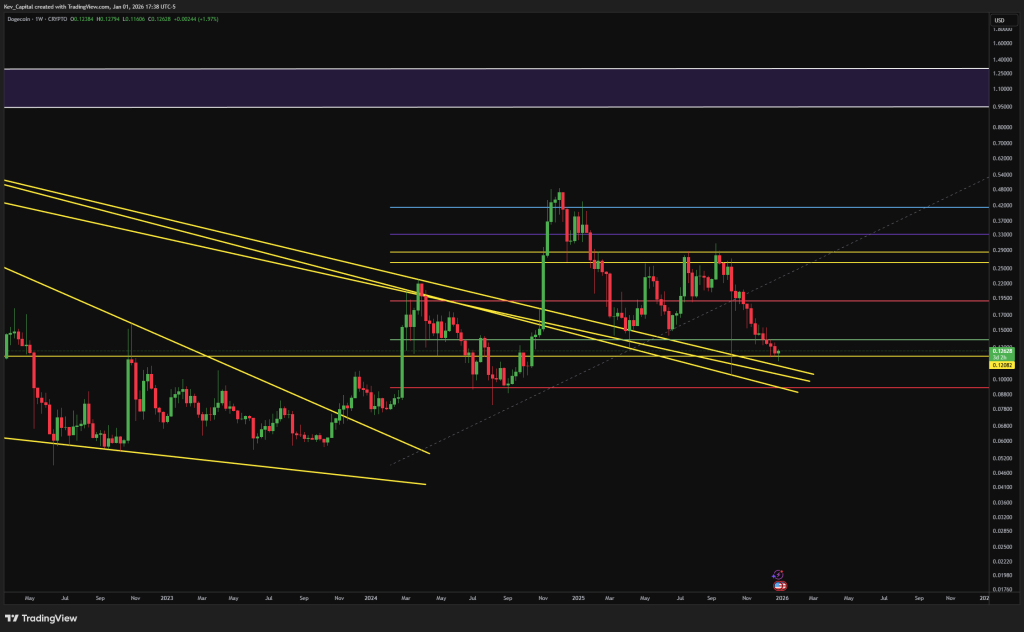
Kevin (Kev_Capital_TA) shifts the emphasis to the weekly. Via X, he posted: “Still early but Dogecoin is currently printing a really nice weekly reversal demand candle within a major demand zone.”
Dogecoin weekly chart analysis

His conditions are tight and time-bound: “If you can confirm that weekly candle by Sunday close, reclaim the 4HR 200 sma/ema on both Doge and BTC then you could see the low put in for this major correctional phase and the counter trend move higher occuring. All eyes on 88K-91K on BTC.”

For Dogecoin traders, the immediate calls are straightforward: Dogecoin needs to keep defending the $0.11–$0.12 area, while the weekly close either validates or negates Kevin’s reversal-candle thesis.

If price loses the $0.11778 monthly retracement, the “bottoming” narrative weakens quickly; if it holds and begins reclaiming nearby resistance levels, the charts collectively argue the market may be transitioning from correction to base-building, one confirmed close at a time.

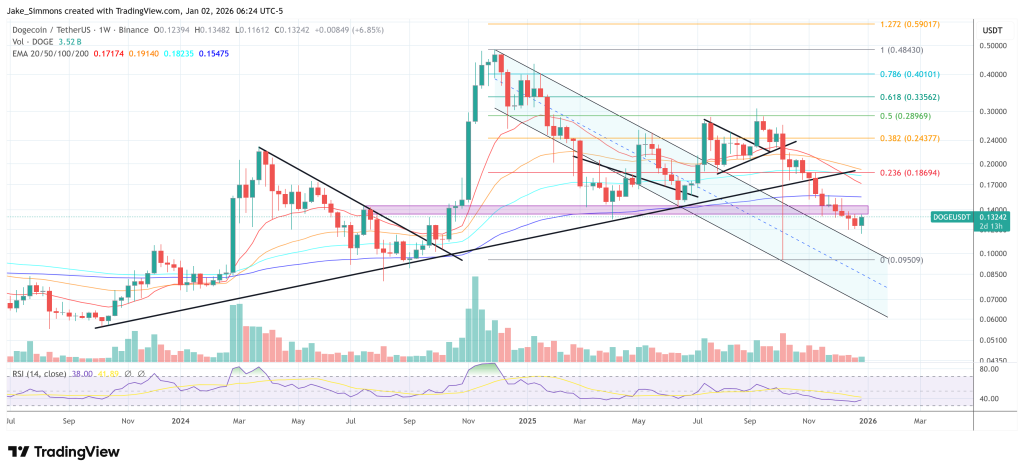
At press time, DOGE traded at $0.13242.
Dogecoin price chart
Market Opportunity
Belong Logo
Belong Price(LONG)
$0.003823
$0.003823$0.003823
+1.00%
USD
Belong (LONG) Live Price Chart
Disclaimer: The articles reposted on this site are sourced from public platforms and are provided for informational purposes only. They do not necessarily reflect the views of MEXC. All rights remain with the original authors. If you believe any content infringes on third-party rights, please contact service@support.mexc.com for removal. MEXC makes no guarantees regarding the accuracy, completeness, or timeliness of the content and is not responsible for any actions taken based on the information provided. The content does not constitute financial, legal, or other professional advice, nor should it be considered a recommendation or endorsement by MEXC.

You May Also Like

The Channel Factories We’ve Been Waiting For

The Channel Factories We’ve Been Waiting For

The post The Channel Factories We’ve Been Waiting For appeared on BitcoinEthereumNews.com. Visions of future technology are often prescient about the broad strokes while flubbing the details. The tablets in “2001: A Space Odyssey” do indeed look like iPads, but you never see the astronauts paying for subscriptions or wasting hours on Candy Crush.  Channel factories are one vision that arose early in the history of the Lightning Network to address some challenges that Lightning has faced from the beginning. Despite having grown to become Bitcoin’s most successful layer-2 scaling solution, with instant and low-fee payments, Lightning’s scale is limited by its reliance on payment channels. Although Lightning shifts most transactions off-chain, each payment channel still requires an on-chain transaction to open and (usually) another to close. As adoption grows, pressure on the blockchain grows with it. The need for a more scalable approach to managing channels is clear. Channel factories were supposed to meet this need, but where are they? In 2025, subnetworks are emerging that revive the impetus of channel factories with some new details that vastly increase their potential. They are natively interoperable with Lightning and achieve greater scale by allowing a group of participants to open a shared multisig UTXO and create multiple bilateral channels, which reduces the number of on-chain transactions and improves capital efficiency. Achieving greater scale by reducing complexity, Ark and Spark perform the same function as traditional channel factories with new designs and additional capabilities based on shared UTXOs.  Channel Factories 101 Channel factories have been around since the inception of Lightning. A factory is a multiparty contract where multiple users (not just two, as in a Dryja-Poon channel) cooperatively lock funds in a single multisig UTXO. They can open, close and update channels off-chain without updating the blockchain for each operation. Only when participants leave or the factory dissolves is an on-chain transaction…
Share
BitcoinEthereumNews2025/09/18 00:09
Solana Prepares Major Consensus Upgrade with Alpenglow Protocol

Solana Prepares Major Consensus Upgrade with Alpenglow Protocol

TLDR: Alpenglow reduces Solana finality from 12.8 seconds to 100-150 milliseconds, a 100-fold improvement. Votor enables one or two-round block finalization through
Share
Blockonomi2026/01/03 02:29
Gold continues to hit new highs. How to invest in gold in the crypto market?

Gold continues to hit new highs. How to invest in gold in the crypto market?

As Bitcoin encounters a "value winter", real-world gold is recasting the iron curtain of value on the blockchain.
Share
PANews2025/04/14 17:12